
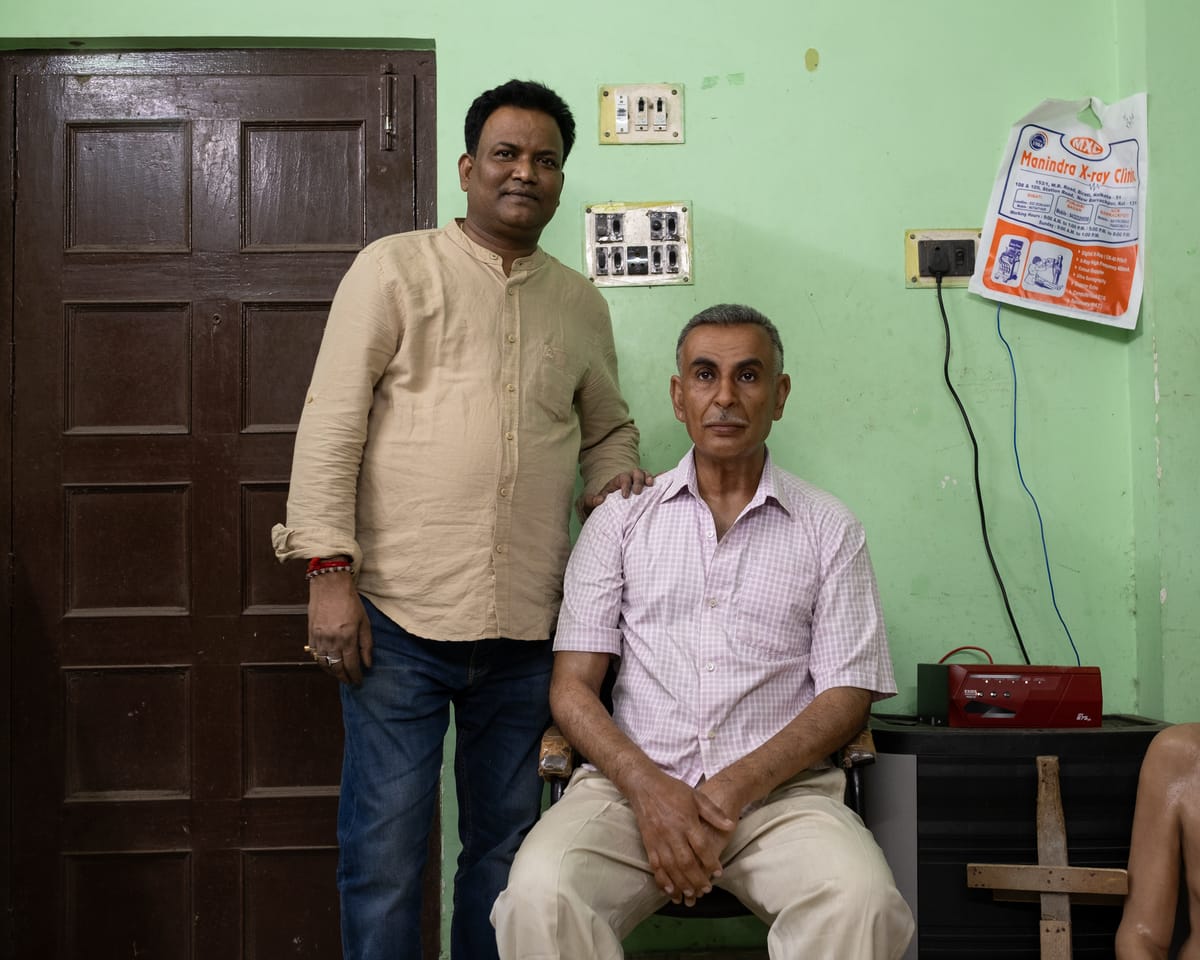
In northern Kolkata, close to Dum Dum Junction, Subimal Das and a team of about 80 operate out of an aging factory‑warehouse. With clay, fiberglass and silicone they produce life‑size copies of religious deities, cultural personalities, cricketers and film actors.
The workshop also offers a growing service: bespoke 30‑kilogram likenesses of deceased individuals, requested by relatives and friends.
Widowed persons form the majority of clients at Subi Creative House. They provide a photograph of their late spouse to Das and his staff, and after a few months receive the finished figure.
One of the figures being prepared is that of Mr. S. Roy from Ranaghat, a West Bengal town noted for its flowers. He is seated, wearing a checked shirt and trousers, awaiting shipment. Close by stands a model of Mrs. Parija, originally from Odisha; her short silver‑grey hair and red bindi are in place, though the torso is still being assembled. The price of each figure is roughly 2.5 lakh rupees (about $2,760). In 2025, a client named Samit Kumar commissioned replicas of his parents, Arun and Hena, and later displayed them in an open‑top vintage vehicle during a Kolkata festival.
Das notes that his clients seek a tangible reminder of their departed relatives. For many, the practice helps them cope with death and bereavement. The figures are frequently clothed in a preferred garment or sari and positioned in a familiar place within the household.
“To the relatives, they appear almost like the person,” Das explains. “I assure them I can achieve the closest likeness possible.” He strives for a high degree of realism, even incorporating genuine human hair. “When they see the replica of their mother, the way she wears her jewellery, her sari, the detail of the eyes, both they and I become deeply moved,” he says.
Das pursued art studies in Kolkata after a childhood in rural West Bengal. He once painted the historic Kolkata trams before most were retired and later created models for a museum. He opened his workshop in 2013, initially producing figures for festivals and ceremonies. The onset of the Covid pandemic in India, however, led to a sharp increase in orders for likenesses of the deceased.
Viewed from a Western perspective, the workshop’s output may appear unsettling, yet Hindu traditions often encompass a nuanced view of death, the afterlife and remembrance. Within Hinduism there is a wide range of beliefs, but generally death is seen as a transitional phase preceding another existence, not a final conclusion.
Consequently, Das’s facility resembles more a place of remembrance than a bizarre wax museum, despite occasional scenes like plastic‑wrapped figures awaiting transport to a buyer’s vehicle. It reflects the Hindi concept of ‘smaran’, meaning remembrance.
Tapas Sandilya, 67, lost his wife Indrani to Covid in 2021. A decade earlier they had noticed a silicone statue of a well‑known Hare Krishna leader in a temple, which Indrani admired. “She told me, ‘If I die before you, I would like you to have a statue of me like this,’” he recalls. “We shared 39 years of marriage. I was left with that wish.”
Read next
My final clashwith my Palestinian dad lingers, leaving the past unburied for both of us
The last argument my father andI ever had took place on a May night in 2021, the evening before his first chemotherapy session. At that point in our story I had just become a mother, and he was a year and a half away from dying. To treat his stage‑
Experts WarnRussia's War Is Pushing Black Sea Dolphins to Breaking Point
Inthe besieged harbours of Odesa, a research vessel rides at anchor, its hull scarred by unseen harm. No one can approach the damage to the Boris Alexander caused by Russian drones and artillery that have struck the port city throughout four years of war in Ukraine; the risk is too
Italy confiscates€20 million in assets tied to embezzlement from Ursula Andress
Italian authorities have confiscated assets worth €20 million (£17.3 million) in Tuscany, comprising real‑estate, vineyards and olive groves, allegedly purchased with funds embezzled from the actress Ursula Andress.
The 90‑year‑old Swiss‑born star lodged a complaint in her home country claiming a “progressive and significant depletion