
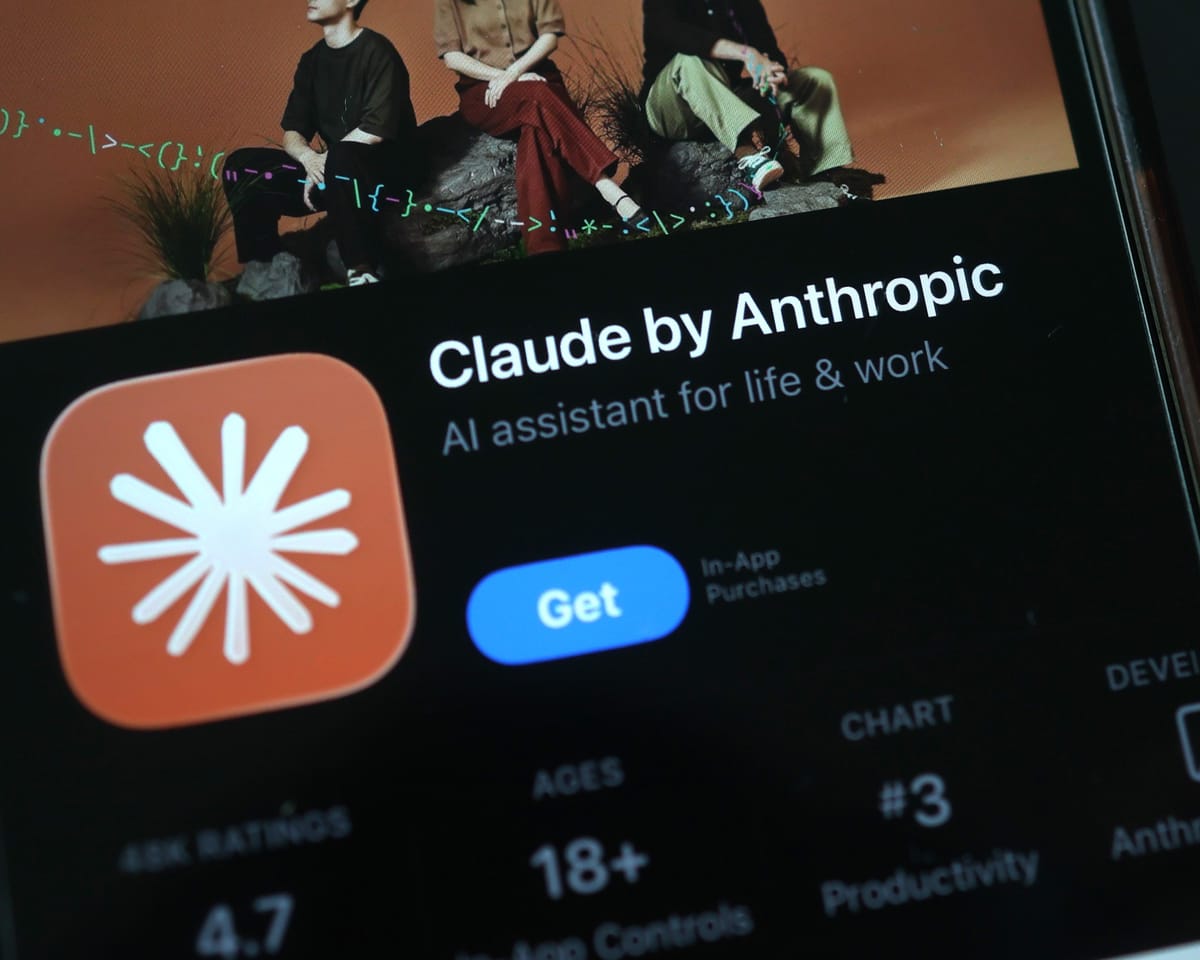
The AI system Claude has risen sharply in use after the Pentagon placed it on a blacklist last week over ethical concerns.
Claude reached the top position on Apple’s list of free apps in the United States on Saturday, overtaking OpenAI’s ChatGPT, just a day after the Pentagon selected OpenAI to provide AI for classified military networks. The application also moved up the iPhone rankings in the United Kingdom, though it did not surpass ChatGPT there. On Android, Claude advanced in both the U.S. and U.K. charts, while ChatGPT remained the leader, according to Sensor Tower data.
Early Monday, Claude and other Anthropic applications experienced service interruptions, which the company attributed to “unprecedented demand for Claude” over the preceding week. Downdetector recorded more than 1,400 users reporting problems shortly after 6 a.m. ET. Anthropic announced that the issue was resolved by 11 a.m. ET.
Despite the dispute with the Pentagon, user registrations continued to climb. A company statement noted that each day of the previous week set a new record for Claude sign‑ups.
U.S. Defense Secretary Pete Hegseth labeled Anthropic a supply‑chain risk after CEO Dario Amodei refused to relax his firm stance on the use of the firm’s technology for mass surveillance and fully autonomous weapons. Amodei has argued that current AI models are not dependable enough for such weapons and that mass surveillance conflicts with constitutional protections. He has also challenged the government’s authority to designate Anthropic as a supply‑chain risk and has told customers and Pentagon contractors that their operations remain unaffected.
The federal government has accused Anthropic of overreaching, with former President Donald Trump writing on his Truth Social platform: “The left‑wing actors at Anthropic have made a disastrous mistake trying to strong‑arm the Pentagon and force them to follow their terms of service instead of our Constitution.” The administration subsequently turned to OpenAI’s ChatGPT for the task.
OpenAI chief executive Sam Altman announced on Friday that his company reached an agreement with the federal government hours after talks between the Pentagon and Anthropic collapsed. He said the military would not employ ChatGPT for autonomous lethal systems or mass surveillance. Those assurances have been questioned by AI scholars, legal experts, technology workers and users, who wonder why the government abandoned its talks with Anthropic only to sign a deal with OpenAI that includes the same restrictions it previously criticized. Some ChatGPT users, including singer Katy Perry, publicly declared a move to Anthropic on social media and urged others to cancel their subscriptions.
Anthropic reported a strong start to the year, with active free users rising by more than 60 % and daily registrations quadrupling, according to the company. The number of paid Claude subscribers also more than doubled.
Read next
OpenAI revises Pentagon contract after Sam Altman concedes it appears ‘sloppy’
OpenAI is revising its quickly‑made agreement to provide artificial‑intelligence tools to the U.S. Department of War after the company’s chief executive acknowledged that the arrangement appeared “opportunistic and sloppy.”
The contract sparked concerns that the San Francisco firm’s AI might be employed for domestic mass

Iran conflict ushers in AI-driven bombings faster than the speed of thought
The deployment of artificial‑intelligence tools to facilitate attacks on Iran signals a new phase of bombing that proceeds faster than “the speed of thought”, analysts have warned, raising concerns that human decision‑makers may be bypassed.
Anthropic’s language model, Claude, is said to have been employed by the

Datacentre developers urged to reveal impact on UK’s net emissions.
Datacentre developers are under growing scrutiny to disclose whether their schemes will raise the United Kingdom’s net greenhouse‑gas output, as worries mount that the facilities could double the nation’s electricity consumption.
Advocacy groups have addressed a letter to the UK technology secretary, Liz Kendall, cautioning that the