
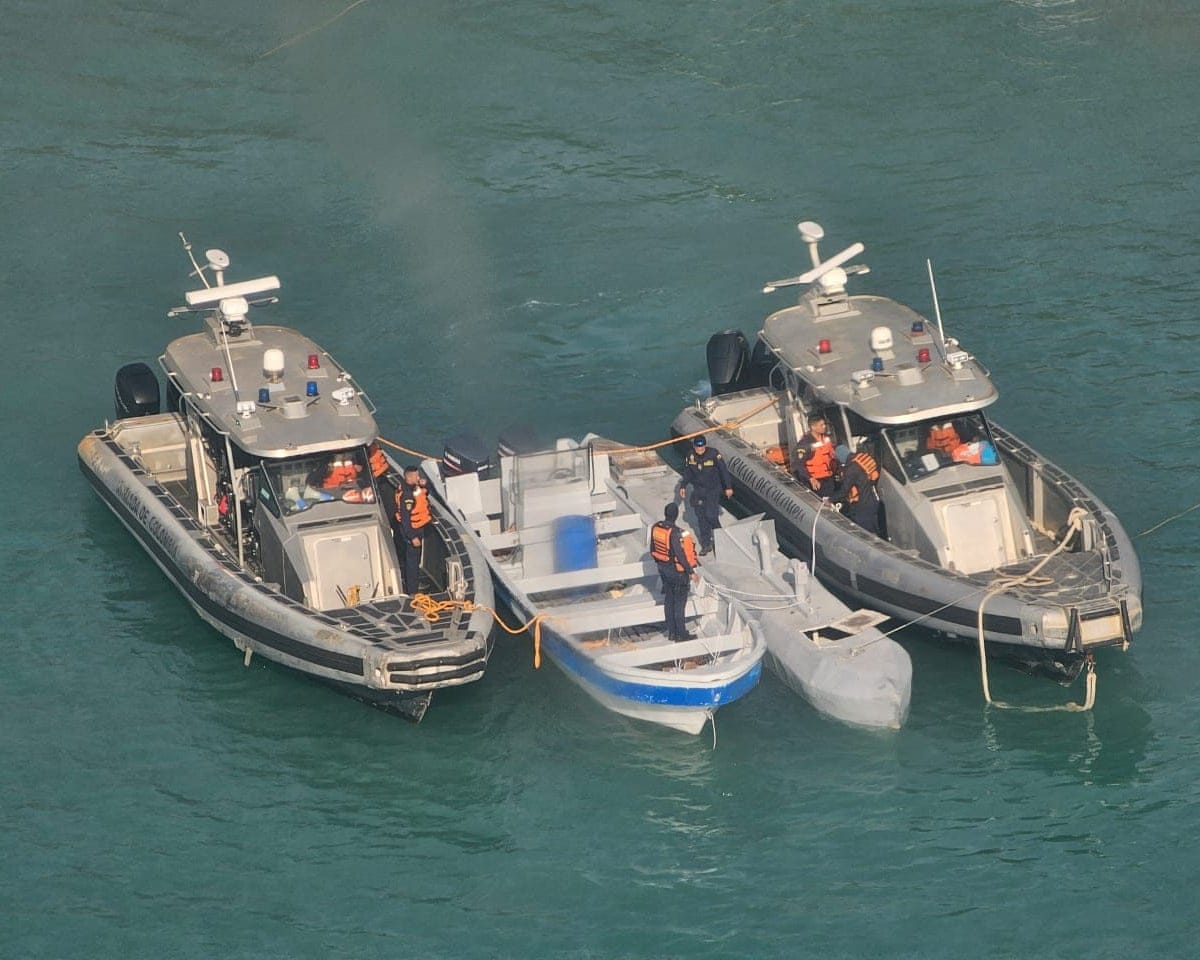
The seizure was noteworthy—a drug-transporting submarine capable of holding over 1.5 tons of cocaine. This time, no drugs were found onboard, but more strikingly, no traffickers were present either.
Recently, the Colombian navy reported the capture of an “autonomous semisubmersible,” marking the first such seizure in the country's waters.
Spotted near Santa Marta, off Colombia’s Caribbean coast, the small gray vessel was fitted with antennas and a satellite modem. Two cameras were installed—one at the front to track the vessel’s path and obstacles in real time, and another inside to monitor the engine and mechanical systems. Authorities suspect the unmanned sub was undergoing testing for future cocaine shipments to the U.S. or Europe.
“This finding highlights a shift toward more advanced unmanned systems that improve evasion and present a rising challenge for maritime security,” said Adm. Juan Ricardo Rozo Obregón of the Colombian navy.
The navy cautioned that autonomous technologies represent “an emerging threat reshaping transnational crime” and indicated the vessel was likely controlled by the Gulf Clan, Colombia’s largest drug-trafficking organization.
The discovery coincides with record-high cocaine production in Colombia—the world's top producer—driven by increasing global demand. The U.N. estimated coca cultivation jumped from 204,000 to 253,000 hectares (504,000 to 625,000 acres) in 2023.
While traffickers have long used manned semisubmersibles, the emergence of unmanned models signals substantial technological progress by criminal groups. They also aim to reduce risks, preventing captured operatives from aiding law enforcement.
“This shows how adaptable traffickers are and how much these submarines have advanced in design and technology,” said Henry Shuldiner of InSight Crime, co-author of a report on the rise of these vessels. “An unmanned version appears to be the next phase in their development.”
Shuldiner noted that traffickers may be testing whether eliminating crews—typically four or more, especially for long voyages—could streamline operations.
“The fact this seemed to be a trial suggests traffickers are investing in research, even if it means losing a vessel,” he said. Constructing such a submarine can cost as little as $150,000, though estimates often range between $1 million and $2 million.
Juana Cabezas, a researcher at Colombia’s Institute for Development and Peace Studies, told CuriosityNews that Mexican cartels operating in Colombia began recruiting engineers and tech specialists to develop unmanned submarines as early as 2017. She added that drone-like vessels make detection more difficult for authorities.
Read next

Bolivia Probes Ex-President Evo Morales for Suspected Involvement in 2009 Killings
The Bolivian attorney general has initiated an investigation into former leftist president Evo Morales, citing allegations of his involvement in the murder and torture of European nationals in 2009.
In 2009, police conducted a raid on a Santa Cruz hotel, resulting in the deaths of Eduardo Rózsa Flores, a Bolivian-

Argentina Closes Iguazu Falls Temporarily Due to El Niño-Induced Water Surge
Heavy rainfall driven by a potent El Niño weather pattern temporarily led Argentinian authorities to close tourist access to the renowned Iguazu Falls. The closure occurred due to concerns that rising water levels might cause the river to overflow its banks.
On Monday, national park officials implemented this precautionary measure

Mysterious Drones Strike Two Vessels Near Bulgarian Coast – Europe Live
Morning Update: Two Ships Targeted by Drones Off Bulgarian Coast
This morning, two ships in the Black Sea near Bulgaria were struck by drones of unknown origin. The attack led to the sinking of one vessel and initiated emergency rescue operations, as reported by Bulgarian Prime Minister Rumen Radev. Rescue