
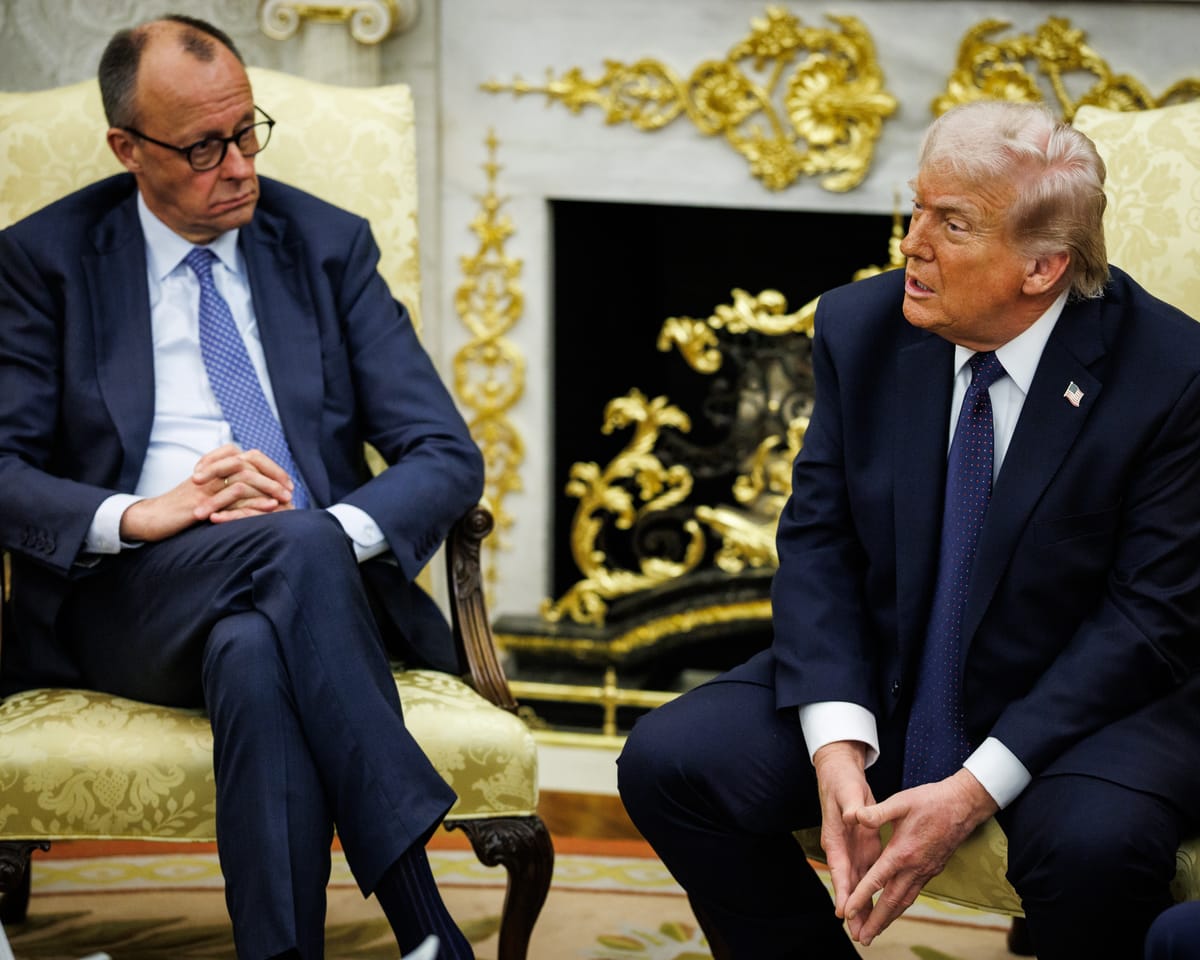
One could understand why Friedrich Merz might seem eager to be far from Germany these days.
Yet the prospect that his Washington visit this week would grant the chancellor even a short break from domestic troubles was shattered by Donald Trump’s daring Iran maneuver.
Fresh from intense trade negotiations in China, the unpopular Merz stepped onto the Konrad Adenauer, the state jet, and headed for the United States after the weekend’s dramatic developments.
The US‑Israeli strike in the Middle East has again cast European leaders as onlookers in a disquieting reshaping of great‑power relations, and the conflict will inevitably produce far‑reaching economic, political and security consequences for Europe.
As the first European official invited into the gilded Oval Office since the war began, Merz faced the challenge described by analysts as a “high‑wire act” – defending European priorities while avoiding provocation of the increasingly unpredictable Trump.
During his brief stint in the White House’s hot seat, Merz worked to find common ground and stress to his often‑distracted counterpart the importance of the issues at stake. He also refrained – at least publicly – from intervening when Trump launched criticisms at allies Spain and the United Kingdom for alleged shortcomings, and he avoided invoking international law.
“We share the goal of removing that dangerous regime in Tehran, and we will discuss what follows,” Merz replied to one of the many open‑ended questions about Iran’s future.
The chancellor, however, did not soften his language regarding the ripple effects of Operation Epic Fury, which has rattled stock markets and driven energy prices upward.
“This is, of course, harming our economies,” he said. “That is why we all hope the war ends as quickly as possible.”
While Trump remained fixated on Iran, Merz repeatedly tried to redirect the dialogue toward Europe’s chief concerns: the United States’ erratic tariff stance and the situation in Ukraine.
German‑American political scientist Cathryn Clüver Ashbrook, whose new volume on this tense phase of transatlantic relations, *The American Wake‑up Call*, has just appeared, noted that European leaders have very limited levers to keep Trump appeased.
“Merz finds himself in a difficult position, as do all European heads of state at the moment. Their sphere of influence is narrow,” she told me. “We live in a world where every domain is now weaponised.”
One narrow avenue, she suggested, is to underline how Europe can prove valuable to the United States, even as it endures sharp rebukes from the Trump administration on matters ranging from defence and free speech to trade and migration.
The approach calls for significant progress in rearmament and a greater assumption of responsibility for Ukraine.
Read next

Tokyo tourist hotspot outlaws short-term rentals amid complaint surge
Shinjuku Ward, Tokyo, has moved to ban short-term rental accommodations in residential areas and near schools and important cultural sites, following a slew of complaints about visitor behaviour. The decision, to be enacted through a local ordinance, marks the latest sign that Japan’s patience with mass tourism is
Canada implements retaliatory US tariffs as trade dispute intensifies
Canada’s retaliatory tariffs on about $20 billion worth of American imports took effect at 12.01am on Tuesday, ranging from 15% to 50% and applying to steel, dairy, appliances, agricultural equipment, pulp and paper, and electronics. The measures, a response to the United States’ 50% tariff on $20 billion
Prosecutor general resigns amid political turmoil in Kyiv during Ukraine war
Ukraine’s prosecutor general Ruslan Kravchenko resigned amid corruption accusations after anti-graft officers searched his offices at the weekend. He called the allegations “completely unsubstantiated” and denied wrongdoing. The National Anti-Corruption Bureau (NABu) and Specialised Anti-Corruption Prosecutor’s Office (Sapo) announced Saturday they uncovered a money-laundering