
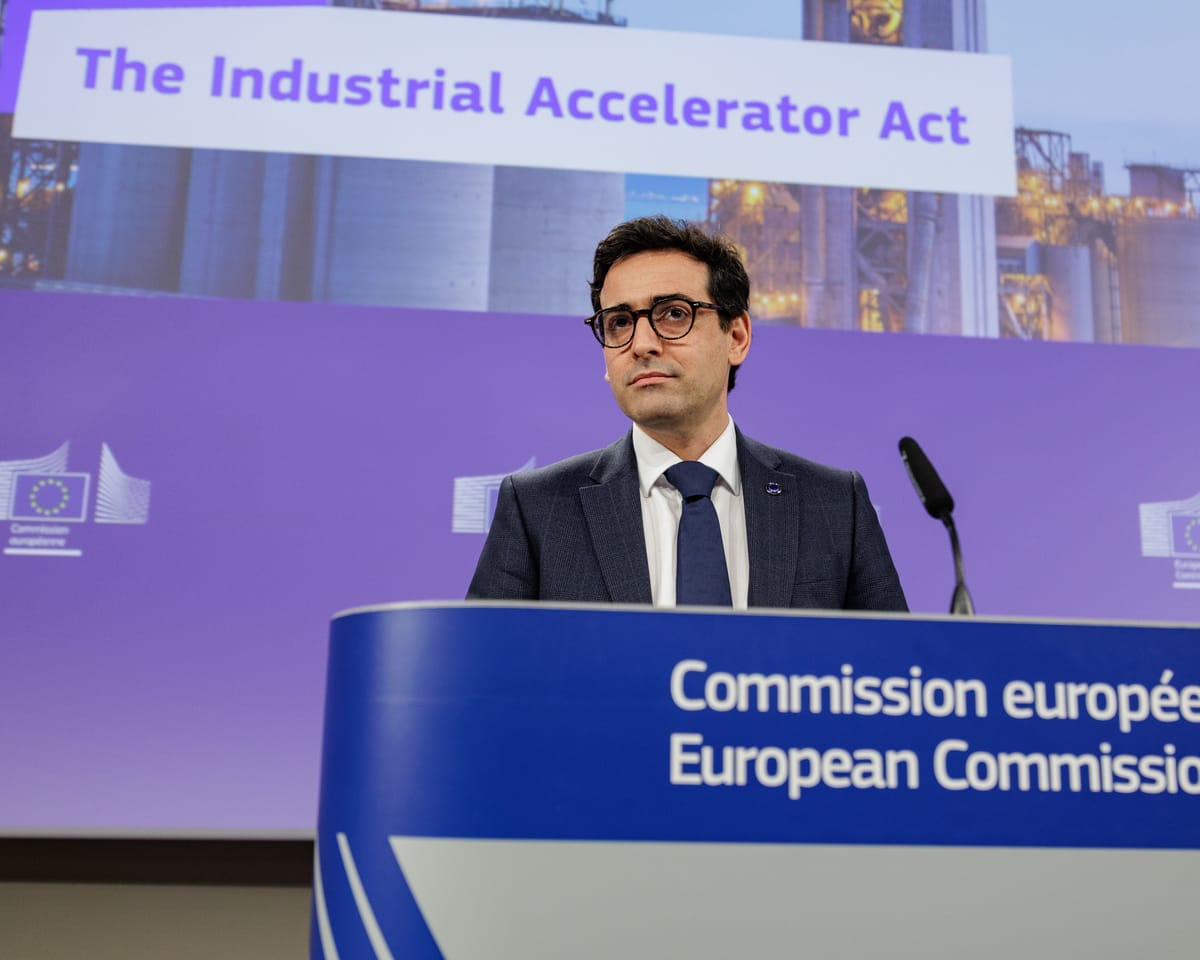
The European Commission has unveiled a “Buy EU” scheme aimed at strengthening home‑grown low‑carbon sectors and enhancing the continent’s ability to compete with China.
On Wednesday the commission released a draft regulation, the Industrial Accelerator Act, which sets requirements for EU‑origin and low‑carbon content in contracts funded with public money. The proposal signals a notable shift in Brussels’ traditionally market‑oriented policy stance.
Following internal debate, officials indicated that countries with close economic links to the bloc, such as the United Kingdom, could be included provided there is reciprocal market access.
Stéphane Séjourné, the commission’s vice‑president for industry, called the act “a change in doctrine” that would have been “unthinkable only a few months ago”.
Referencing the recent upheaval in the Middle East that has driven up energy prices, Séjourné – a former French foreign minister – said the situation in Iran highlights the urgency of a plan to reinforce European industry. “Without a robust industrial base and a European social model, we cannot achieve a climate transition nor strategic autonomy,” he said.
Drawing on ideas from the French government, the plan responds to intense competition from Beijing that has seen Europe’s once‑vibrant solar‑panel sector overtaken by China. Séjourné warned: “If we do nothing, it will soon be the case that virtually all technology is produced in China.”
EU officials suggested that the United Kingdom and Japan might be treated as domestic suppliers for electric‑vehicle procurement because their markets are open.
By contrast, nations with more protectionist markets such as the United States and India could face restrictions. Séjourné did not specify “who is in, who is out”, but promised a “reciprocity assessment” of the EU’s trading partners in the coming months.
He added that, without intervention, Europe’s cement and steel sectors could be “offshored completely” within a few years.
EU data show that roughly half of the batteries and 94 % of solar photovoltaic modules and cells used in the bloc are imported from China.
The initiative aims to reverse Europe’s industrial decline, targeting a rise in manufacturing’s share of GDP to 20 % by 2035, up from 14.3 % in 2024.
To meet this objective, regional and national authorities would have to fulfil “Made in the EU” content thresholds when allocating public funds or designing subsidy programmes for goods in “strategic sectors” such as green technology and automobiles. For example, at least 70 % of the components of electric cars – excluding the battery – would need to be produced in the EU when purchased by governments or supported by public money.
Authorities would also be required to procure higher‑cost, low‑carbon steel, aluminium and cement.
Read next

Tokyo tourist hotspot outlaws short-term rentals amid complaint surge
Shinjuku Ward, Tokyo, has moved to ban short-term rental accommodations in residential areas and near schools and important cultural sites, following a slew of complaints about visitor behaviour. The decision, to be enacted through a local ordinance, marks the latest sign that Japan’s patience with mass tourism is

Canada implements retaliatory US tariffs as trade dispute intensifies
Canada’s retaliatory tariffs on about $20 billion worth of American imports took effect at 12.01am on Tuesday, ranging from 15% to 50% and applying to steel, dairy, appliances, agricultural equipment, pulp and paper, and electronics. The measures, a response to the United States’ 50% tariff on $20 billion

Prosecutor general resigns amid political turmoil in Kyiv during Ukraine war
Ukraine’s prosecutor general Ruslan Kravchenko resigned amid corruption accusations after anti-graft officers searched his offices at the weekend. He called the allegations “completely unsubstantiated” and denied wrongdoing. The National Anti-Corruption Bureau (NABu) and Specialised Anti-Corruption Prosecutor’s Office (Sapo) announced Saturday they uncovered a money-laundering