
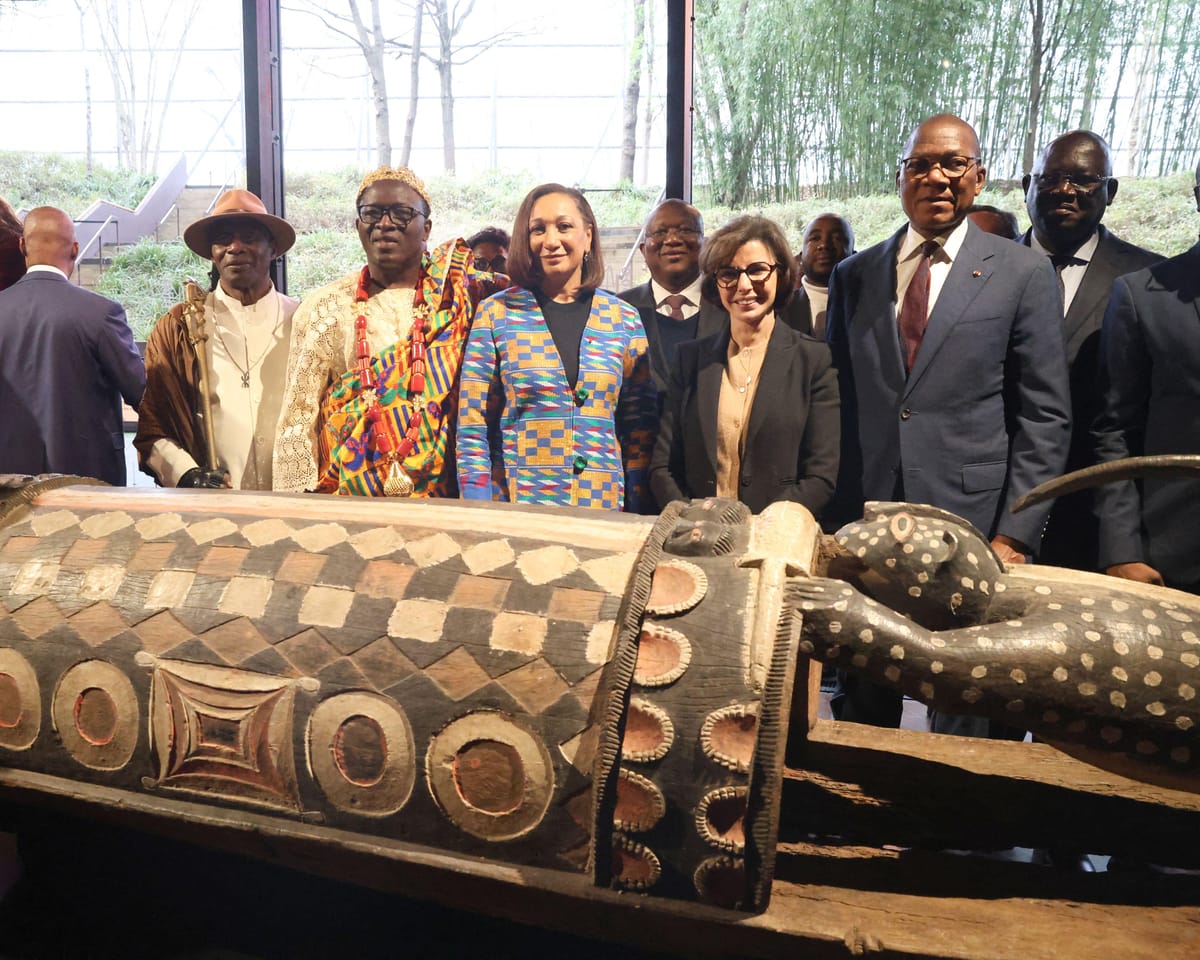
A sacred object taken by French colonial officials over a hundred years ago has been handed back to Côte d’Ivoire in one of the most notable cultural restitutions to a former French colony in recent times.
The Djidji Ayôkwé, a talking drum seized in 1916 by French administrators, arrived at 8:45 a.m. on Friday at the airport in Port Bouët on the outskirts of Abidjan, the country’s economic hub. It had been transferred to Ivorian representatives in Paris earlier this month after being removed from the Quai Branly – Jacques Chirac Museum.
Aboussou Guy Mobio, leader of the Adjamé‑Bingerville community, said: “After a long exile from this land, it is returning to its own people and it is an honour for us and a relief to welcome it. This is the missing piece of the puzzle that is returning today … Receiving this sacred instrument is a relief, but it is also another form of connection with our ancestors who were very close to this instrument.”
Talking drums are hour‑glass‑shaped pressure drums that imitate the tone, pitch and rhythm of spoken language. The four‑metre Djidji Ayôkwé, weighing 430 kg, held cultural and political importance for the Ebrié people—after whom the lagoon in Abidjan is named—as a symbol of resistance. Before and during the colonial era it was used to transmit messages across several miles to announce deaths, celebrations or, on occasion, warn villages of danger. When villagers opposed forced labour on a road in 1916, colonial authorities confiscated the drum and shipped it to France.
President Emmanuel Macron pledged to return the drum in 2021, but it required four years of negotiations and lobbying before the French parliament ratified the decision.
“I feel deep emotion. We are indeed experiencing a moment of justice and remembrance,” said Françoise Remarck, Côte d’Ivoire’s minister of culture and Francophonie, in her Friday address. She thanked President Alassane Ouattara and Macron for what she described as “a historic day”.
She then spoke to the drum: “Djidji Ayôkwé, today your return is a message for our youth who have chosen to reclaim their history, and for the communities … a symbol of social cohesion, peace and dialogue … 13 March is just one step.”
As a forklift operator moved the wooden crate containing the drum from the aircraft, a cultural troupe performed the traditional tchaman dance. A further ceremony is planned to mark the drum’s permanent installation at the Musée des Civilisations de Côte d’Ivoire in the Plateau district, likely in April. In preparation for public exhibition, UNESCO has contributed $100,000 (£75,400) through its Abidjan office for research and training at the museum.
Sylvie Memel Kassi, former museum director and founder of the TAPA Foundation for Arts and Culture, said the drum’s return opens the door to additional restitutions. “We are studying eight other objects,” she said.
Read next
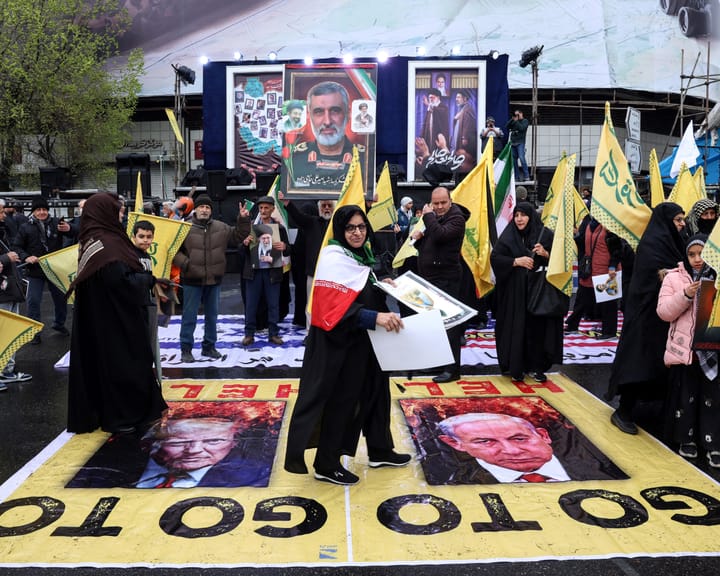
Anti-regime Iranians slam Trump, declaring “You’re all worse than each other.”
After years of arrests, disappearances and mass killings of demonstrators, the animosity in Iran toward the hard‑line, repressive government had boiled over into such a desperate fury that many clung to Donald Trump’s claim that the United States would “come to their rescue.”
Now, after two weeks of
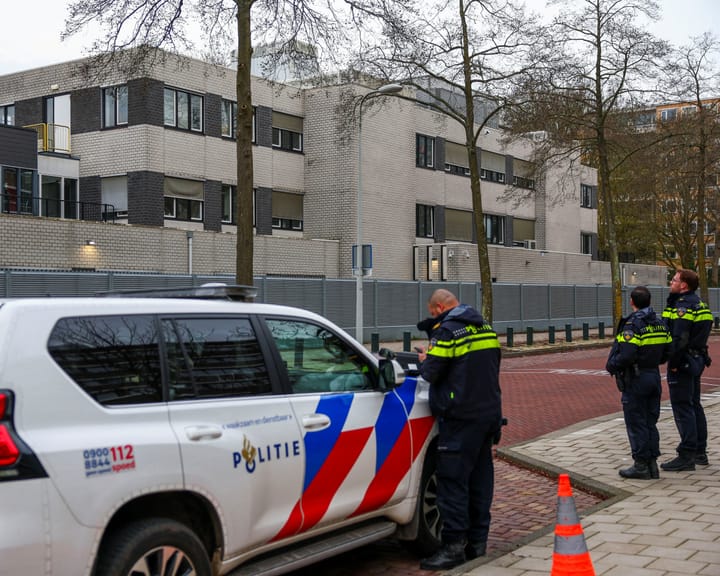
‘Deliberate attack’: blast hits Jewish school in Amsterdam.
An explosion damaged a Jewish school in Amsterdam, which the city’s mayor called “a deliberate attack against the Jewish community.”
The blast occurred early Saturday in a residential district on the city’s south side, causing only minor damage, Mayor Femke Halsema said in a press release, as police
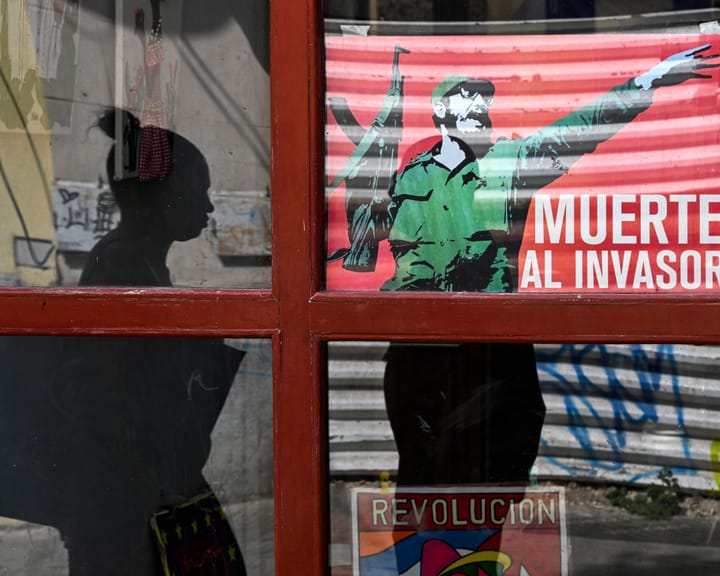
Five detained in Cuba after protest at a local Communist Party office
Five individuals were taken into custody in Cuba on accusations of “vandalism” after a handful of demonstrators forced entry into a provincial office of the Cuban Communist Party and set fire to computers and furniture.
The episode, which also impacted a pharmacy and another shop, occurred in the town of