

In 1983, CIA analysts concluded that the Gulf’s most vital resource was its desalinated drinking water.
While the failure of a single facility could be managed, “successful attacks on several plants in the most dependent nations could spark a national emergency, prompting mass departures and civil disorder.” The principal perceived danger to the region’s water supply? “Iran.”
Consequently, four decades later, on Saturday the world listened as Iran’s foreign minister, Abbas Araghchi, charged the United States with “a blatant and desperate crime” for striking a desalination plant on Qeshm Island in the Strait of Hormuz, declaring, “The US set this precedent, not Iran.”
Washington rejected the accusation, but the following day Bahrain reported that one of its own desalination facilities had been damaged, attributing the incident to “Iranian aggression.”
The situation appeared to threaten the stability of the region’s cities and industries, with a cascade of retaliatory blows against essential water infrastructure, yet the assaults on desalination sites abruptly ceased. Why?
Fresh water has long been a limited commodity in the Gulf; precipitation across the Middle East is scant and erratic, and most nations lack sizable permanent rivers to meet their needs.
In the past the area relied on modest groundwater reserves, but the expansion of the oil sector from the 1950s onward pushed demand beyond those supplies, depleted aquifers, and compelled rapidly growing states to adopt desalination—converting seawater into potable water.
Current figures show that desalination provides 70 % of Saudi Arabia’s drinking water, 86 % in Oman, 42 % in the United Arab Emirates and 90 % in Kuwait; Israel, despite access to the Jordan River, depends on five major coastal plants for half of its potable supply.
Together the Middle East produces roughly 40 % of the world’s desalinated water, with a daily capacity of about 28.96 million cubic metres.
“In several Persian Gulf states, modern cities would simply not function without it,” observed Nima Shokri, director of the Institute of Geo‑Hydroinformatics at Hamburg University of Technology.
In 2026, as in 1983, analysts warn that this strategic vulnerability could be exploited against neighboring Arab countries, noting that “targeting desalination plants could swiftly generate water shortages across multiple Gulf states.”
“Many urban centres rely on a handful of large coastal facilities, so a successful strike could interrupt drinking‑water supplies within days; unlike oil installations, these plants cannot be quickly replaced or repaired, and in extreme scenarios governments might be forced to ration water for entire populations,” Shokri added.
Damage to desalination plants would also carry environmental consequences.
Read next

Iran's regional allies refrain from full-scale conflict with the US and Israel
Iran‑backed militias across the Middle East are persisting in attacks on Israel, the United States and their partners in response to the US‑Israeli campaign against Tehran, yet they have so far avoided a full‑scale clash, analysts and regional officials say.
This measured approach indicates that Tehran may

Iran war live: Regime threatens protesters; US says it destroyed mine‑laying vessels near Hormuz Strait
The International Energy Agency has suggested the biggest drawdown of oil stocks in its history, aiming to lower crude prices that have jumped over the past ten days, the Wall Street Journal reported Tuesday.
The proposed drawdown would surpass the 182 million barrels that IEA member nations released in two
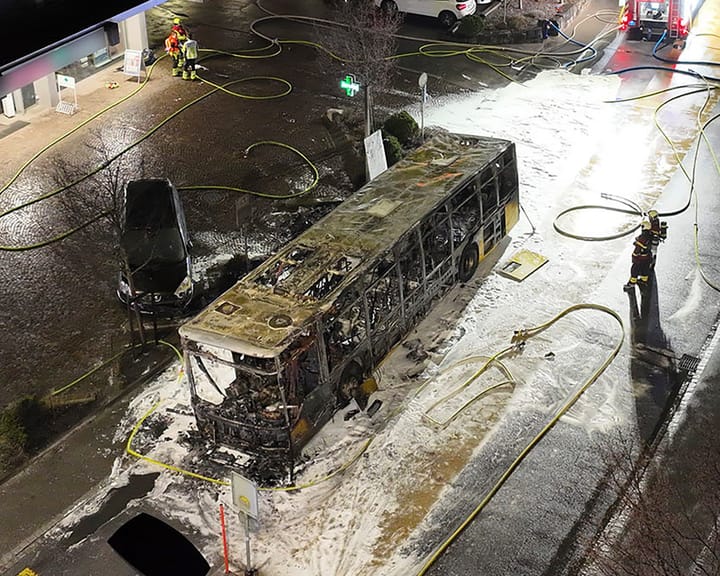
Six dead, five hurt as Swiss bus catches fire.
A bus ignited in western Switzerland on Tuesday, killing at least six people and wounding five others, in what authorities described as possibly a deliberate act.
The blaze erupted on a bus travelling along the main street of the small town of Kerzers, roughly 20 km (12 miles) west of