
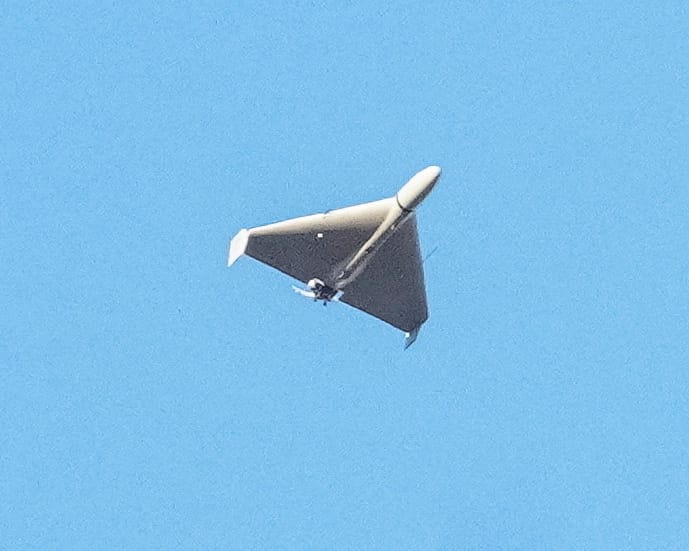
Iran’s noisy $50,000 delta‑winged Shahed‑136 drones have long been an unwelcome presence over Ukrainian airspace.
In the past two days, hundreds of these distinctive machines have struck Bahrain, Kuwait, the United Arab Emirates and other Gulf states as Tehran seeks to pressure and penalise Washington’s regional partners.
Footage from Bahrain captures a delta‑winged drone heading toward a high‑rise at night, the low‑raking hum of its engine audible, before it crashes into the structure, sending flaming fragments past a balcony window. The flat likely would not have survived a direct impact.
More than a thousand unmanned aircraft – most probably Shahed‑136s – have been aimed at Iran’s Gulf neighbours since the United States and Israel launched strikes on Tehran on Saturday morning.
On Monday afternoon the UAE reported an assault by 689 drones, of which it intercepted 645, leaving 44 – just over six percent – to get through.
The Shahed‑136 measures about 3.5 m in length with a 2.5 m wingspan. Its modest price and simple production process, especially when compared with a ballistic missile that Iran could only build in limited numbers before the recent US‑Israeli raids, suggest the drones will remain a fixture of the fighting for the foreseeable future.
Most Shahed‑136s travel at modest speeds, although faster jet‑engine versions have appeared in Ukraine, and each can carry roughly 50 kg of explosives – sufficient to damage a high‑rise but not to topple it.
Nevertheless, their roar, size and steep terminal dive readily inspire fear.
A second Bahrain video shows a lone delta‑winged drone soaring over the core of the naval base that hosts the U.S. Fifth Fleet, then diving to strike and demolish a radar dome.
Shahed attacks have also been reported in Kuwait and the UAE, and possibly at the RAF station in Akrotiri, Cyprus.
Their operational range can reach 1,250 miles (2,000 km), and they are usually pre‑programmed to follow intricate low‑altitude routes designed to evade radar.
However, mounting evidence from Ukraine indicates they can be guided remotely, allowing operators to alter their course at the last moment.
The Shahed‑136 was conceived in Iran toward the end of the previous decade and was first confirmed in July 2021 during an assault on the Israeli‑owned tanker Mercer Street, which killed a British and a Romanian citizen.
The type may have been employed earlier, in September 2019, against Saudi oil facilities at Abqaiq and Khurais.
Originally produced by Shahed Aviation Industries Research Center – an Iranian firm the United States says answers to the Islamic Revolutionary Guard Corps – the drones gained wider exposure after Russia deployed them in Ukraine from autumn 2022.
After an initial export phase, Iran shared the design with Russia, enabling large‑scale production at a plant in Yelabuga on the Volga River.
Read next

Tokyo tourist hotspot outlaws short-term rentals amid complaint surge
Shinjuku Ward, Tokyo, has moved to ban short-term rental accommodations in residential areas and near schools and important cultural sites, following a slew of complaints about visitor behaviour. The decision, to be enacted through a local ordinance, marks the latest sign that Japan’s patience with mass tourism is

Canada implements retaliatory US tariffs as trade dispute intensifies
Canada’s retaliatory tariffs on about $20 billion worth of American imports took effect at 12.01am on Tuesday, ranging from 15% to 50% and applying to steel, dairy, appliances, agricultural equipment, pulp and paper, and electronics. The measures, a response to the United States’ 50% tariff on $20 billion

Prosecutor general resigns amid political turmoil in Kyiv during Ukraine war
Ukraine’s prosecutor general Ruslan Kravchenko resigned amid corruption accusations after anti-graft officers searched his offices at the weekend. He called the allegations “completely unsubstantiated” and denied wrongdoing. The National Anti-Corruption Bureau (NABu) and Specialised Anti-Corruption Prosecutor’s Office (Sapo) announced Saturday they uncovered a money-laundering