
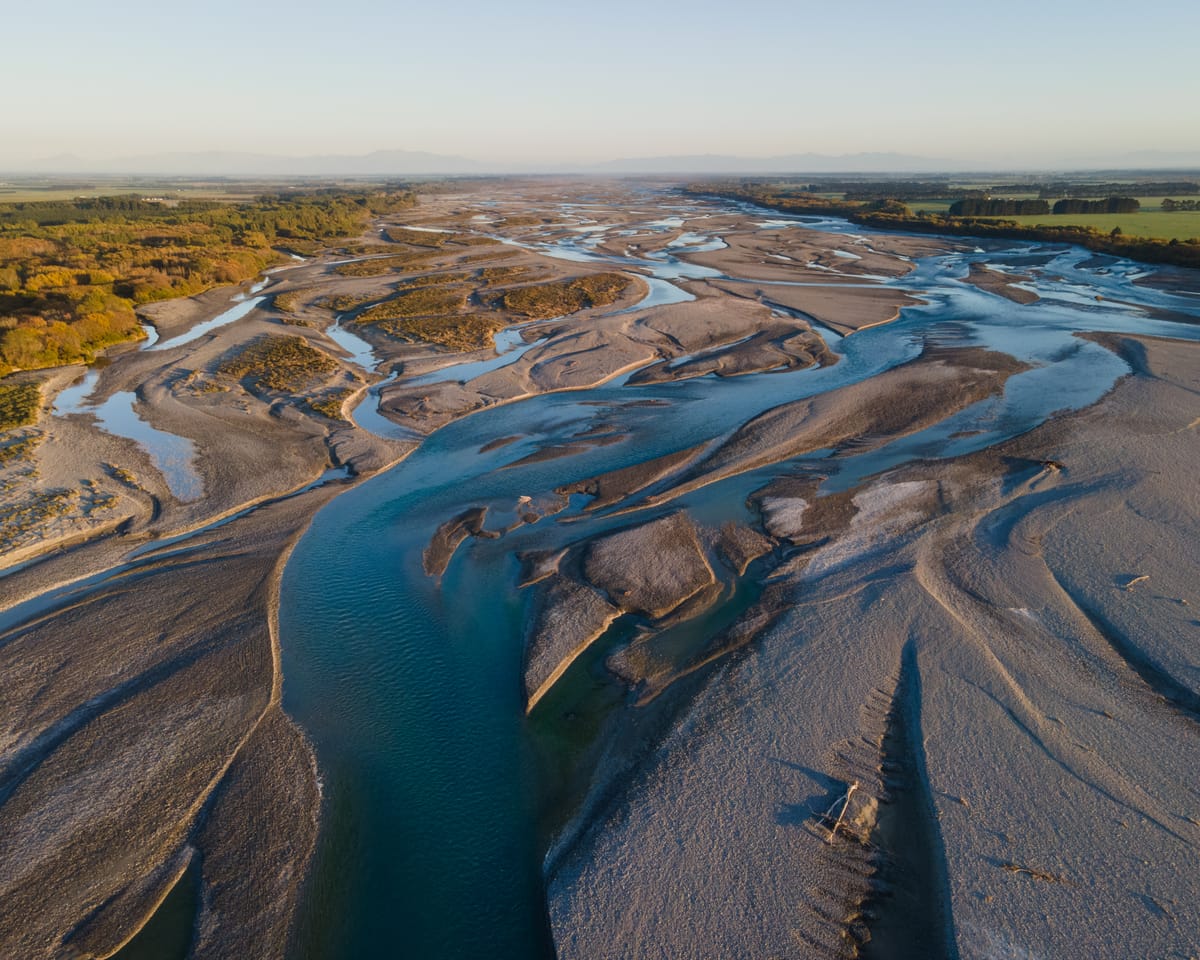
When British settlers began constructing Christchurch city 170 years ago, they largely overlooked the nearby Waimakariri River, which winds from the South Island’s alps toward the eastern coast.
Rain and glacial movements forced the braided river – a globally uncommon form with many intertwined channels – to reshape itself, at times flooding surrounding land and leaving behind tonnes of shingle.
By the 1920s, officials labelled the Waimakariri a “flood menace” in a report that noted a “deficiency of nature, which must be made good by the art of man”.
Consequently, the river was brought under control, gradually confined by stopbanks, exotic tree plantings and gravel removal. Today it demands continual maintenance to curb flood threats to homes, infrastructure and the neighbouring airport.
“People say you shouldn’t interfere with the river; the outcome if we don’t is worse,” said Fred Brooks, a river engineer with Environment Canterbury, the local regional council.
“It has been intervened in so much already that we must keep intervening.”
The Waimakariri is one of roughly 150 braided rivers in New Zealand, about 60 % of which lie in the Canterbury region of the South Island. Such systems exist in only a handful of other locations worldwide, including Alaska, Canada and the Himalayas.
These rivers confront – and also create – a complex set of challenges. They have been altered to accommodate farming and community growth, yet those modifications harm ecosystems and species, degrade water quality and heighten flood risk for nearby populations.
Growing worries about the future resilience of braided rivers raise questions about how the nation can coexist with them while preventing further decline.
“Braided rivers are iconic – we use their iconography everywhere,” remarked Jo Hoyle, a river geomorphologist at Earth Sciences New Zealand. “Yet, are we truly looking after them?”
Changing the course
Unlike single‑channel rivers, braided rivers are dynamic. They originate in alpine zones, rush down slopes toward the plains, transporting gravel and carving channels that split, weave and fan out into numerous strands. A braided river may carve new routes across broad areas while withdrawing from former paths; a heavy rainstorm can drive it back to its earlier bed.
Over time, Canterbury’s braided rivers have been deliberately narrowed. Their gravel beds have been excavated for flood protection and road construction, and water has been diverted to support intensive dairy farming.
In the Waimakariri, diggers and trucks extract gravel most days to prevent the river from overtopping the stopbanks and inundating tens of thousands of homes.
Because of these interventions, the Waimakariri may struggle to revert to its natural condition.
Read next
Tokyo tourist hotspot outlaws short-term rentals amid complaint surge
Shinjuku Ward, Tokyo, has moved to ban short-term rental accommodations in residential areas and near schools and important cultural sites, following a slew of complaints about visitor behaviour. The decision, to be enacted through a local ordinance, marks the latest sign that Japan’s patience with mass tourism is
Canada implements retaliatory US tariffs as trade dispute intensifies
Canada’s retaliatory tariffs on about $20 billion worth of American imports took effect at 12.01am on Tuesday, ranging from 15% to 50% and applying to steel, dairy, appliances, agricultural equipment, pulp and paper, and electronics. The measures, a response to the United States’ 50% tariff on $20 billion

Prosecutor general resigns amid political turmoil in Kyiv during Ukraine war
Ukraine’s prosecutor general Ruslan Kravchenko resigned amid corruption accusations after anti-graft officers searched his offices at the weekend. He called the allegations “completely unsubstantiated” and denied wrongdoing. The National Anti-Corruption Bureau (NABu) and Specialised Anti-Corruption Prosecutor’s Office (Sapo) announced Saturday they uncovered a money-laundering