
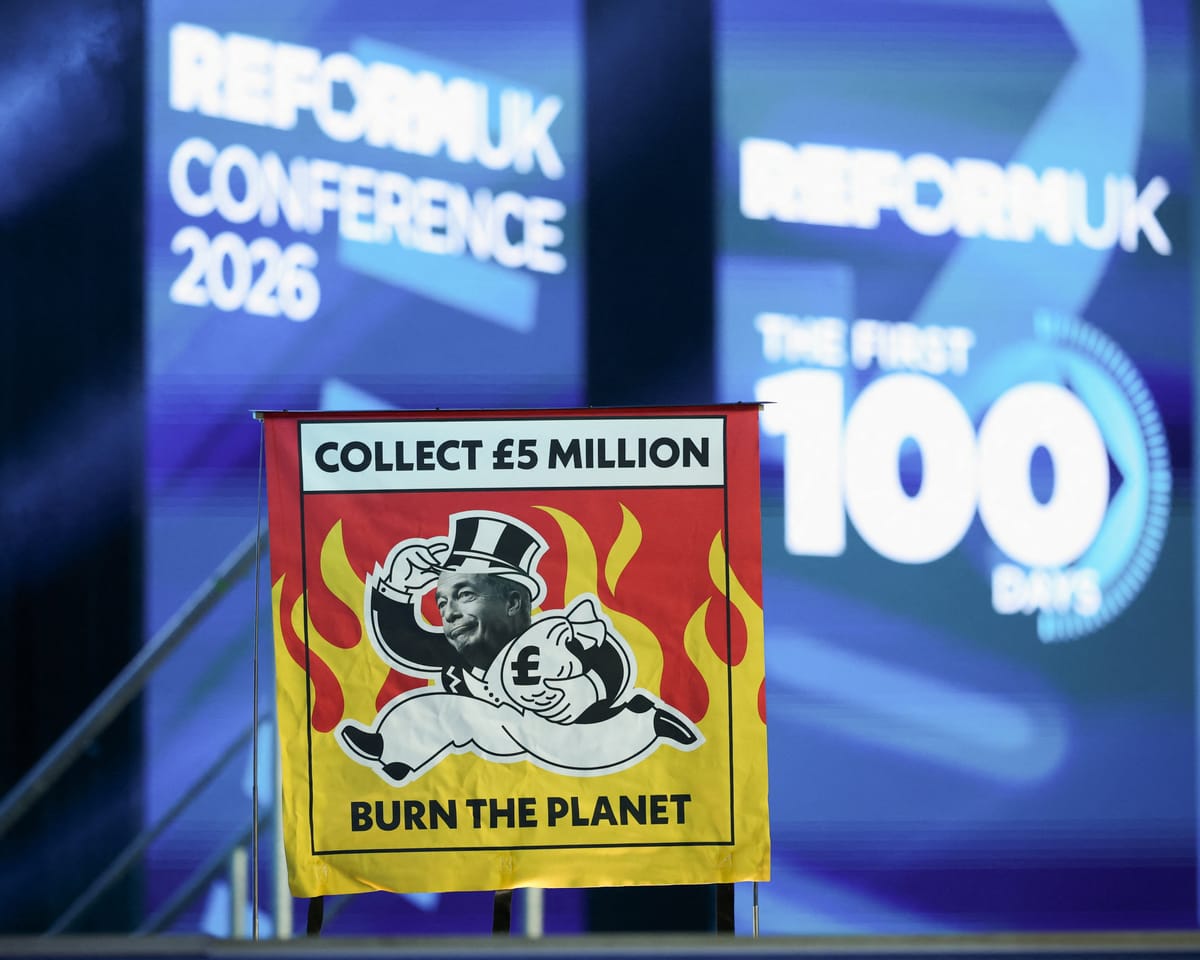
At the second day of the Reform UK conference, Richard Tice addressed attendees. An undercover investigation had recently alleged that party officials plotted to evade the law on foreign donations. Within minutes of Tice speaking, a banner appeared behind him reading: “Collect £5m, burn the planet.” It was removed quickly. Tice has repeatedly called on people to enjoy the summer’s five successive heatwaves and record drought. He continued speaking.
Among stalls offering simulated helicopter rides, gold as an investment, tattoos and discounts on rum, climate scepticism was common among Reform members at the Birmingham venue.
“I enjoyed the heat this summer,” said Jeanette Bowden, of Bexley. “I don’t think people need telling to take care of themselves.” Her partner, James, added, without scientific backing: “Carbon dioxide was much higher in the past, it was 10 times higher than this during the ice ages. It’s not a human problem.”
“It’s overhyped,” said Yvonne, who did not wish to give a surname.
“I don’t believe the predictions,” said Jim Langford. “They told us Norwich would be underwater by now and it’s not Atlantis yet.” Ed Rennie, a former Labour councillor from north London, said the Intergovernmental Panel on Climate Change had reduced some of its higher predictions.
Many of the same people who cast doubt on climate science also criticised the government for failing to protect people against the hot weather. Bowden pointed to new-build houses. “They have really small windows,” she said. “That might be good in winter, but in summer it must be too hot, you can hardly open them. The government should not force this on people.”
Yvonne added: “The government were all on their holidays in the summer, not doing their jobs [to help people during the heatwaves]. Government should ensure there is clean water and sewage, but they’re not even doing that.”
Nicholas, another delegate who did not wish to be named in full, said air conditioning should be installed in all hospitals, schools, libraries and public buildings, and made more easily available for homes.
Langford said the government was “absolutely not” doing enough to help people cope with the impacts of extreme weather. “They’re not preparing us at all, they’re just wasting resources.” Beryl Kingsbury said people should take responsibility for their own safety during hot weather, but farmers needed help. “They should have more support, but this government seems to hate farmers.”
Mark Henderson, a facilities manager who works mostly outside looking after three large yards, said the government’s role should be to apply common sense to health and safety. “I wear a helmet all the time, which was very hot [in the heatwaves], but I don’t need it all the time. You should be able to relax those rules in hot weather, to make them task-specific,” he said.
Michael Jacobs, an emeritus professor of political economy at the University of Sheffield, said the confusion among Reform supporters was to be expected given the party leadership’s peddling of “myths and lies” over the climate. Voters often say they want contradictory things, such as high standards of social care without tax rises to pay for them, Jacobs pointed out. But on the climate, they face an even more intense bombardment from contradictory viewpoints, as parties of the right try to turn the issue into a culture war.
“It’s really incoherent to be in favour of adaptation but not [cutting greenhouse gas emissions], but it’s not surprising people think that, given what they’ve been told,” Jacobs said. “Tice and Farage have claimed net zero would be economically ruinous, which is simply wrong. They try to say the UK is acting alone in cutting emissions, also untrue. These are pernicious myths. They have obscured the scientific fact that net zero is the description of where you need to get to, to stop the climate crisis getting any worse.”
Party activists of all stripes tend to have stronger opinions than a party’s voters. Polls consistently show that Reform voters are much less likely to deny climate science than their leaders, and large majorities would like to see renewable energy sited near them, despite opposition to renewables from the party leadership. Although Reform has railed against “net stupid zero”, a significant minority, roughly a quarter by some polling, remain in favour of the target. In contrast to the leadership’s stance, which is to scrap the North Sea windfall tax, about 70% want higher taxes on fossil fuels, according to a poll taken last year.
Labour’s climate minister, Katie White, said Reform was out of step with voters. “After the summer we’ve just had, outright climate denial is a pretty lonely corner of British politics,” she said, noting that the government was investing in flood and coastal defences, and in strengthening the response to wildfires.
“My plea to Reform members, MPs and their leadership is a genuine one: please don’t turn climate change into another culture war. Britain has always been at its best when we lead, invent and build. I want our country developing the technologies the world will need, backing British businesses and innovators, and protecting the people and places we love.”
Dissenting voices were hard to find among delegates, but there were occasional flashes of doubt. One younger Reform member, a 25-year-old candidate to be a councillor in the north-west, was unusual in being less certain of the leadership’s stance. “I’m not sure what they should be doing on the climate,” he said. “But I know I and my generation will have to live with it.”
Read next
Falklands dispute highlights urgency of meeting 3% defence spending target, warns Labour defence committee chair
Labour defence committee chair urges Burnham to raise military spending amid Falklands threat
Tan Dhesi, the Labour chair of the defence committee, has argued that comments by Argentinian president Javier Milei this week regarding the Falkland Islands demonstrate why the government should raise military spending to 3% of GDP by
Burnham's English devolution push faces catastrophic dangers, warns Phillip Inman
Devolution in England is going to be difficult and drawn-out, and carries enormous dangers that Andy Burnham overlooks at his own risk.
The prime minister’s devolution agenda will be messy because Whitehall’s deep-rooted reluctance to hand over money and power will result in fragmented agreements, beginning

Chancellor faces dilemma amid tensions with Burnham's ambitious plans at No 11
Until now, Andy Burnham has been a fortunate prime minister. In office for just over six weeks, no major domestic crisis derailed his plans over the summer, Reform has been on the back foot, and he arrived back at Westminster with his personal approval ratings climbing and optimism undampened.
But