
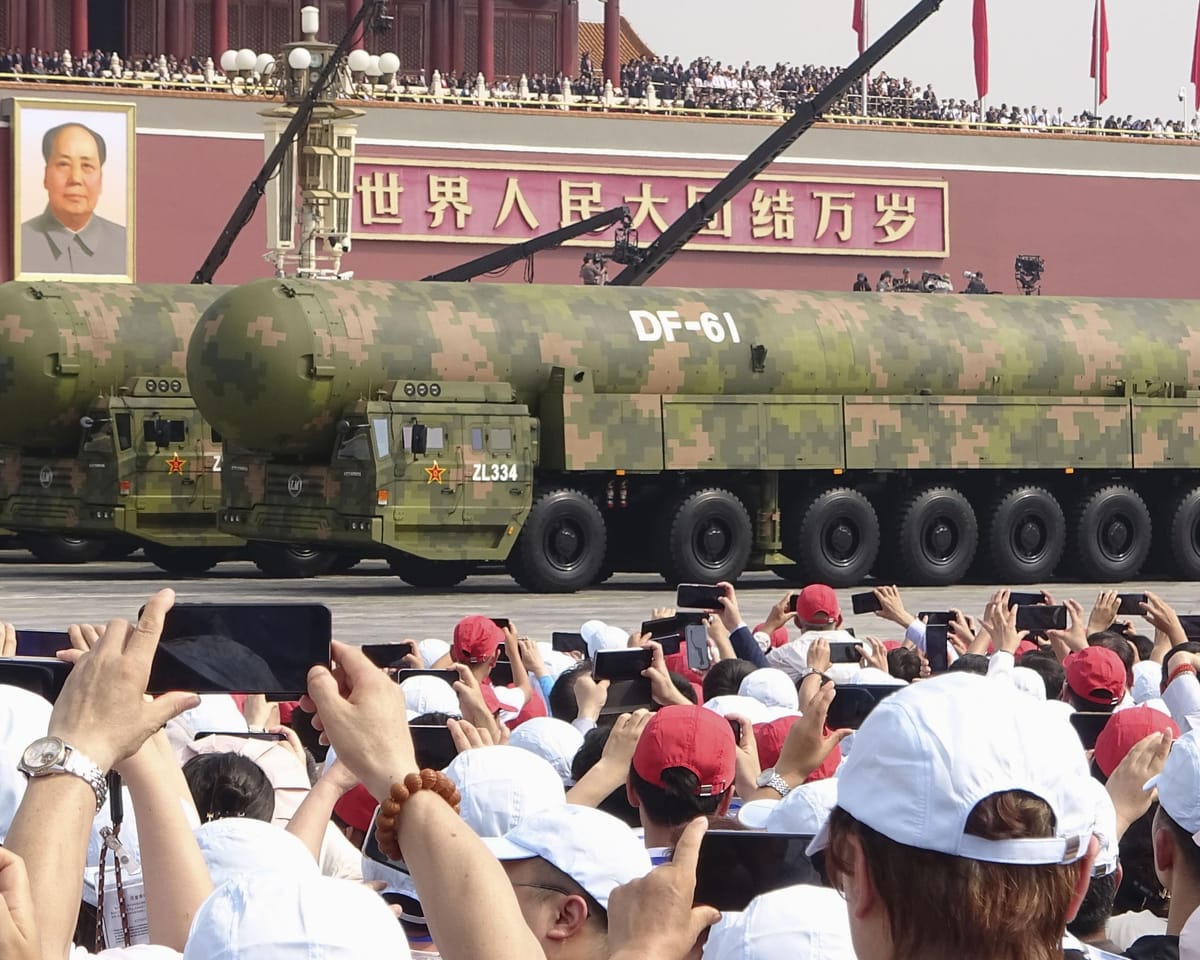
China’s recent military parade showcased a significant display of nuclear capabilities, emphasizing its long-term goal of reaching parity with the United States in military strength. The event featured air-, sea-, and land-based nuclear weapons, reinforcing Beijing’s strategic deterrence.
Also on view were large underwater drones resembling torpedoes, designed to counter naval threats, alongside anti-drone lasers and robotic systems. While their operational effectiveness remains uncertain, the display was clearly intended to draw attention.
Though China has not engaged in conflict since its brief 1979 war with Vietnam, it has pursued extensive military modernization, expanding its defense budget thirteenfold since the mid-1990s. Meanwhile, military exercises near Taiwan continue to raise regional tensions.
The parade’s focal point was its nuclear missile formations, with rows of launchers transported on massive trucks. The designations, marked in Roman letters, were easily identifiable for foreign observers.
State media described the nuclear triad as a critical element in defending national sovereignty. Among the highlights were four new DF-61 intercontinental ballistic missiles, each mounted on 16-wheeled vehicles. Analysts, including those from the Federation of American Scientists, noted these as the most unexpected feature, though it was unclear whether the missiles were armed.
Estimates suggest the DF-61 has a range of about 7,500 miles—enough to reach Washington, D.C., from Beijing. China now possesses up to nine intercontinental ballistic missiles, prompting questions about necessity. "How many ways do they need to launch a nuclear strike for deterrence?” one expert remarked.
Also displayed were JL-3 submarine-launched missiles, with an estimated range exceeding 6,200 miles, intended for China’s Jin-class submarines. Additionally, the JL-1 marked Beijing’s debut in air-launched nuclear weapons, joining a select group of nations.
China’s nuclear stockpile is growing faster than any other country’s, with estimates suggesting around 600 warheads and an annual increase of 100. Reports indicate a target of 1,500 by 2035, still far below U.S. or Russian stockpiles, which exceed 5,000 each. Nonetheless, even a small number of nuclear weapons could cause catastrophic damage.
The parade also introduced unusually large underwater drones, measuring 18 to 20 meters, transported on extended eight-wheeled vehicles as part of China’s strategic weapons development. Their size and function distinguish them from conventional models.
Read next

Pete Hegseth's proposal to stream executions aligns US with controversial nations.
If the US defense secretary, Pete Hegseth, proceeds with plans to livestream the execution of a soldier radicalized to extremist Islam, who killed 13 people at a military base in Texas, the US would join a group of lesser powers and rogue actors known for public executions in recent years.

Criminals steal €5m from renowned Italian winery
In a significant theft in Tuscany, thousands of wine bottles valued at €5 million have been stolen from the renowned Marchesi Antinori winery, marking what is considered the largest heist of its kind in Italy. A group of at least seven masked individuals breached the winery's cellar in

Illuminated Theater in Havana – A Photographic Journey
Widespread blackouts have become more frequent in Cuba since the US imposed energy sanctions in January. These outages often last longer than 24 hours as the aging electrical grid struggles to cope. The Impulso theatre group has been forced to adapt, as the power cuts present significant challenges for the