
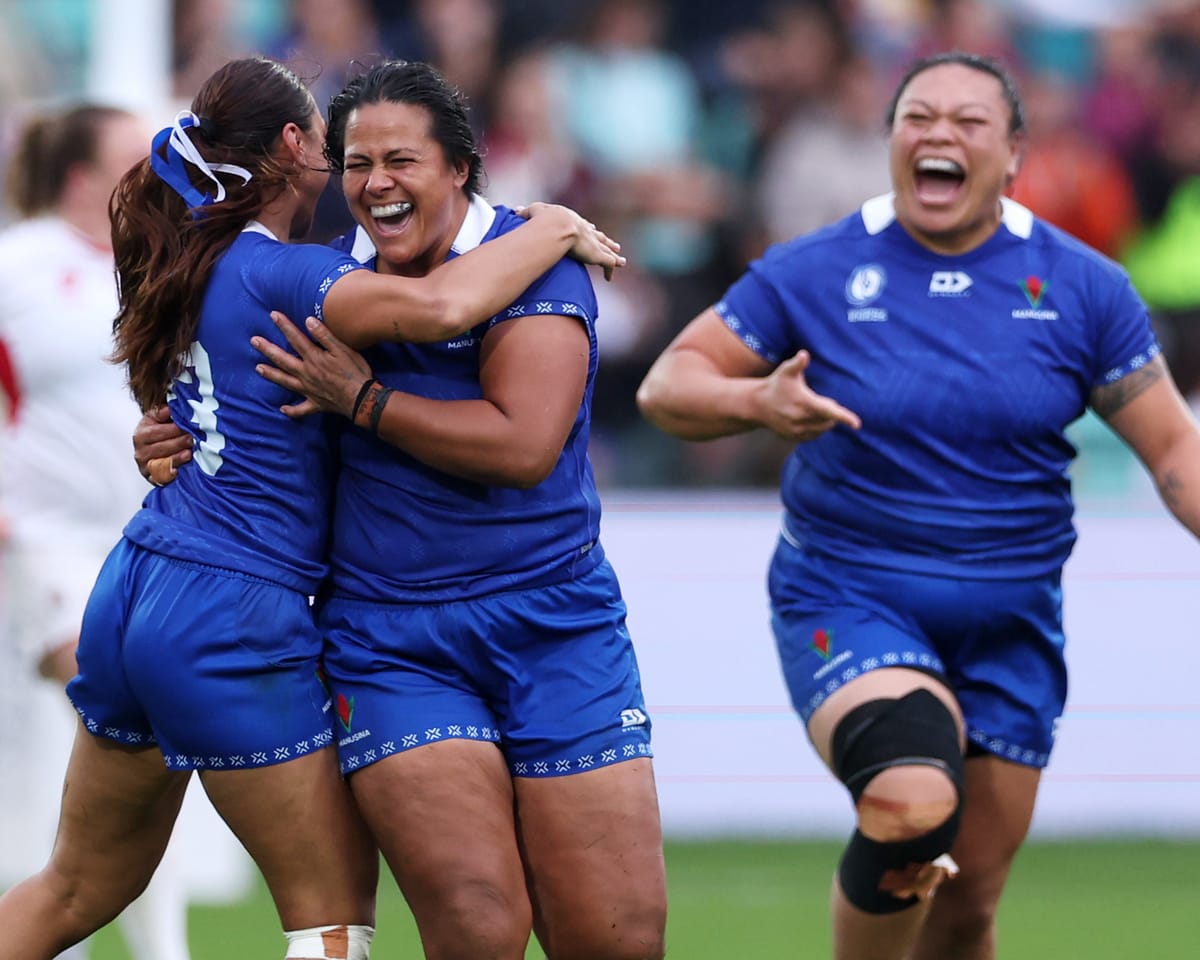
You can set aside the 92 points England scored. The focus should be on Samoa’s three. It’s been 11 years since Samoa last registered a point in a World Cup match. They missed the tournaments in 2017 and 2021, and in this edition’s opening weekend, they suffered a heavy 73-0 defeat against Australia. So when the team earned a scrum penalty just inside England’s half in the 42nd minute, 32 meters out and directly in front of the posts, the crowd at Franklin’s Gardens fell silent. Everyone understood the significance of that moment—it was about far more than just narrowing England’s lead.
Their coach, Ramsey Tomokino, thought they would opt for a quick tap-and-go, as they had practiced. But on the field, captain Sui Pauarasia turned to fly-half Harmony Vatau and asked, “You got this?” Vatau, usually reserved, met her gaze and nodded. The team was so surprised by the decision that no one initially fetched the kicking tee. Players had to urgently call for it from the sidelines as the shot clock ticked down. The kick sailed straight through the posts.
The stadium erupted. In the stands, the small group of traveling supporters cheered wildly, while Samoa’s players celebrated with a joyous dance as they retreated to their half. “Seeing the happiness on Harmony’s face and the rest of the team was incredible,” Tomokino said. He had hoped for a try, something Samoa hasn’t achieved against England in three meetings over 25 years. But the players’ expressions showed how much those three points meant.
Samoa had Glory—their prop forward. They had Faith—their hooker. And now they had hope. What they lacked was time and resources. To perform at the level of teams like England requires both.
Building that kind of scrum demands countless training sessions, along with access to coaches, analysts, and fitness staff. Mastering set plays, developing teamwork for complex attacking and defensive strategies, even perfecting skills like kicking under pressure or handling in difficult conditions—all require investment.
Samoa’s players are amateurs. Their squad includes a property manager, a primary school teacher, and a police officer. They play purely for the honor of representing their nation. For most, rugby league offers the only chance to earn a living in sports. There’s little financial support for men’s rugby in Samoa, and even less for the women’s game. The governing body has struggled since the pandemic, operating on minimal funds.
Read next

Pidcock Furious as Teammates Crash into Police Motorcyclist in Italy
Tom Pidcock admitted he nearly quit the Tre Valli Varesine race in frustration after a police motorcyclist drove into the peloton, injuring two of his Pinarello Q36.5 teammates. After finishing second in the northern Italy race, Pidcock recounted the incident: “A police motorbike was going the wrong way down

2026 Rising Stars: Top 60 Young Football Talents Worldwide
Next Generation 2017: 60 of the Best Young Talents in World Football
In the dynamic world of football, young talent is always at the forefront of shaping the future of the sport. The 2017 edition of the Next Generation list highlights 60 of the most promising young players from across

Arsenal and Chelsea to miss a month of WSL due to Club World Cup commitments
The Women's Super League (WSL) is set to face significant disruption in the upcoming season due to the Club World Cup. Arsenal and Chelsea are likely to miss domestic matches for up to a month, as the inaugural Women's Club World Cup is scheduled for January