
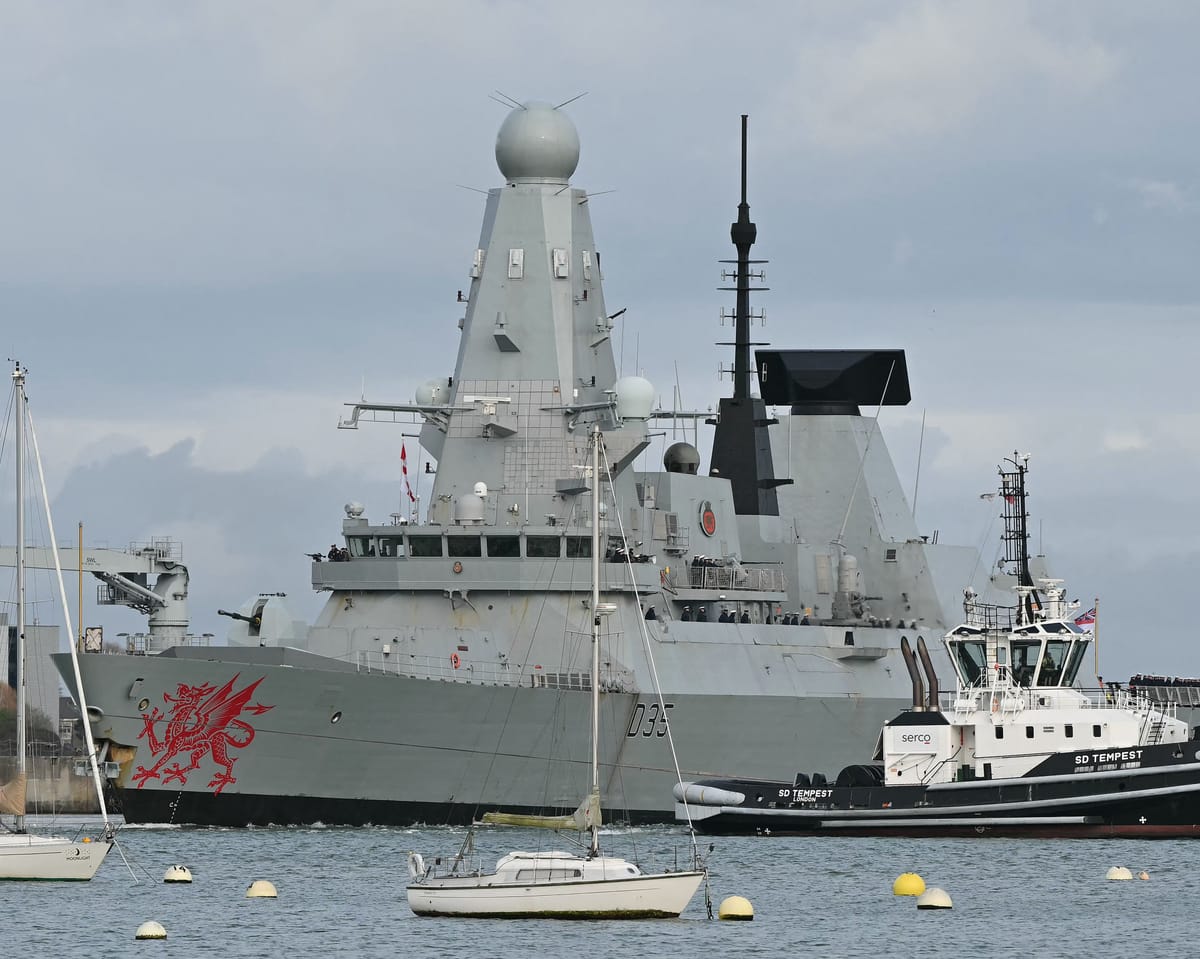
It will have been more than three weeks since the United States and Israel first struck Iran when the first British warship finally reached the waters off Cyprus, a delayed defensive move that has underscored the shortage of military capability available to the United Kingdom.
In name, HMS Dragon was one of three destroyers drawn from a pool of six. In practice the vessel had to be pulled from dry dock, readied and, after being launched, undergo several days of trials in the Channel. Its exact arrival date remains unconfirmed.
“It is evident that a major issue for the armed forces is providing the government with contingency options,” said Matthew Savill of the Royal United Services Institute, noting years of budgetary pressure. “Manpower and capacity have been reduced, even though the UK has tried to argue that a smaller force can be more efficient.”
Political focus has also been directed elsewhere. As the United States began to amass forces in the Middle East in late January, Britain chose to stay on the sidelines. A small number of fighter jets were dispatched to RAF Akrotiri in Cyprus and to Qatar early in 2026 as a modest additional layer of defence in case Iran responded across the region.
“Keir Starmer decided this was not our war,” a former senior British military commander said. He added, “once that decision is made it colours your deployments elsewhere” – implying that the UK is unlikely to be fully prepared if the conflict ignited by the United States and Israel were to expand rapidly.
Ministry of Defence insiders say the order to send HMS Dragon was taken on the fourth day of the hostilities with Iran. Only then was the option presented to Chief of Defence Staff Richard Knighton, who approved it together with Defence Secretary John Healey.
That decision came roughly 36 hours after hostile drones targeted the UK base at Akrotiri. One struck a hangar used by U.S. reconnaissance aircraft, prompting the evacuation of non‑essential staff and thousands of nearby Cypriot residents.
HMS Dragon is the only Royal Navy warship confirmed as deployed so far, although the United States has urged Britain to join a possible naval escort through the Strait of Hormuz. The sole nuclear‑powered attack submarine available from a fleet of six, HMS Anson, may be heading toward the Middle East after departing western Australia more than a week ago.
The broader lack of readiness, argued former General Richard Barrons, a member of Labour’s strategic defence review team, stems from “the armed forces we have ended up with at the close of the post‑Cold War era – a military sized for a period perceived as free of major threat”.
At the end of the Cold War the United Kingdom operated 51 destroyers and frigates while spending 3.2 % of GDP on defence. That number fell to 25 by 2007 and now stands at just 13, most of them ageing. Defence spending is currently 2.4 % of GDP, a figure Labour has pledged to raise modestly to 2.5 % by April 2027.
Britain has kept four mine‑hunters and a support vessel in Bahrain for two decades.
Read next

New dual‑national rules leave more British teens stranded overseas
Two more British teenagers have found themselves unable to return to the United Kingdom because of the Home Office’s new border regulations for dual nationals.
Their situations were reported only hours after a 16‑year‑old British schoolgirl was prevented from boarding a flight in Denmark for the UK

Health Department withdraws statement that sunbeds are as harmful as smoking
The Department of Health and Social Care (DHSC) has withdrawn a misleading statement that sunbeds pose a cancer risk comparable to smoking.
In January, officials announced tighter regulations for sunbeds, wrongly asserting they were “as dangerous as smoking”. The claim was echoed in social‑media posts from the health secretary

Rich Britons fleeing Gulf conflict skip the UK to dodge tax bills
Wealthy Britons escaping conflict in the Gulf are looking for refuge in places such as Ireland and France to sidestep large tax charges at home.
Facing possible claims from HM Revenue and Customs, high‑net‑worth individuals who have been residing in the United Arab Emirates and nearby states hope