
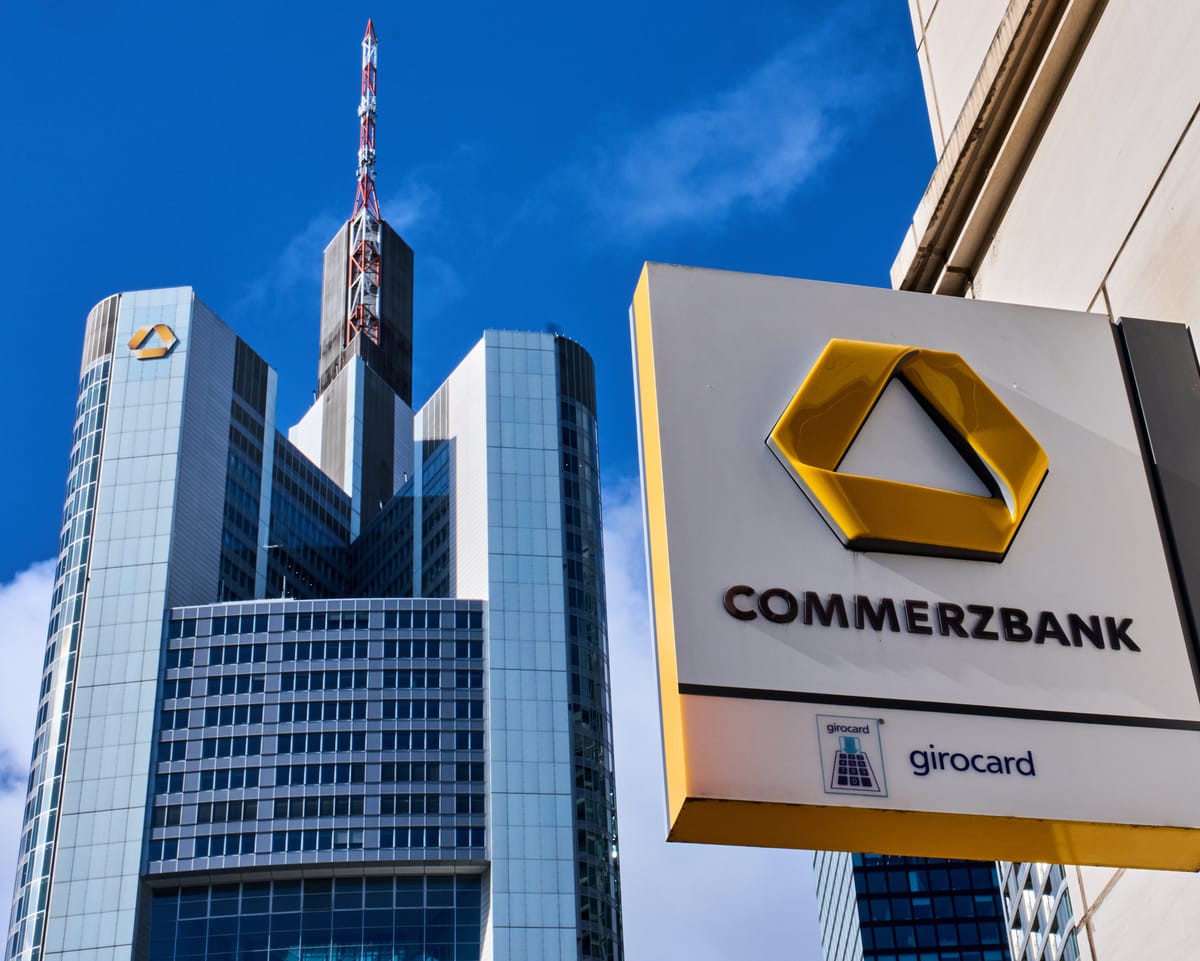
Two major European banks have entered a €35 billion (£30 billion) takeover contest after Italy’s UniCredit intensified its long‑standing bid for German lender Commerzbank, despite firm resistance from the German government.
UniCredit initially acquired a 9 % stake in Commerzbank in September 2024 and has since increased its holding to just under 30 %. On Monday the bank announced plans to raise its share further and move the rival toward formal merger negotiations.
German law requires a shareholder with more than a 30 % interest to launch a takeover offer. The Milan‑based institution said it intends to propose a share‑swap valuing each Commerzbank share at €30.8, amounting to roughly €34.7 billion in total. Commerzbank’s price rose to €31.30 in early trading on Monday.
The proposal places UniCredit at odds with Commerzbank’s board and the German state, which rescued the bank during the 2008 crisis and still retains a little over 12 % of its equity.
“UniCredit is prepared to discuss the proposal with Commerzbank and relevant stakeholders,” the bank said.
UniCredit added that the offer would move it past the “30 % threshold defined by German takeover rules” and enable further dialogue with Commerzbank and its partners in the coming weeks.
“The UniCredit board views the proposal as a practical step that does not diminish the value of its existing holding,” the statement continued.
Frankfurt‑based Commerzbank, founded in 1870, is one of Germany’s oldest banks and employs about 40 000 people across 40 countries.
The 2008 rescue involved a €18.2 billion cash injection from the German government.
“The government’s stance on this matter is clear and unchanged,” a spokesperson for the finance ministry told Die Welt. “We remain committed to Commerzbank’s independence.”
Former chancellor Olaf Scholz also described the Italian initiative as “an unfriendly attack.”
UniCredit, Italy’s second‑largest lender, has returned to profit after the global financial crisis and already owns the German bank HypoVereinsbank.
Commerzbank remains a leading creditor to the Mittelstand – the family‑run small and medium‑sized enterprises that underpin the German economy – and has faced several takeover approaches, including a failed merger with Deutsche Bank.
“This proposal was not coordinated with us,” said Bettina Orlopp, chief executive of Commerzbank, adding that the offer “does not contain a premium for our shareholders.”
Germany’s second‑largest trade union, Verdi, has repeatedly opposed a UniCredit takeover. “We reject any takeover that could harm the German economy and jobs at both HypoVereinsbank and Commerzbank,” said union board member Christoph Schmitz‑Dethlefsen.
Read next
US Postal Service faces cash shortage by Feb 2027, agency chief warns
The United States Postal Service faces a cash shortfall within the next twelve months unless Congress removes the borrowing limit imposed on the agency, the postmaster general warned.
Speaking to the Associated Press, David Steiner said the service – which funds its operations through stamps and fees rather than tax revenue
IEA weighs tapping additional oil reserves amid Iran conflict driving up prices
The international energy regulator is weighing another release of emergency crude reserves into the world market to temper climbing oil prices, after cautioning that market recovery will be slow following the ongoing strait of Hormuz crisis.
Fatih Birol, chief of the International Energy Agency, noted that member nations still hold

Micro-restaurants: where the chef is just a metre away, offering cosy charm
It began with a cut‑back in portion sizes, as all‑you‑can‑eat buffets were trimmed to modest, bite‑size servings. Soon after, menus shrank, with once‑lengthy lists reduced to a single A5‑sized sheet.
A new wave of contraction is now hitting the sector. Micro‑restaurants—venues