
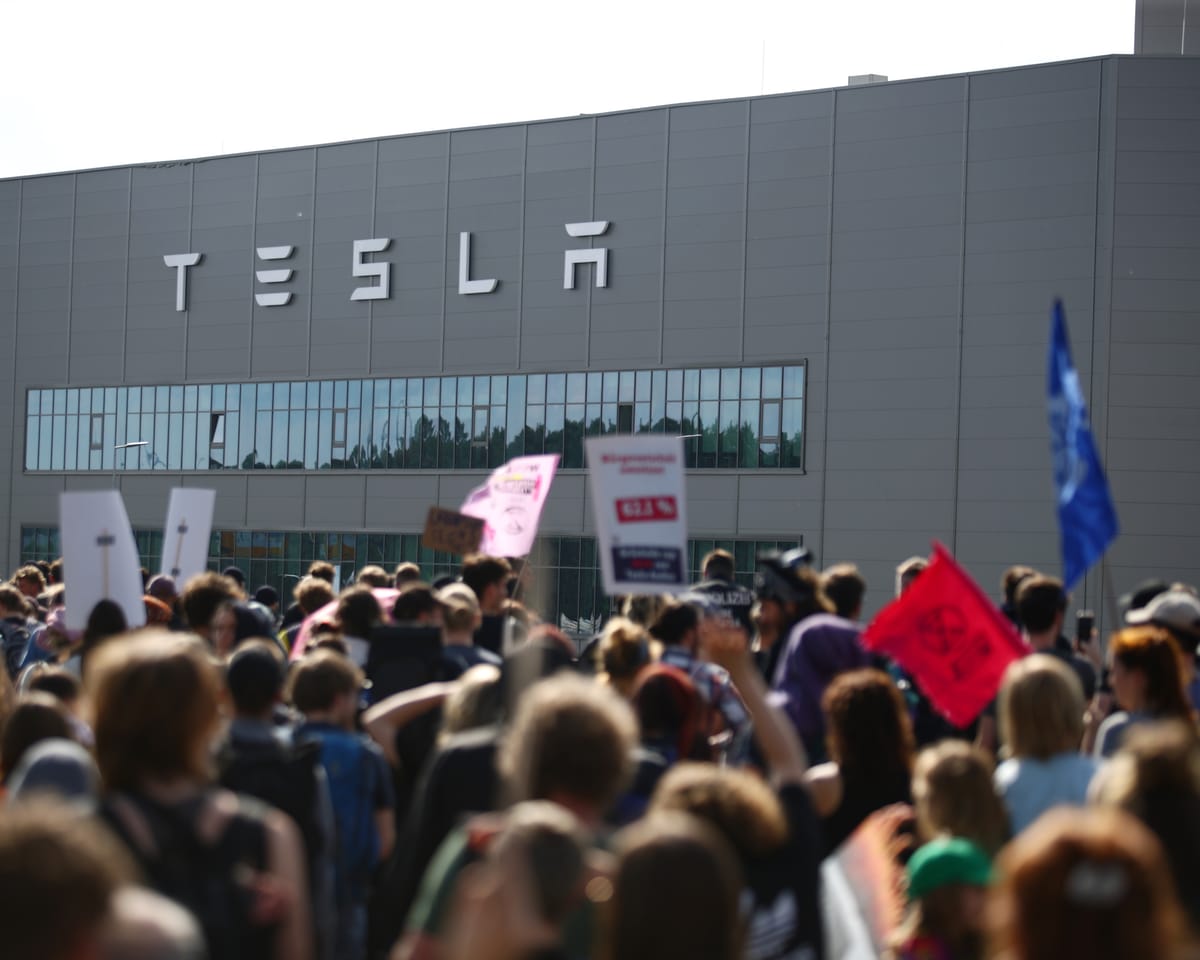
Europe’s biggest trade union is seeking to take over the works council at Elon Musk’s Tesla gigafactory near Berlin, in a labour‑relations clash marked by lawsuits and mutual accusations of defamation.
The works council – an elected body of staff that negotiates matters such as working hours and pay with management – is a long‑standing feature of German corporate life, especially in the automotive sector.
Yet it has already been a point of dispute at the Grünheide plant, located about 30 km south‑east of Berlin, even before the site opened almost four years ago.
The factory, which employs roughly 10,000 people and is the American electric‑car maker’s sole production location in Europe, has witnessed frequent friction between Tesla’s fast‑paced management style and Germany’s tradition of a social market economy that relies on employee representation and collective bargaining.
Voting for the works‑council election, now dominated by non‑union members, began on Monday and will run until Wednesday.
The confrontation has been framed as a showdown between the century‑old IG Metall union and Musk, who claims the dispute threatens economic growth. The union describes the battle as an existential danger to European workers’ rights and accuses Musk, the world’s wealthiest individual, of trying to “break the union”.
IG Metall alleges that Tesla offers substandard working conditions and dismisses workers it says are underperforming. It argues that a collective agreement is necessary to safeguard employees.
Tesla counters that the union is merely seeking to expand IG Metall’s membership. It rejects claims of poor conditions and says it pays wages above the industry average.
Musk has warned that the result of the conflict could decide the plant’s future and whether planned investments will proceed.
The dispute intensified last month when Tesla’s management accused an IG Metall member of illegally recording a works‑council meeting. The union denies the allegation. Both parties have launched legal actions against each other over the matter.
The Brandenburg state government has been asked to intervene, but the regional economics ministry has urged the sides to settle the issue themselves, stating it would encourage Tesla to accept a collective agreement.
IG Metall has put forward 116 candidates for the council in an attempt to secure a simple majority of 19 out of 37 seats. In the previous election two years ago, it won 16 seats when the council comprised 39 members.
Labour experts have portrayed Tesla’s management as unusually confrontational, adding to the negative press surrounding the automaker, which is already grappling with weak sales in Europe amid stiff competition from lower‑priced Chinese electric‑vehicle models.
In Germany, public sentiment against Musk has risen following his support for the far‑right Alternative für Deutschland party.
Read next
Jaguar Land Rover suppliers voice ‘everything is against us’ amid cutbacks
David Roberts, chair of Coventry-based Evtec, says the outlook for Britain’s automotive sector is grim, with “everything against us.” Evtec is a tier 1 supplier to Jaguar Land Rover, which this week announced 4,000 job cuts over two years despite chancellor John Healey’s attempt to talk
Europe’s fighter jet plans in disarray: what comes next?
When former ECB president and Italian PM Mario Draghi urged Europe to catch up economically with the US and China, defence collaboration was prescribed. No more should each nation build independent boats, tanks or jets; allies should share costs and technologies.
Europe stumbled at the first hurdle. German Chancellor Friedrich
John Healey supports growth but insists Labour must be truthful about spending
John Healey has stated that his primary goal as chancellor will be to boost economic growth, while acknowledging that Labour must be straightforward about controlling public spending at next month's budget.
In his first major address since assuming the role in July, Healey said the leading focus of