
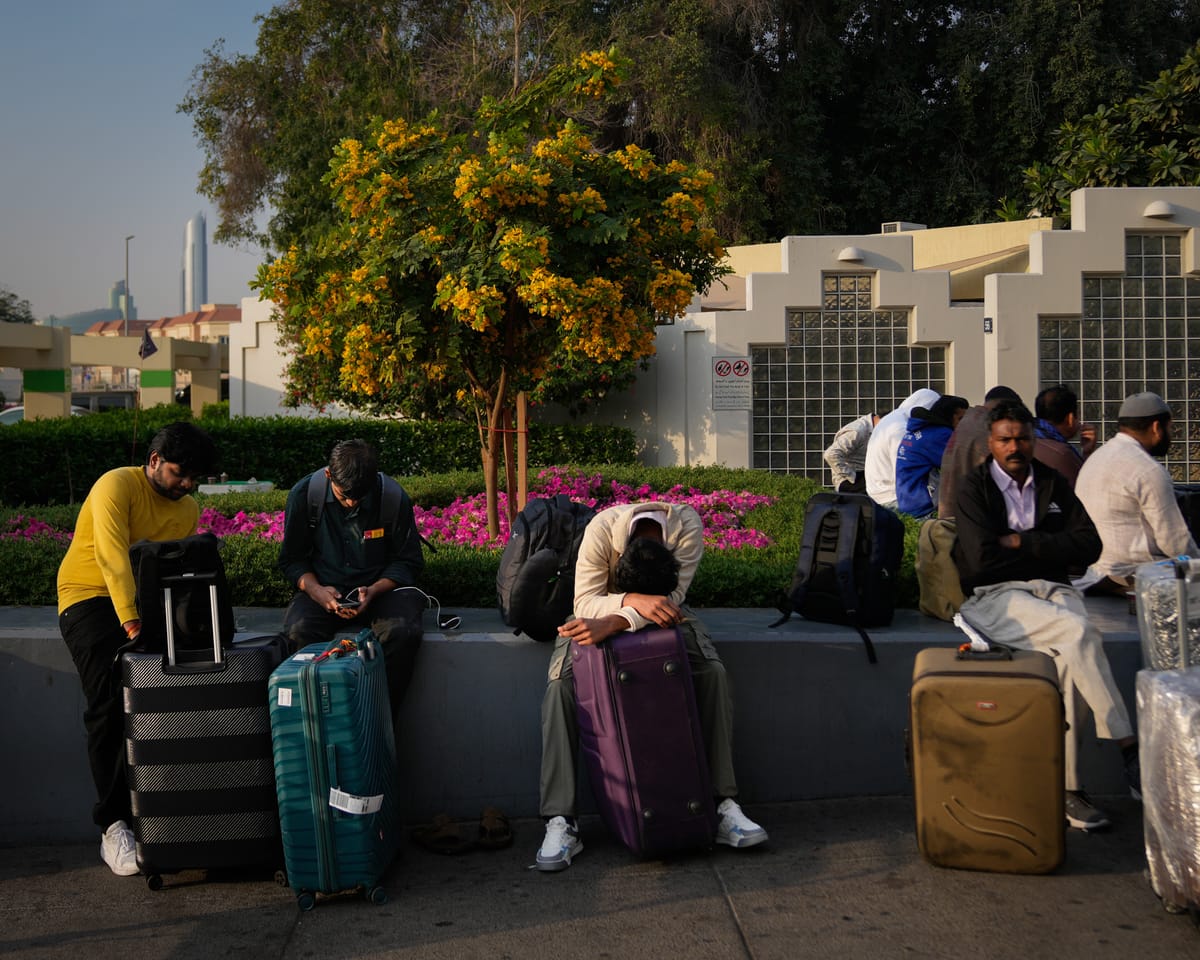
A conflict sweeping the Middle East has emptied the region’s skies, compelling airlines to adopt extensive rerouting measures and leaving a huge gap in what is normally a bustling segment of global airspace.
With Israel and the United States striking Iran repeatedly, and Tehran answering with successive missile and drone salvos, carriers have been forced to steer their passenger aircraft away from the Gulf or face the danger of a disastrous incident.
How did the airspace become unavailable?
The world’s airspace is divided into Flight Information Regions (FIRs), which generally correspond to national borders. Each government oversees the FIR above its territory, providing air‑traffic services.
In an extreme case such as a regional war, authorities inform pilots that they are limiting or shutting down their FIRs by issuing a NOTAM – a Notice to Air Missions. Several Middle‑Eastern FIRs have been closed since the bombardments began, creating a void of roughly 2.8 million sq km (1.08 million sq mi).
It is not only governments that produce empty skies. Airlines decide where not to fly based on a range of considerations, including alerts from the states where they are registered (for example, the United Kingdom for British Airways or India for Air India) and whether their insurers will cover a flight over hazardous zones. Dispatch teams monitor developments continuously to chart safe routes.
“In the end, the decision about whether a piece of airspace is safe to fly your passengers through it is that of the airline and the airline’s dispatchers, depending on the level of risk,” explains former British military pilot and aviation analyst David Learmount. This clarifies the situation over Lebanon, which is being hammered by Israeli strikes. Although Lebanon’s FIR has not been formally closed, most carriers avoid it.
What have airlines done?
Major routes that link Europe, Africa and Asia via the Middle East have been altered dramatically.
When the bombings started on Saturday, airlines were able to begin rerouting immediately, as contingency plans for years had already mapped alternative paths that bypass certain hot‑spot nations. In many cases, aircraft already had these routes programmed into their navigation systems.
Two principal detour options have surfaced – one that arcs northward through the Caucasus while staying beneath Ukraine’s closed airspace, and another that channels traffic southward via Egypt, as well as Saudi Arabia and Oman, which are also experiencing sporadic attacks.
These corridors are absorbing the displaced traffic but are also creating a bottleneck, which explains the growing number of delays and cancellations.
“This problem is not getting better, it’s getting worse,” said Learmount. “You can see the patterns of the way aircraft are going.
Read next
Tokyo tourist hotspot outlaws short-term rentals amid complaint surge
Shinjuku Ward, Tokyo, has moved to ban short-term rental accommodations in residential areas and near schools and important cultural sites, following a slew of complaints about visitor behaviour. The decision, to be enacted through a local ordinance, marks the latest sign that Japan’s patience with mass tourism is
Canada implements retaliatory US tariffs as trade dispute intensifies
Canada’s retaliatory tariffs on about $20 billion worth of American imports took effect at 12.01am on Tuesday, ranging from 15% to 50% and applying to steel, dairy, appliances, agricultural equipment, pulp and paper, and electronics. The measures, a response to the United States’ 50% tariff on $20 billion

Prosecutor general resigns amid political turmoil in Kyiv during Ukraine war
Ukraine’s prosecutor general Ruslan Kravchenko resigned amid corruption accusations after anti-graft officers searched his offices at the weekend. He called the allegations “completely unsubstantiated” and denied wrongdoing. The National Anti-Corruption Bureau (NABu) and Specialised Anti-Corruption Prosecutor’s Office (Sapo) announced Saturday they uncovered a money-laundering