
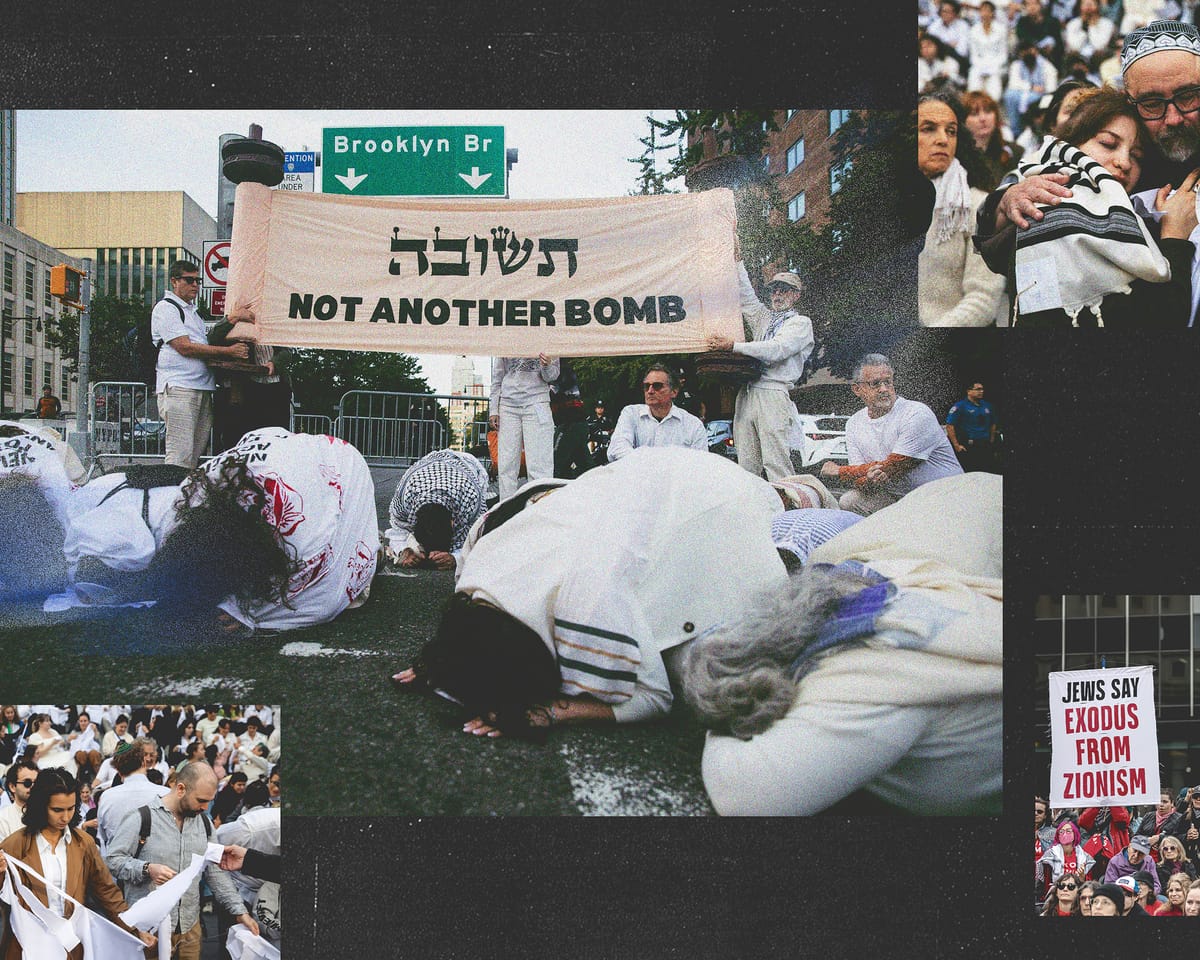
Two years have passed since the tragic events of 7 October 2023, an incident that deeply affected Jewish communities worldwide more than any other since Israel’s founding.
For Jews, it was devastating. For Israel, it was a profound humiliation. The founding vision of a Jewish state was built on the promise that such horrors would never be repeated.
A reaction was unavoidable. But the path Israel chose—decimating Gaza, causing widespread civilian casualties—was a deliberate decision. This has made it difficult for many American Jews to reconcile the initial attack with the subsequent actions taken in its name. Now, the community faces a challenge: how to honor the victims of an atrocity while confronting the suffering inflicted on others in their name?
The difficulty of remembrance stems from the lack of agreement on what any of this represents. In fact, among American Jews, the past two years have seen the breakdown of a decades-long alignment on Zionism itself.
Early support for Zionism in the American Jewish community traces back to a 1915 essay by lawyer and future Supreme Court Justice Louis Brandeis, titled *The Jewish Problem; How to Solve It*. However, widespread consensus only solidified after the 1967 Six-Day War. Before that, American Jews held diverse perspectives on the necessity of a Jewish state—Zionists, non-Zionists, and anti-Zionists coexisted in a fragile balance.
This balance endured through the 1950s and 60s, visible in remnants of Jewish socialism, organizations like the non-Zionist American Jewish Committee and the anti-Zionist American Council for Judaism. Louis Finkelstein, chancellor of the Jewish Theological Seminary, viewed Zionism as spiritual rather than political, refusing to allow the Israeli anthem, Hatikvah, at seminary ordinations in the early 1960s. Zionism was not central to Modern Orthodoxy until after 1967. Alternative Jewish identities thrived.
But when Israel defeated its neighbors in the Six-Day War, seizing control of the West Bank, Gaza Strip, Golan Heights, and East Jerusalem, American Jewish perceptions shifted dramatically. Israel’s victory, combined with long-standing fears of another catastrophe, reinforced the belief in the country’s vital role for Jews and became a point of pride. Talk of a "miraculous" triumph and the "liberation" of territory lent Zionism a near-religious fervor. During this period, much of the lingering doubt about Zionism vanished. In the early 1970s, *Commentary* editor Norman Podhoretz famously declared, "We are all Zionists now."
Still, this consensus excluded most ultra-Orthodox Jews, who maintained that a Jewish state should only be established under divine will.
Read next

Russian Assault on Buses Near Ukraine Border Results in 30 Deaths
Thirty people have been killed and eighteen injured following an attack by Russia on two passenger buses in Kramatorsk, near the frontline in eastern Ukraine, according to local authorities.
The Donetsk regional prosecutor's office reported that the death toll from the morning attack on the buses had reached

Ethiopia Conducts Drone Strike on Eritrean Forces in Tigray Region
Eritrean forces reportedly crossed into Ethiopia's Tigray region and faced drone attacks from Ethiopian government forces, raising concerns about the potential for a broader regional conflict between the two neighboring countries.
Military vehicles transporting soldiers crossed the southern border of Eritrea into Tigray on Wednesday, reaching Adigrat, approximately

Israel Advances Film Resembling NAZA Documentary
The Israeli government is promoting an online film project designed to counter the findings of the award-winning documentary NAZA, which details Israel’s mass killings of civilians in Gaza. NAZA, directed by Oscar-winning filmmakers Yuval Abraham and Rachel Szor, is currently in cinemas and will be shown in