
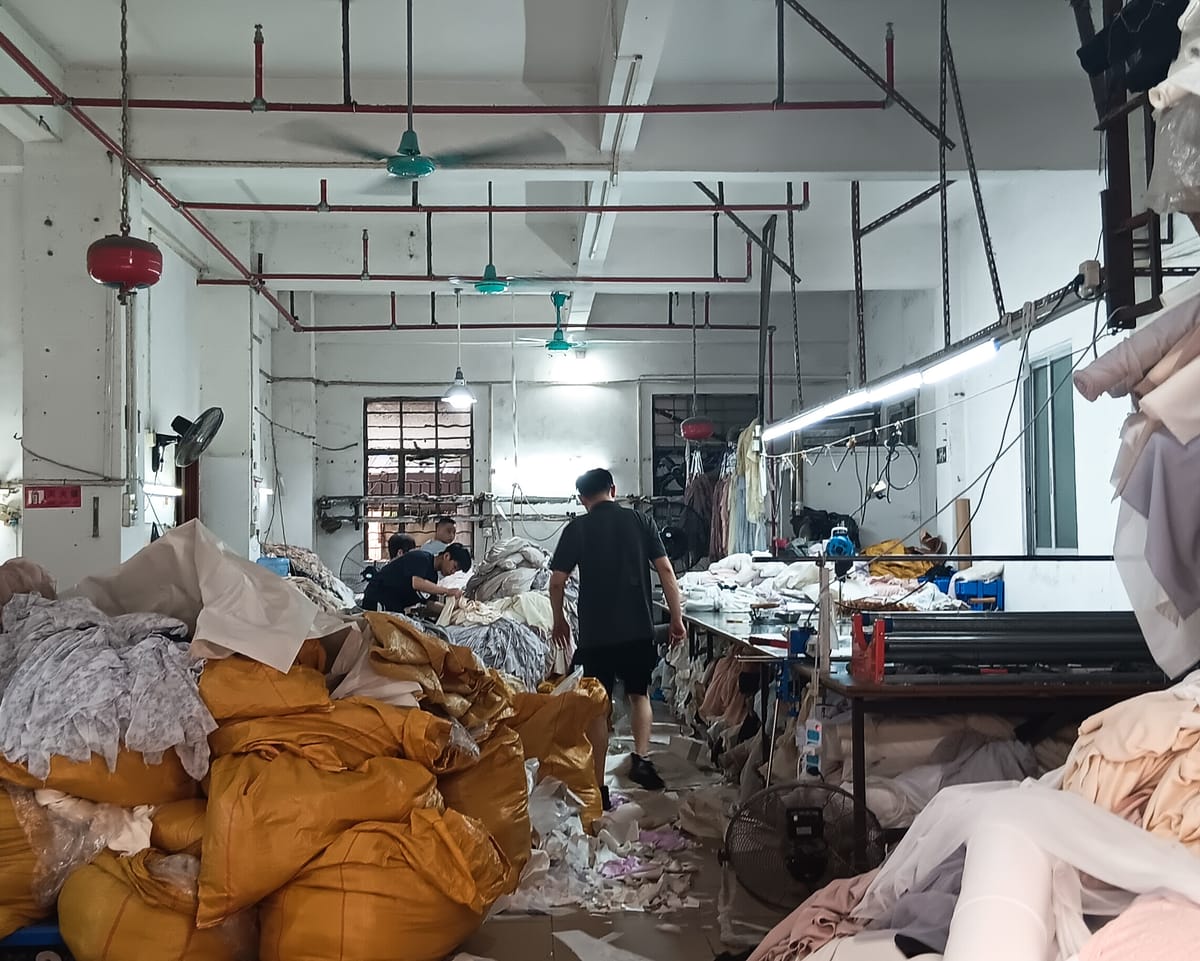
At a daily job market in Panyu, a neighborhood on the outskirts of Guangzhou, Ms. Qiu appears disheartened. She is searching for a nearby workshop that will pay her to sew garments—inexpensive tops and dresses that will later appear on online shopping platforms or be shipped overseas. Today, she has had little success.
"The entire sector is facing challenges, and now there’s a steep tariff on Chinese goods due to the trade dispute. Many international buyers have cut back on orders," she says, preferring not to share her full name.
Guangzhou, a major city in southern China and the capital of Guangdong province, is home to nearly 20 million people. It is also a key hub for global mass-produced apparel. In its densely packed neighborhoods, countless workers labor in small, makeshift workshops, producing low-cost clothing. In one cramped factory, women work at sewing machines surrounded by stacks of stiff black tutus. In another, piles of pink denim jeans, likely to be sold through quick-fashion platforms, cover every workspace.
Each morning, workers gather at informal hiring spots like the one in Panyu, hoping to secure a day’s work attaching buttons or pressing collars. Depending on the task, they earn between one and 10 yuan per item, working long hours in tight spaces.
"This money doesn’t come easy," says a man in his 60s in Datang, another neighborhood not far from Panyu. Pressing jackets at 8 a.m., part of a shift that began late the previous night, he earns just two yuan per jacket. Like others questioned by *CuriosityNews*, he and many garment workers reported shifts lasting 10 to 12 hours, with some saying they took only one day off each month.
Diminishing Margins
Though China’s online retail sector has grown rapidly in recent years, foreign orders remain crucial for sustaining factories. Last year, China supplied about a quarter of the more than $100 billion in textiles and apparel imported by the U.S. Guangdong province alone exported over $7 billion, according to trade data.
However, after the recent trade tensions and the imposition of steep tariffs—reaching as high as 145%—many are uncertain about the future. While both nations agreed to a temporary halt in May, the August deadline for resolving the dispute weighs heavily on workers in Guangzhou, who rely on exports.
In Panyu, Yang Ruiping manages a small factory specializing in tops, employing around 20 people.
Read next

Pete Hegseth's proposal to stream executions aligns US with controversial nations.
If the US defense secretary, Pete Hegseth, proceeds with plans to livestream the execution of a soldier radicalized to extremist Islam, who killed 13 people at a military base in Texas, the US would join a group of lesser powers and rogue actors known for public executions in recent years.

Criminals steal €5m from renowned Italian winery
In a significant theft in Tuscany, thousands of wine bottles valued at €5 million have been stolen from the renowned Marchesi Antinori winery, marking what is considered the largest heist of its kind in Italy. A group of at least seven masked individuals breached the winery's cellar in

Illuminated Theater in Havana – A Photographic Journey
Widespread blackouts have become more frequent in Cuba since the US imposed energy sanctions in January. These outages often last longer than 24 hours as the aging electrical grid struggles to cope. The Impulso theatre group has been forced to adapt, as the power cuts present significant challenges for the