
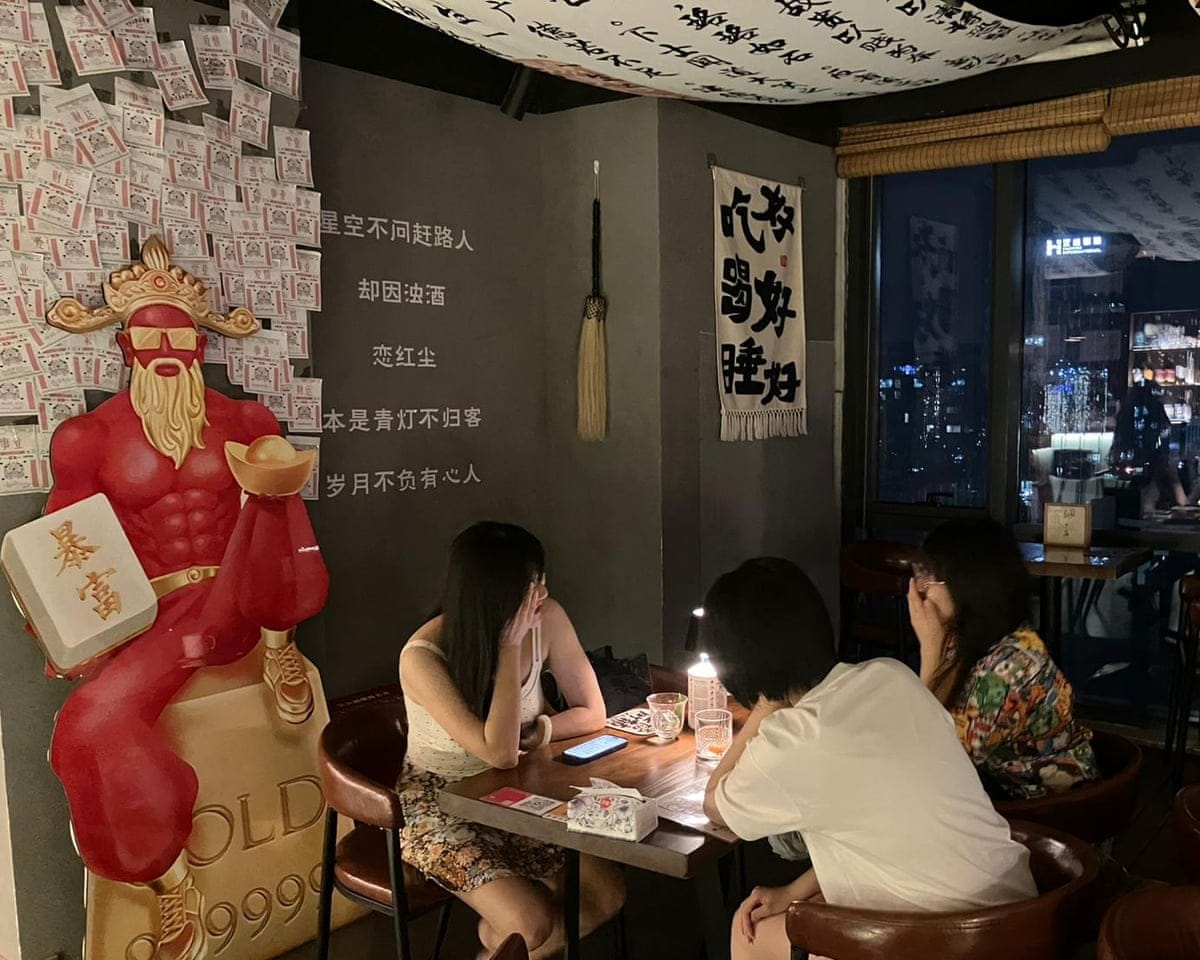
In an era where self-improvement and personal reflection dominate, people have more ways than ever to seek direction. While those feeling unsure might have once turned to search engines, many now engage in seemingly meaningful conversations with AI tools like ChatGPT or—in China—DeepSeek.
Yet some believe our ancestors had greater wisdom about life or, at least, knew better how to search for answers. This belief has led many young Chinese to explore ancient divination methods in hopes of glimpsing the future. Over recent years, fortune-telling bars have emerged in cities across China, combining drinks with **xuanxue** (spiritual practices). The trend aligns with the country’s struggling economy; as consumers tighten spending, a night out for fortune-telling offers a cheaper alternative to expensive distractions or professional therapy. Rooted in mystical traditions blending Daoist, Buddhist, and folk beliefs—many of which have persisted despite government efforts to suppress superstition—turning to the mystical feels natural for some.
This week, I decided to try it myself.
I visited **Qie Le**, a new bar in Beijing’s affluent Chaoyang district. On a Thursday evening, the space—decorated with yellow Daoist talismans and sheer curtains—was quiet. Perfect, I thought, for monopolizing the fortune-teller’s attention with my self-centered questions. But **Wan Mo**, either through intuition or experience with narcissistic millennials, saw through me immediately: only one question per drink.
Dressed in a loose white Tang-style jacket tied with traditional knots, the 36-year-old specializes in **qiuqian** (Chinese fortune sticks). The practice involves shaking a wooden cylinder filled with inscribed sticks while concentrating on a question. One stick eventually falls, revealing an answer through its engraved text and numbers. Dating back to the Jin dynasty (AD 266-420), qiuqian has endured wars, revolution, and even the AI era, remaining a staple in Daoist temples and now Beijing bars.
So, my first question: *Will AI take my job?*
“Use both hands,” Wan Mo instructs firmly. A no-nonsense guide, she warns that as a foreigner, my connection to the sticks may be weaker than a native’s, so I must focus carefully.
After intense shaking, two sticks tumble onto the table.
Examining the first, Wan Mo reads: “This suggests AI will affect your work… Though skilled, you can’t match its reach.”
Read next

Bolivia Probes Ex-President Evo Morales for Suspected Involvement in 2009 Killings
The Bolivian attorney general has initiated an investigation into former leftist president Evo Morales, citing allegations of his involvement in the murder and torture of European nationals in 2009.
In 2009, police conducted a raid on a Santa Cruz hotel, resulting in the deaths of Eduardo Rózsa Flores, a Bolivian-

Argentina Closes Iguazu Falls Temporarily Due to El Niño-Induced Water Surge
Heavy rainfall driven by a potent El Niño weather pattern temporarily led Argentinian authorities to close tourist access to the renowned Iguazu Falls. The closure occurred due to concerns that rising water levels might cause the river to overflow its banks.
On Monday, national park officials implemented this precautionary measure

Mysterious Drones Strike Two Vessels Near Bulgarian Coast – Europe Live
Morning Update: Two Ships Targeted by Drones Off Bulgarian Coast
This morning, two ships in the Black Sea near Bulgaria were struck by drones of unknown origin. The attack led to the sinking of one vessel and initiated emergency rescue operations, as reported by Bulgarian Prime Minister Rumen Radev. Rescue