
Sometimes change is measured by what is no longer there. That was the case on the first day of Wimbledon this year when the tournament’s line judges, a long-standing presence, were absent for the first time.
Electronic line calls are now in use at the All England Club, following the lead of other major tournaments in Melbourne and New York, as well as the ATP Tour. Only the French Open retains on-court officials for line calls. The switch to an automated, camera-driven system marks a significant shift for Wimbledon, where hundreds of line judges had contributed to the event’s character for 147 years.
The change drew mixed reactions—some protest outside the grounds (though mostly playful) and divided opinions among spectators. Unexpectedly, players also voiced reservations. In the men’s competition, Carlos Alcaraz and his opponent Fabio Fognini questioned a call made by the new system, seemingly unaware that the option to challenge rulings has also been phased out.
On the women’s side, China’s Yuan Yue found the system difficult to hear. “The voice is too quiet—I couldn’t catch the call,” she said. “I asked the umpire to raise the volume, but he said it couldn’t be adjusted. Instead, he offered to relay the decision since he had access to the system. It’s not a big issue, but I just want clarity. The umpire’s announcements are louder, so we hear those clearly. Other tournaments haven’t had this problem.”
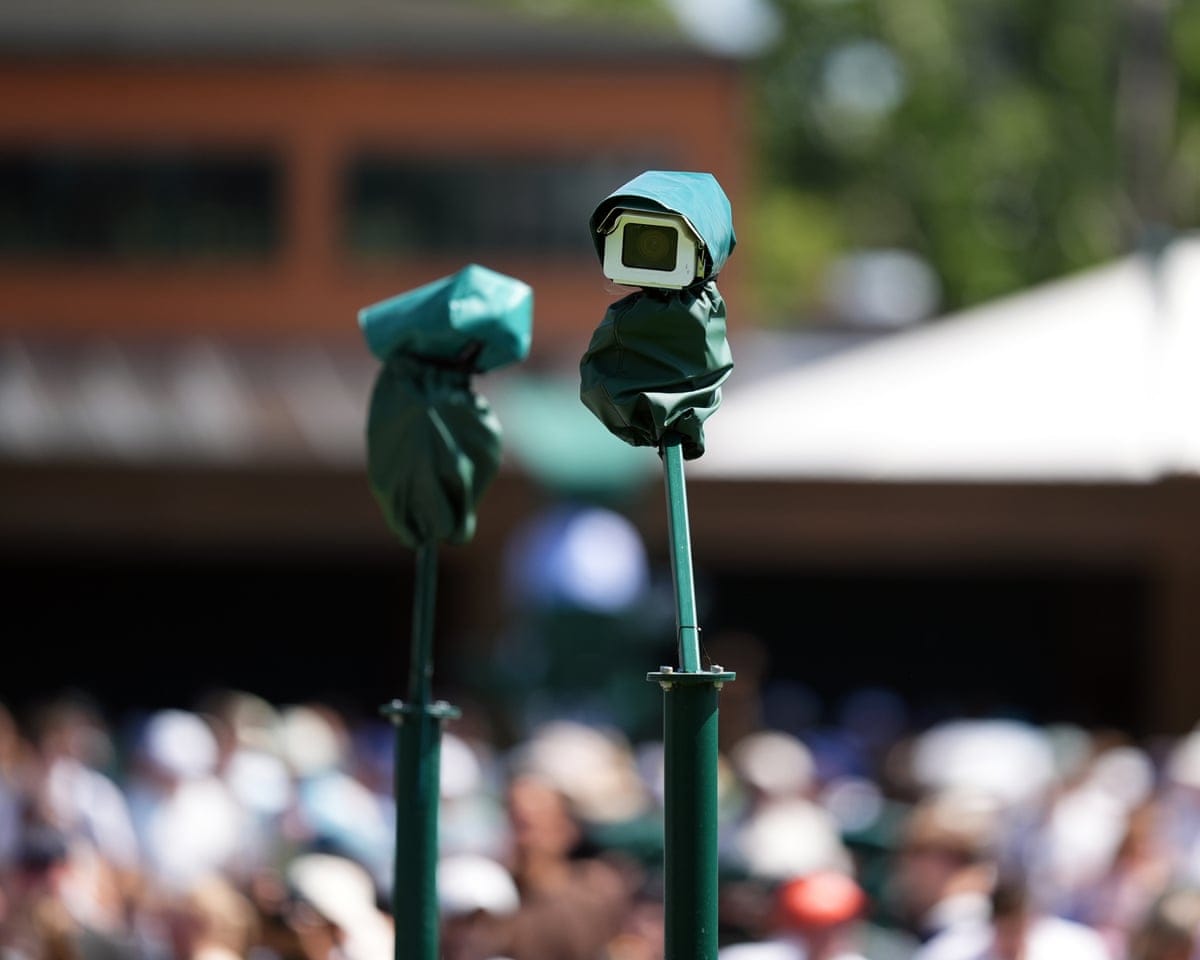
The technology, developed by Hawk-Eye, relies on AI to process footage from up to 18 cameras tracking the ball’s movement. Officials say the system signals faults or out-of-play shots within milliseconds. A distinct Wimbledon touch ensures these rulings are voiced by recorded clips of All England Club staff.
For viewers and players alike, this creates an unusual dynamic. During Cameron Norrie’s match against Roberto Bautista Agut on Court 18, “fault” calls were voiced by a young ballboy (announced with emphasis), while “out” decisions came in a mix of adult voices. On smaller courts, calls from different matches sometimes overlapped, creating confusion. Britain’s Sonay Kartal, who once lost a point in Melbourne after reacting to a call meant for another game, later described the conditions as “perfectly fine” but shared Yuan’s concerns.
“At crucial moments, the crowd noise drowned out the automated calls, so I missed a few,” she said after defeating Jelena Ostapenko in three sets.
Sally Bolton, head of the All England Club, explained the decision as an effort to balance tradition with modern expectations. “For us, it was time,” she said.
Read next

Weekly Sports Quiz: Focus on Harry Kane, Victor Wembanyama, and WSL Champions
Local Community Efforts Drive Environmental Change
In a small town nestled between rolling hills and dense forests, residents have taken it upon themselves to spearhead a movement aimed at fostering environmental sustainability. This grassroots initiative is drawing attention for its comprehensive approach to tackling ecological challenges.
At the heart of

France and US Reign in Rapid and Blitz at Pall Mall Masters Chess Event
Mastering chess in central London is uncommon, though the annual ChessFest in Trafalgar Square draws over 20,000 visitors.
In London's Pall Mall club scene, the RAC clubhouse has been the site for the Oxford vs. Cambridge Varsity match for nearly fifty years. In 2023, the Athenaeum hosted

Indiana Fever and the Magasphere: A Risky Route to Fame for a WNBA Team
The Indiana Fever's season has concluded, marked by both its on-court performance and off-court controversies. Despite being eliminated by the Las Vegas Aces for the second consecutive year, the team has drawn significant attention, becoming a focal point in the WNBA this season.
The Fever'