
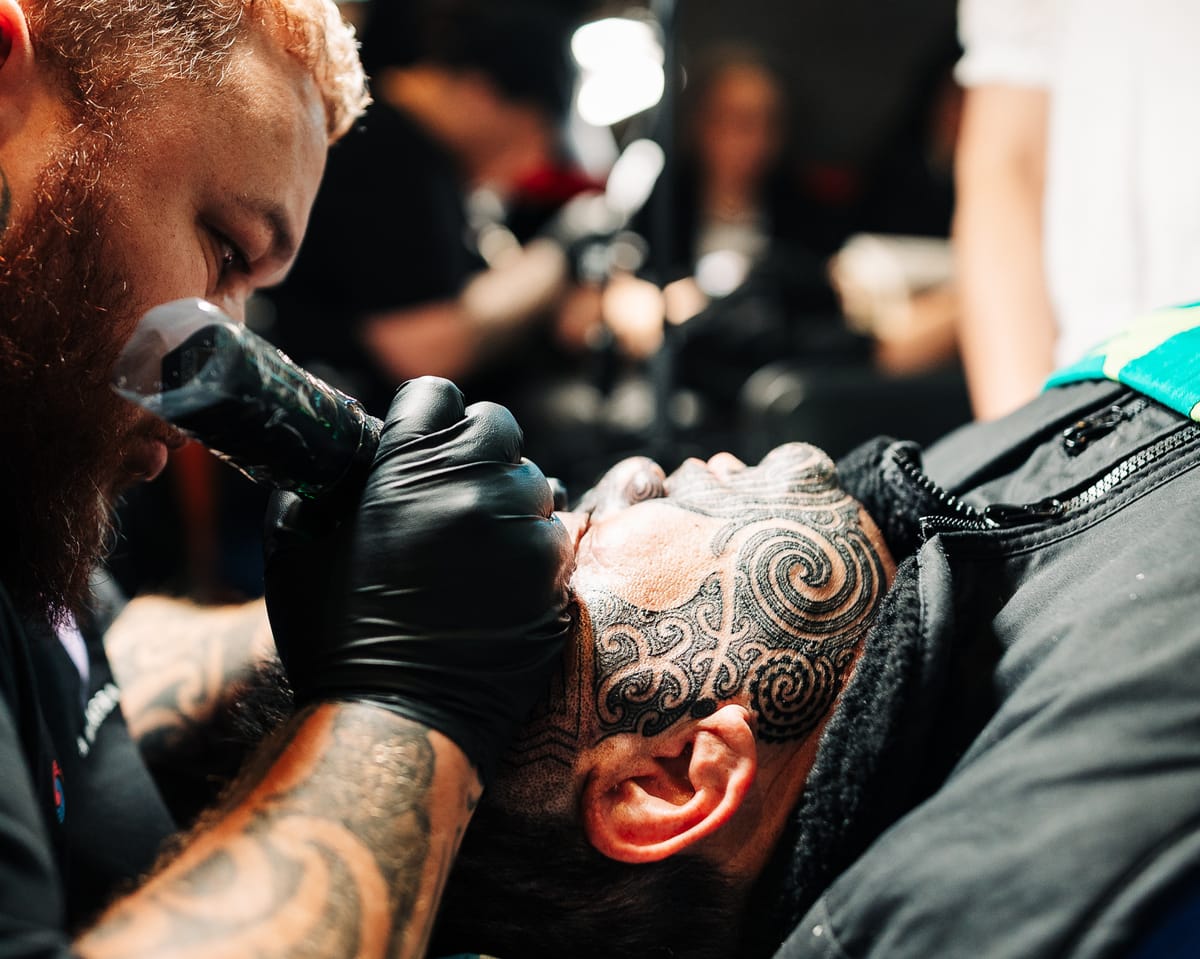
Traditional Māori Tattoo Practice Gains Visibility in New Zealand
At New Zealand’s national museum, skilled Māori tattoo artists carefully mark the faces of eight individuals as an audience observes.
Delicate lines trace the contours of the men’s cheeks, extending toward their jaws and across their foreheads, while patterns curve along the women’s chins—each detail reflecting the wearer’s identity, ancestry, and personal journey. Nearby, family members offer support, singing softly and holding their loved ones’ hands during the solemn, often private ritual.
The artists are creating **tā moko**, a traditional Māori tattoo practice that has grown increasingly prominent in recent years. This month’s public demonstration accompanied new research examining preserved Māori heads, or **toi moko**, to gain deeper understanding of historical tattooing techniques. Over three days, crowds gathered to observe the rare display.
“Our people have embraced moko in great numbers,” says Tamahou Temara of the arts organization Toi Māori Aotearoa. “This wasn’t common two or three decades ago—now it’s widespread.”
While comprehensive data is limited, a 2018 study on Māori well-being indicated around 18% of Māori now wear traditional tattoos, a 3% increase from 2013.
Beyond community adoption, tā moko is gradually entering mainstream spaces. Leaders of Te Pāti Māori, the Māori political party, wear the markings, as did former Labour foreign affairs minister Nanaia Mahuta. In 2022, Oriini Kaipara, now a member of parliament, became the first woman with a moko kauae (chin tattoo) to anchor a major prime-time news program.
Learning from the Past
Recent research into 200 ancient preserved Māori heads, each bearing complex tattoos, has informed contemporary tattooing practices. Due to cultural protocols, the heads remain in a controlled environment at the national museum, Te Papa. Their origins predate European contact, though their exact age is uncertain.
Historically, toi moko served as portraits of loved ones, and in some cases, as war trophies of rival chiefs. They were stored in remote locations like caves and displayed during important events. Some were exchanged between tribes, but trade expanded with settler arrivals, who circulated them globally as artifacts of curiosity.
Years of repatriation efforts have returned many of these heads to New Zealand. Modern tattoo practitioners and Te Papa researchers have studied their markings, uncovering insights into their histories, lineages, and the artistry of traditional tattooing.
Derek Lardelli, a master tattooist present at the event, notes that the research has “influenced how we approach tattooing as artists today.”
Read next

Russian Assault on Buses Near Ukraine Border Results in 30 Deaths
Thirty people have been killed and eighteen injured following an attack by Russia on two passenger buses in Kramatorsk, near the frontline in eastern Ukraine, according to local authorities.
The Donetsk regional prosecutor's office reported that the death toll from the morning attack on the buses had reached

Ethiopia Conducts Drone Strike on Eritrean Forces in Tigray Region
Eritrean forces reportedly crossed into Ethiopia's Tigray region and faced drone attacks from Ethiopian government forces, raising concerns about the potential for a broader regional conflict between the two neighboring countries.
Military vehicles transporting soldiers crossed the southern border of Eritrea into Tigray on Wednesday, reaching Adigrat, approximately

Israel Advances Film Resembling NAZA Documentary
The Israeli government is promoting an online film project designed to counter the findings of the award-winning documentary NAZA, which details Israel’s mass killings of civilians in Gaza. NAZA, directed by Oscar-winning filmmakers Yuval Abraham and Rachel Szor, is currently in cinemas and will be shown in