
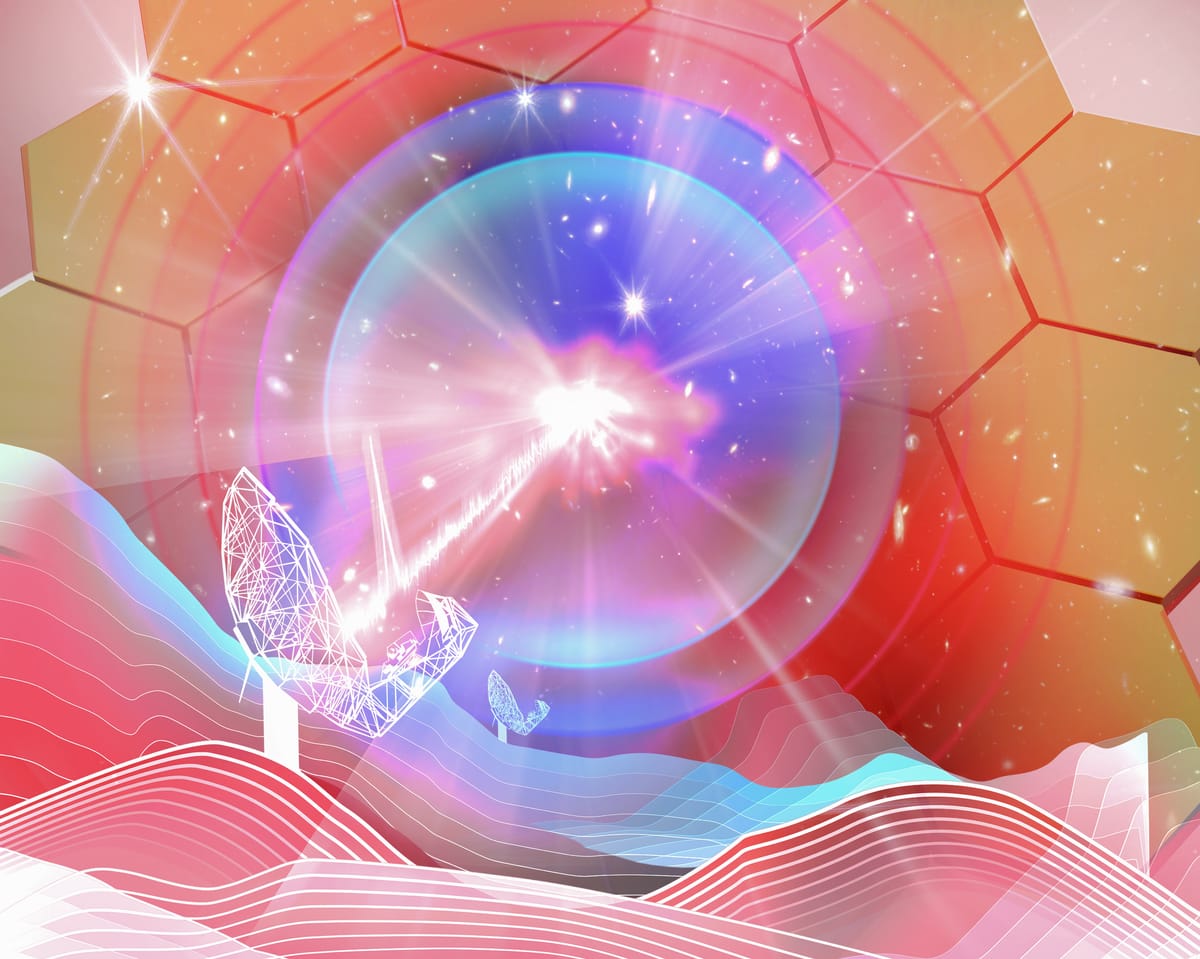
In a distant past within the universe, astronomers have identified a mysterious burst of energy— a flash of radio waves that journeyed over 10 billion years to reach Earth. This event is considered the most distant fast radio burst (FRB) ever recorded, according to recent studies.
FRBs are powerful radio wave bursts that, in mere milliseconds, release as much energy as our sun does over months or years. First detected in 2007, these enigmatic signals have intrigued scientists, with some even speculating about extraterrestrial origins.
A new study published in Science reports the discovery of an FRB originating when the universe was only about 3 billion years old. This means the signal has traversed approximately 80% of cosmic history. The burst, named FRB 20240304B, sets a new record for distance, more than doubling previous records.
Researchers identified this burst using the MeerKAT radio telescope in South Africa and pinpointed its host galaxy with NASA’s James Webb Space Telescope (JWST). Dr. Themiya Nanayakkara of the University of Sydney, a lead researcher, noted that when the burst occurred, Earth and the Sun did not yet exist. Data from JWST suggests the burst came from a young, small galaxy with rapid star formation and low metal content.
Theories about FRB origins include magnetars, neutron stars with intense magnetic fields. Dr. Nanayakkara emphasized the need for any proposed mechanism to explain the bursts' production in young galaxies with minimal metals.
Since 2007, over 10,000 FRBs have been detected. Some repeat continuously, while others stop after a period, and some are one-off events. Whether FRB 20240304B will produce repeated signals is yet to be determined.
Dr. Nanayakkara highlighted the unique aspect of FRBs: their ability to contribute to science without fully understanding their origins. This particular burst has been traveling for 80% of the universe's age, offering potential insights into mapping unseen matter in the distant universe.
Professor Matthew Bailes of Swinburne University, who first discovered FRBs, described the new findings as a testament to FRBs' power in probing the universe. He likened them to a fundamental tool for counting atoms in the cosmos, as FRBs are influenced by the particles they encounter, allowing scientists to measure otherwise invisible matter.
Dr. Sara Webb, also of Swinburne University, noted that FRBs can be used to count matter along their path to Earth. The discovery suggests that FRBs might have been more common in the early universe.
Read next

How meteorologists recreated weather that helped decide the Second World War
Andrew Scott, in a Royal Air Force uniform with a trim moustache, looks queasy – as he might. Behind him stretches a massive Channel map; facing him, Brendan Fraser as General Eisenhower demands: “I need a forecast.”
The film Pressure, adapted from a true story, casts Scott as Group Captain James

Weight-loss drugs fail: Users experience cravings comparable to heroin withdrawal
When Mercedes's doctor informed her in 2024 that she could be prescribed GLP-1 weight loss injections, she broke down emotionally. "When she said yes, I cried in her office. I didn't really stop crying for a week," she recalled.
"Finally, after being
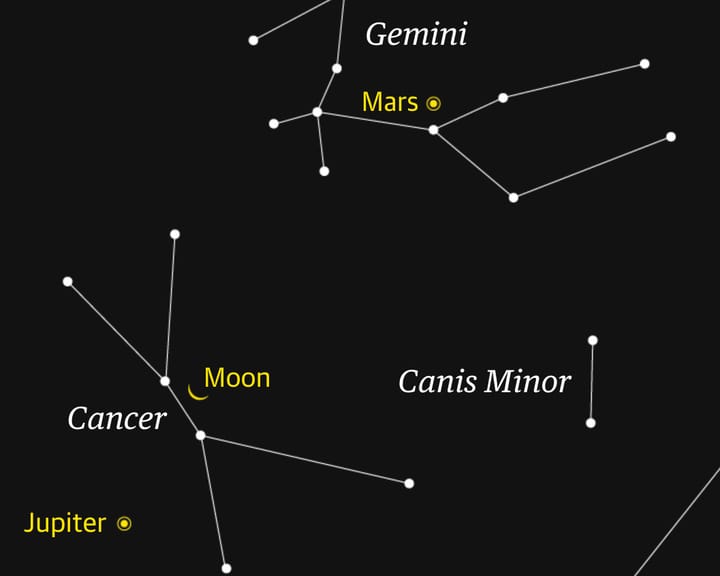
Waning crescent moon pairs closely with bright Jupiter
Early risers at 5am this week will be greeted by a waning crescent moon approaching Jupiter, with Mars visible from a greater distance.
The chart depicts the view looking east from London at 5am on Tuesday. The waning moon will be clearly visible, with roughly 10% of its illuminated surface