
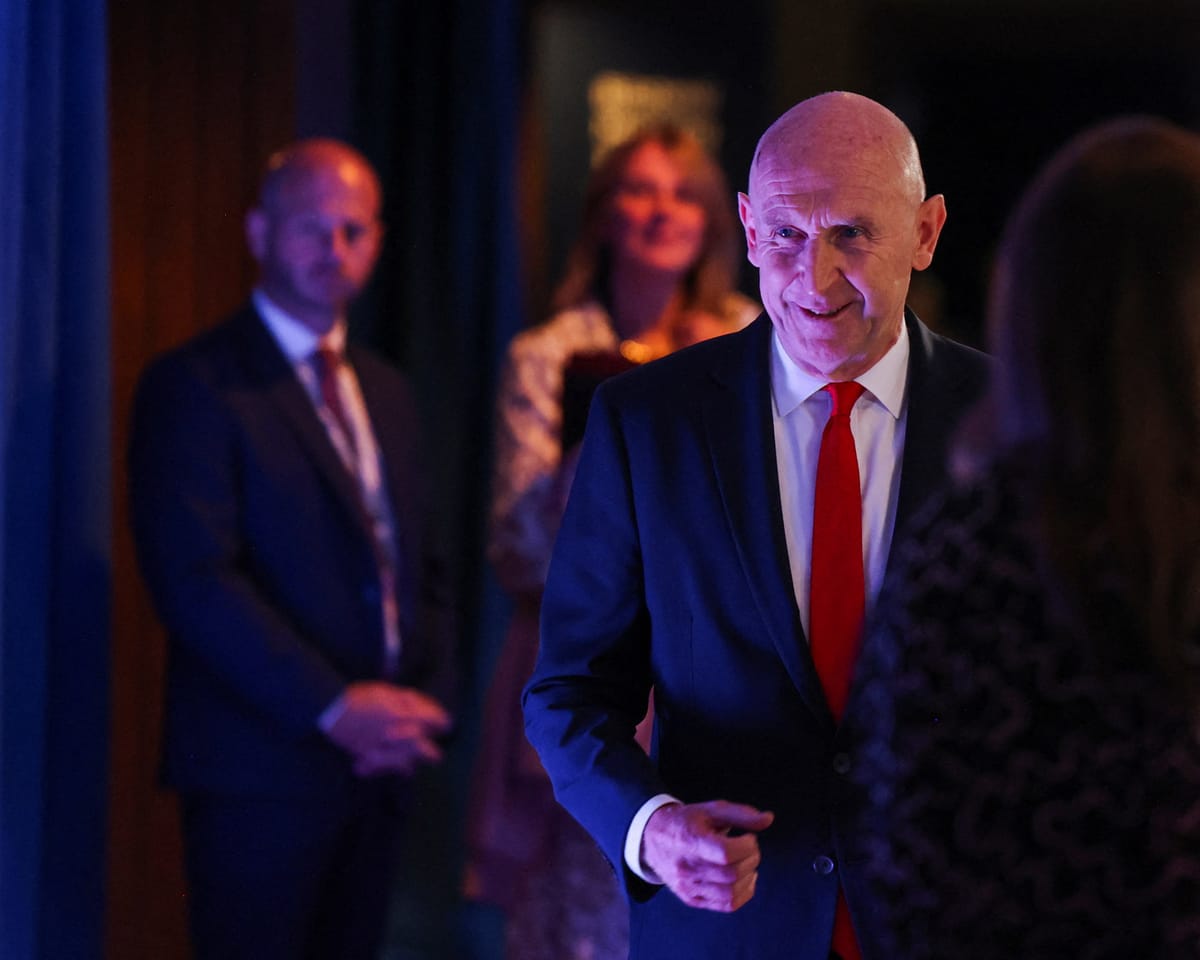
John Healey is expected to state that the government's regional growth strategy will allow the British economy to "turn a corner," despite concerns that turbulent bond markets could complicate Labour's first budget.
The chancellor will likely argue that responsible public spending is inseparable from sustainable growth, particularly given unstable global conditions. This message appears aimed at contrasting with Andy Burnham's more ambitious policy agenda.
Speaking in the West Midlands on Monday, Healey plans to outline measures to strengthen regional economies by streamlining Treasury processes and granting additional authority to local officials to encourage investment, innovation, and workforce development.
However, public finances face strain from elevated global bond yields, which reached an 18-year high last week, increasing government borrowing expenses. This has prompted Healey to signal a difficult budget on 28 October.
Economists forecast that the chancellor, who has called for a "buffer against uncertainty," may need to raise taxes or reduce expenditure to preserve the £24bn fiscal headroom identified by Rachel Reeves the previous year.
"Fiscal credibility is indivisible from good growth," Healey is expected to say. A Treasury representative noted this principle applies "at any time, but especially at a time of global uncertainty," particularly given concerns that conflict in the Middle East could drive up inflation and pressure public finances.
Healey will argue that, despite challenging international conditions, promoting growth in all regions can release "huge latent potential" and demonstrate that Britain is "turning a corner," with citizens and companies prepared to embrace emerging technologies.
The prime minister stated over the weekend that rebuilding infrastructure is essential for a dynamic economy, emphasising the need for affordable energy, dependable transport, and increased investment.
Meanwhile, Jaguar Land Rover, the UK's largest car manufacturer headquartered in the West Midlands, was anticipated to confirm significant job reductions, potentially complicating Labour's reindustrialisation efforts.
At a manufacturing facility on Monday, Healey is expected to stress that economic growth must reach beyond major urban centres.
"The prime minister provided a clear assessment of past failures," he will say. "The solution requires a fundamental shift that begins with distributing power appropriately. The next chapter of Britain's growth story will be written in more places."
He will describe a "dual mission" requiring national government cooperation with the new No 10 North office to eliminate barriers facing local leaders and businesses. "Instead of creating obstacles through complexity and red tape, we need a strong, strategic centre equipped to support local leaders and their ambitions.
"I want to see wealth creation in this country. I want to see businesses make a profit. And to create the conditions for that we need an active, accountable state at all levels to remove blockages and create the conditions for more investment."
Healey will confirm that the British Business Bank will direct £150m toward expanding businesses in northern England, with investments ranging from £5m to £15m supporting university spinouts and other innovative companies.
He will reaffirm the government's dedication to "place-based" growth, building on Reeves's efforts to shift Treasury attention away from the south-east. "Ask an economist what growth is and you'll get a number," he will say. "But ask the country and you'll get a different answer.
"A young person getting a new job in a company that's on the up. A sole trader winning a new contract that pays for a holiday with their kids. A business winning a new export order, giving the community around it a new lease of life."
Businesses are preparing for potential tax increases to address a fiscal shortfall resulting from rising borrowing costs and Burnham's proposed expenditure. In a Financial Times interview on Saturday, Healey declined to dismiss raising levies on bank profits.
Healey has also faced scrutiny regarding defence spending timelines after resigning from Keir Starmer's cabinet over the matter. On Sunday, business secretary Jonathan Reynolds suggested the government would allocate 3% of GDP to defence by 2030.
"We've made some clear movements early on to show that direction of travel … [Healey] has not moved away from the target you've said. He said the fundamental target is the 2035 3.5% of GDP on defence spending that is our Nato commitment. The trajectory to that covers the 3% but that is the principal target," Reynolds stated.
Robert Jenrick, Reform UK's economic spokesperson, said: "Even Rachel Reeves had more vision than this guff. Days after a market meltdown, when grip and direction are required, John Healey has revealed himself to be an empty vessel with no idea about how to rescue our economy."
Andrew Griffith, the new shadow chancellor, characterised Healey's speech as a "policy-light word salad," suggesting it would offer little reassurance to households and businesses concerned about further tax increases or government borrowing rates.
Speaking on the BBC on Sunday, Griffith, who served as a Treasury minister during Liz Truss's controversial mini-budget, acknowledged that statement contained "lots of good things," including tax reductions and deregulation, drawing criticism from Labour.
Read next
Lifelong Friends and Verifiable Facts Must Step Aside for Saving Private Nige
Reform has spent recent days in turmoil following a Channel 4 News exposé suggesting the party was unconcerned about illegally accepting foreign donations. Initially, party representatives dismissed the footage as a fabrication, attributing it to establishment-aligned climate protesters. As scrutiny intensified, internal panic set in. Party figures struggled to

Stone Skimming World Championship returns to Scotland post-cheating scandal with new 'toss master' and focus on mind games
Easdale Hosts World Stone Skimming Championship Amid Fierce Wind and Tough Conditions
As he waited for the ferry, 2025 men’s champion Jonny Jennings clutched the trophy and asked a passerby: “Want to touch it?” The 38-year-old had travelled from Kentucky to Easdale island off Scotland’s west
Farage acknowledges overseas donation scandal appears concerning, insists Reform UK did not break any laws
Nigel Farage has acknowledged that the overseas donation controversy surrounding Reform UK “looks bad” for his party, but he denied that the party had ever accepted foreign money in breach of electoral law.
When asked by BBC presenter Laura Kuenssberg to categorically deny that foreign funds had been channelled to