

Planes are always urgently sought out when a crisis strikes somewhere in the world. Since the US‑Israel war against Iran started on Saturday, demand has outstripped supply with thousands of people stranded in the Middle East frantically searching for an exit route.
While many rely on governments to send aircraft for evacuation, those with sufficient resources can consider a private jet, which is costlier but faster. Matt Purton, director of aviation services at the UK‑based Air Charter Service, is a contact for some.
Purton arranges flights for private clients and also works with governments, handling requests from bodies such as the UK Home Office and the US government for aircraft to transport migrants or conduct evacuations from unstable states like Libya.
Although his firm does not take every private‑plane request, he notes that the current Middle East conflict has increased activity. “Requests for aircraft are probably up 200‑300 % compared with the usual level for this period,” he says.
The firm does not raise prices arbitrarily, but the imbalance between demand and supply means rates reflect the prevailing market. Government contracts are generally based on a fixed fee agreed in advance.
He cautions that the development of the war could affect operations. “Air corridors are already limited,” Purton said. “If additional routes close, moving aircraft in and out of the region will become harder. The situation remains highly fluid, like arriving after an earthquake with only a dustpan and brush.”
“We receive inquiries from a wide range of people – stranded honeymooners in Dubai, holidaymakers trying to pool resources for a return flight, corporate groups and private individuals. Conflict does not discriminate between millionaires and billionaires,” he said.
He estimates that at least half a million people are currently unable to leave the area. At the same time, many aircraft and crews are not positioned to reach the Middle East and transport passengers.
“European governments should coordinate on this. Establishing an air bridge through a location such as Oman could accelerate evacuations, moving people from Muscat or Fujairah International Airport to hubs like Larnaca or Malta,” he suggested.
While the company normally charters whole aircraft, it sometimes offers individual seats, a measure taken to help evacuate those stranded in the region.
An estimated 300,000 Britons are thought to be in the affected parts of the Middle East, and thousands of flights have been cancelled since the joint US‑Israeli operation began.
Read next

Live Middle East crisis: Iran promises retaliation for security chief's death; Israel hints at imminent strike on Beirut
Iran’s armed forces pledged retaliation for the death of security chief Ali Larijani in an Israeli strike, with the army commander warning of a “decisive and regrettable” response.
Tehran also verified that Basij commander Gholamreza Soleimani was killed, after Israel had earlier asserted that its forces carried out the

‘Almost human’: life-size replicas of the dead aid broken hearts in India
In northern Kolkata, close to Dum Dum Junction, Subimal Das and a team of about 80 operate out of an aging factory‑warehouse. With clay, fiberglass and silicone they produce life‑size copies of religious deities, cultural personalities, cricketers and film actors.
The workshop also offers a growing service: bespoke
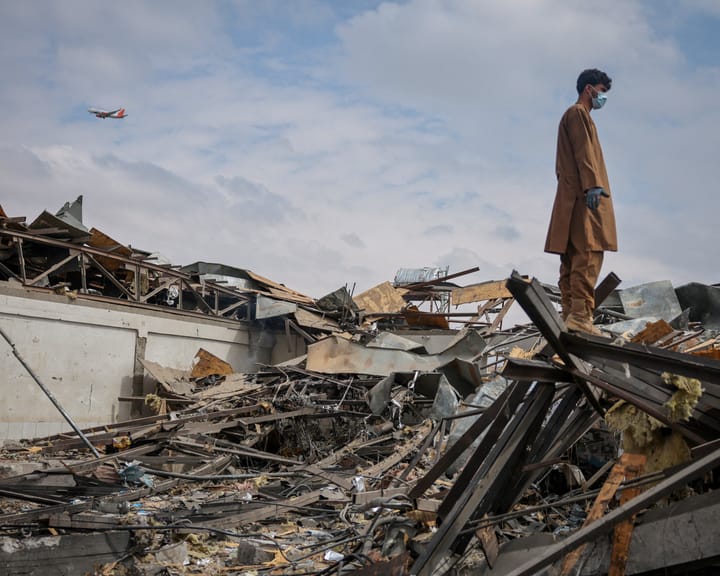
Witnesses say “Everything and people were burning” after strike on Kabul drug rehab centre.
Eyewitnesses and survivors have recounted the dreadful aftermath of a Pakistani air strike that struck a drug‑rehabilitation centre in Kabul, leaving more than 400 people dead, many of whom burned in their beds or were crushed as the structure collapsed.
Afghan rescue teams continued to pull bodies from the