
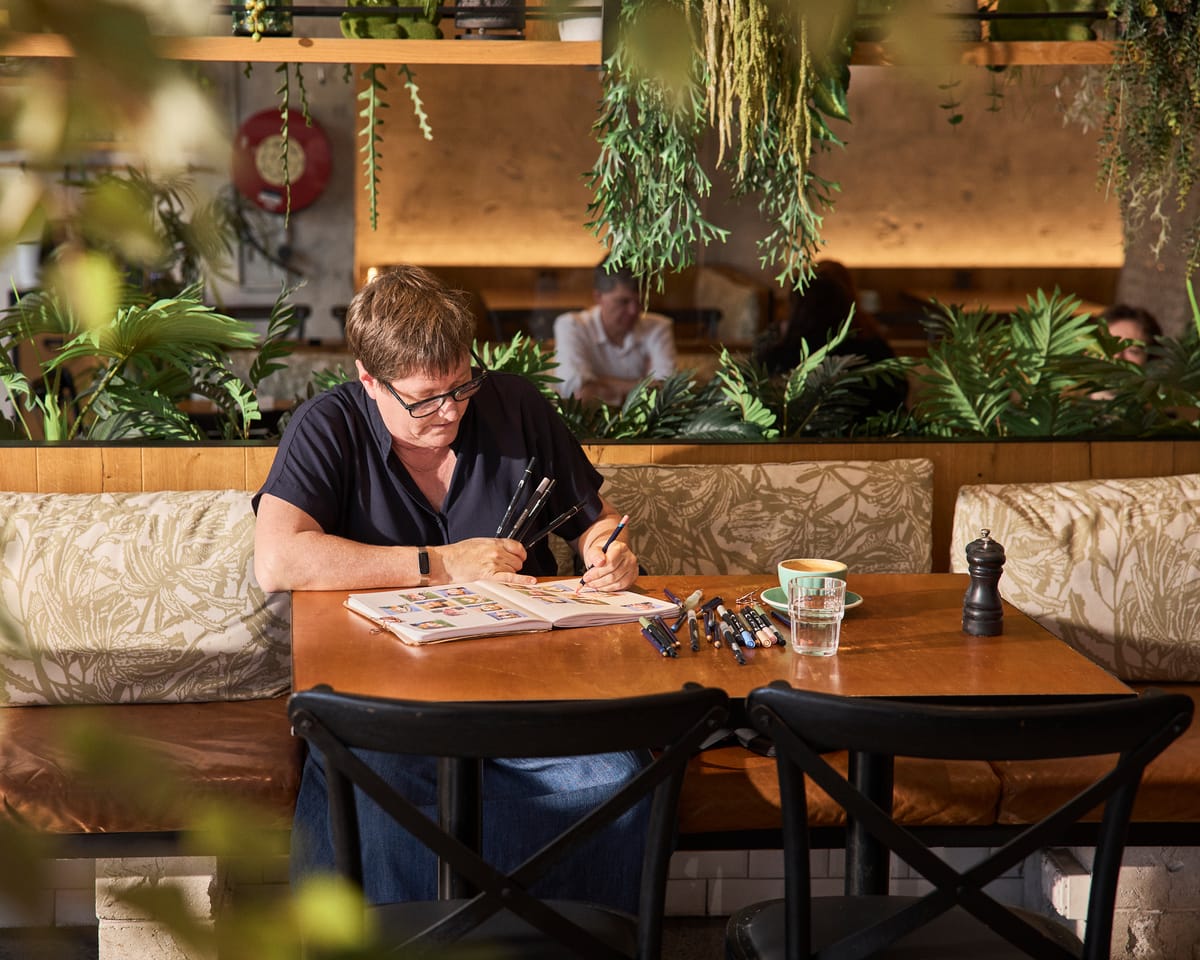
If fortune smiles, you might catch Liz Steel tucked into a sun‑spotted Sydney café, water‑soluble pencils and markers at the ready. Thousands of kilometres away, Marc Taro Holmes follows his sketchbook onto the thawing streets of Montreal, “like a bear emerging from hibernation”.
The pair are co‑founders of the #OneWeek100People challenge, an informal worldwide effort that invites artists to draw 100 people in seven days. Now in its tenth year, the challenge ran this week, but Steel and Holmes stress it is purely for pleasure, and anyone may join and use the hashtag whenever they wish.
The two met at the International Urban Sketchers Symposium in Lisbon in 2011 (this year’s gathering will be in Toulouse in July) and launched the challenge to stay in touch. Since then it has become a staple of the Urban Sketchers community, with hundreds participating across the globe.
“Liz and I began the challenge as an excuse to keep drawing together,” Holmes explains. “Honestly, this event is my free pass to devote an entire week to drawing.”
Steel admits drawing people was not always her strength, but “it’s no exaggeration to say that sketching the world around me reshaped my life and career” – trained as an architect, she now teaches art, as does Holmes.
He first set himself the task of drawing 20 people a day for a week. Together they turned that personal trial into a global invitation.
The target of 100 is deliberately lofty. Holmes says high goals push artists to draw without self‑criticism.
“Quantity is the only aim, not quality,” he notes. “Quietly, that’s the most effective way to improve.”
There is a “special kind of magic” in the momentum, Steel adds. “It’s about practice rather than perfection.”
‘My motivation to live a good life’
Quincy Nadel sits in a Chicago park while her children play.
Seizing a quiet moment, she begins to sketch – noting a pair deep in conversation, a parent shouldering a weary child, the stance of someone waiting alone.
“There is a deep, quiet beauty in the way strangers engage with the world,” she observes.
The week‑long challenge serves as “exposure therapy” for her perfectionism, she says, after teaching herself to sketch in her thirties.
“I was digitally exhausted,” she admits. “Sketching is my ‘permission slip’ to sit and watch the world without the pressure to be productive. My sketchbook has become a record of being ‘here’ instead of ‘online’.”
Nadel shares her progress on Instagram but says the artwork is a side effect of a larger aim.
“It was about rewiring my mind to notice the people who usually drift through my periphery,” she explains.
She finds people‑watching “endlessly fascinating if you slow down enough”.
“I enjoy sketching strangers … wherever people naturally gather,” she says.
Rather than chasing a perfect likeness, she prefers simple drawings that capture the small details she sees, each hinting at a tiny story.
Read next

I Credit Iron Maiden for My English A‑Level: The Literature Our Writers Unearthed via Pop Music
Penelope Farmer via the Cure
I first heard the Cure’s “Charlotte Sometimes” as a teenager, and it felt like emerging from a reverie.
The clashing guitars rang out like distant bells while the vague lyrics about getting ready for sleep unearthed a childhood recollection of Penelope Farmer’s eerie
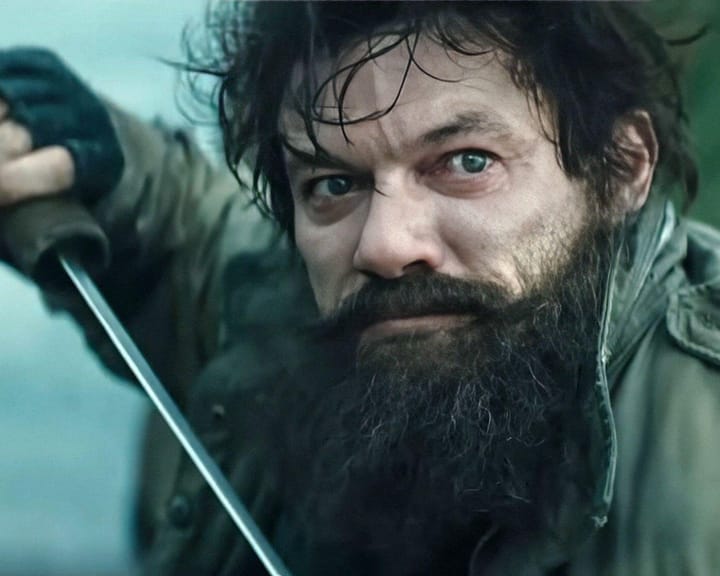
Worldbreaker review – Luke Evans delivers a warm, bear‑hug performance in a thin sci‑fi survival drama
It may be coincidence, but many recent action films now centre on adult men and their daughters—or female stand‑ins—fighting to survive. The men are portrayed as both hardened combatants and protective fathers who train their girls to fight as fiercely as any man, preparing them for a
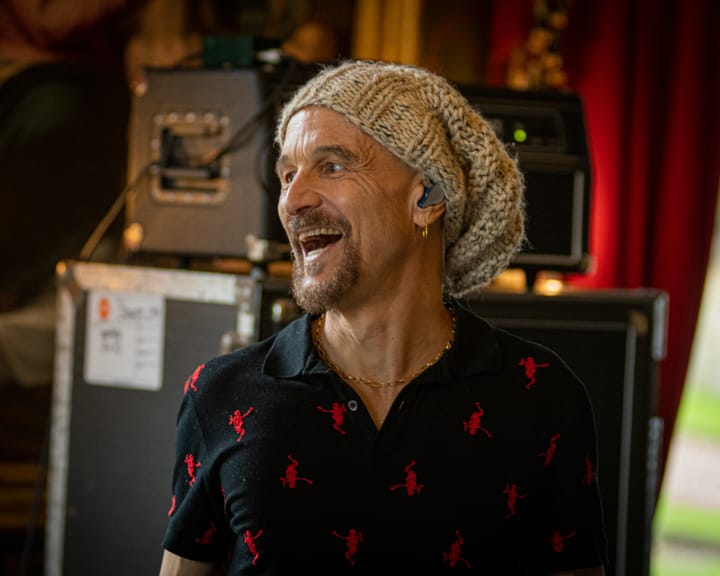
Tim Booth admits he made love to Brian Eno’s music by age 18: his candid playlist
The first song I fell in love with
My older sister, Penny, introduced me to Leonard Cohen’s “So Long, Marianne” when I was eight, as if to mark a rite of passage: “Now you’ve heard a true poet.” The track felt like contraband, starkly different from the pop