
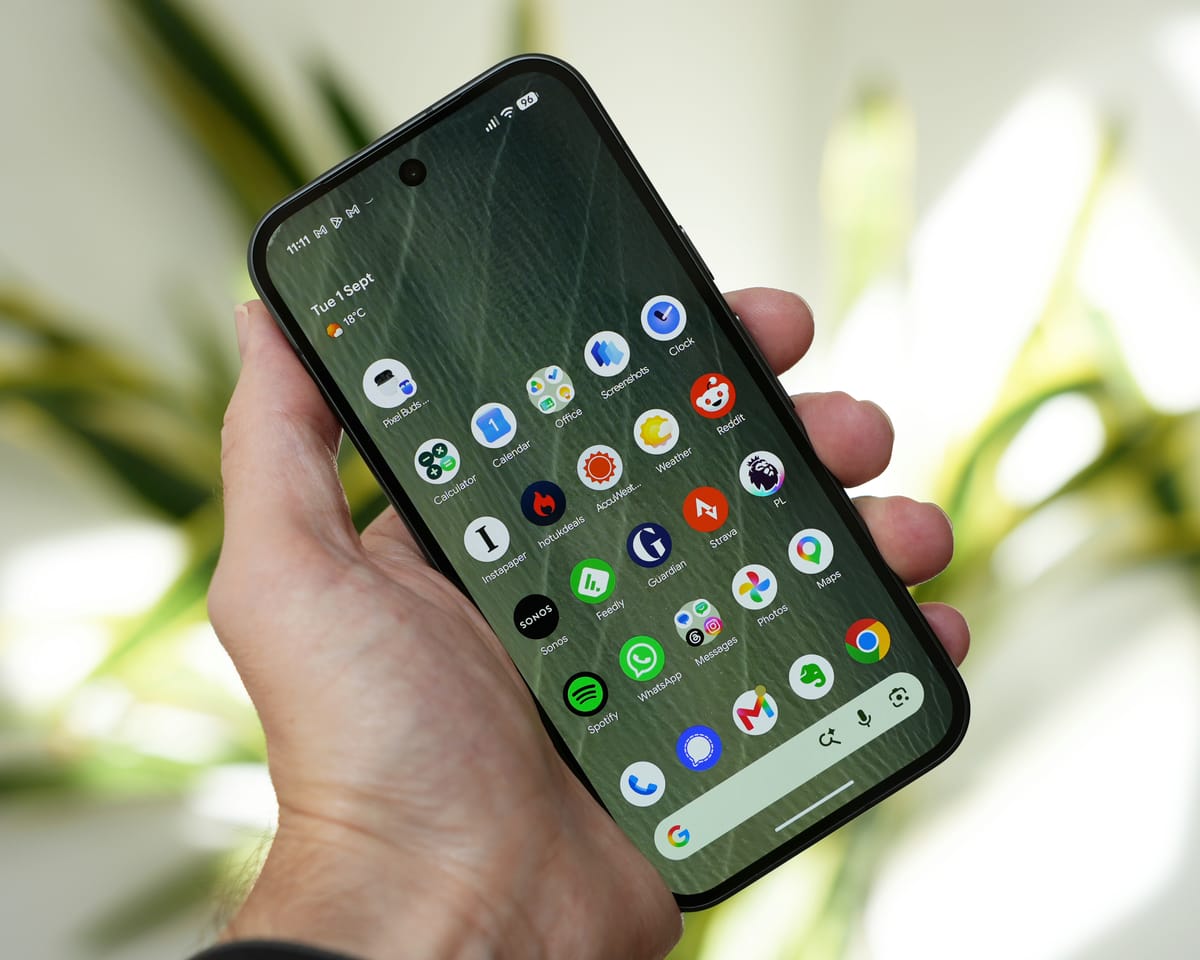
Google’s Pixel 11 continues to define what a base flagship phone should deliver, with leading cameras, extended software support and nearly all the features of its pricier siblings.
The standard Pixel 11 is priced at £879 (€999/$899/A$1,499), £80 higher than its previous version, reflecting ongoing memory cost increases. Despite the elevated price, it includes 256GB of storage and sits £200 below the Pixel 11 Pro, on par with Samsung’s Galaxy S26.
Visually, the Pixel 11 closely resembles Google’s last two phone generations, featuring glass front and back panels, flat aluminium edges and a slimmed-down pill-shaped camera bar on the rear. With a case fitted, the camera protrusion becomes barely noticeable.
The 6.3-inch OLED display delivers sharp visuals and high brightness, with a 120Hz refresh rate for fluid scrolling. The under-display fingerprint sensor is quick and precise, while the camera-driven facial recognition performs reliably in daylight and meets banking app security standards, unlike most Android competitors.
Specifications
Screen: 6.3in 120Hz FHD+ OLED (422ppi)
Processor: Google Tensor G6
RAM: 12GB
Storage: 256 or 512GB
Operating system: Android 17
Camera: 48MP+ 13MP UW + 10.8MP 5x tele; 10.5MP selfie
Connectivity: 5G, eSIM, wifi 6E, UWB, NFC, Bluetooth 6 and GNSS
Water resistance: IP68 (1.5m for 30 minutes)
Dimensions: 152.8 x 72.0 x 8.6mm
Weight: 197g
Tensor G6 processor
The Pixel 11 incorporates Google’s new Tensor G6 chip, offering up to 20% improved performance in benchmarks. While it trails behind top processors from Qualcomm and Apple in raw power, it remains responsive for everyday tasks and handles moderate gaming adequately.
Battery life has also improved, reaching roughly 54 hours under light usage. This includes over seven hours of active screen time for messaging, browsing, photography and apps across mixed 5G and wifi connections.
Heavier gaming and demanding applications drain the battery faster, though the device still lasts through the most intensive usage days.
Android 17 with enhanced AI
The Pixel 11 ships with Android 17 and receives operating system and security updates through August 2033.
The operating system is polished, smooth and well-optimised, offering extensive customisation options. As with prior Pixels, it serves as a platform for many of Google’s AI capabilities, with numerous features running directly on the device for faster response.
Google’s proactive AI systems stand out, though features vary by region. In the UK, Magic Cue appears in messages and select apps with details such as schedules, flight information or order updates, plus recommendations from Google Maps or Photos. In the US, Canada, Australia and select other markets, the equivalent tool is called Gemini Proactive Assistance with comparable functions. Within supported apps like Google Messages, the suggestions prove genuinely useful. The feature does not extend to WhatsApp, Signal or other third-party apps tested, restricting its broader application.
In the UK and US, Gemini can take actions independently, such as booking restaurants through OpenTable, demonstrating the type of assistance AI agents have long promised.
Another practical AI tool is Rambler, integrated into Google’s keyboard, offering advanced voice typing. It transcribes natural speech while removing filler words to generate clear sentences or paragraphs. This simplifies dictation while moving, though text only appears after stopping the recording.
Camera
The Pixel 11 includes three rear cameras and a 10.5-megapixel front-facing camera.
The upgraded 48MP main camera produces strong images across lighting conditions, with a larger sensor improving low-light performance. The 13MP ultra-wide lens ranks among the best in its category, useful for broader scenes or alternate perspectives. The 10.8MP 5x telephoto camera distinguishes it from rivals, effectively closing the distance to subjects. In good lighting, it reaches 30x digital magnification with acceptable quality.
A new addition this year is the “Looks” feature, letting users customise image capture and processing for varied styles beyond basic post-capture filters.
Three default looks – natural, vanilla and shadows – are joined by six distinctive options, including “digi”, which emulates the appearance of older digital cameras. Each look is adjustable in colour, tone, grain and sharpness, enabling artistic or film-style results.
Users who found previous Pixel photos too cold or heavily processed will find this feature particularly relevant.
The Pixel records solid 4K video at 60 frames per second. Magic Capture, a new one-button mode, automatically captures both photos and video, suited to events like birthdays where users prefer to remain present while still recording.
Google has also introduced Creator Suite mode for video, recording directly to a folder for quick storyboarding and trimming. Additional features include a teleprompter mode for face-to-camera recording, a social media alignment grid and speech enhancement that reduces background noise.
These join existing features like Auto Best Take, Add Me and Camera Coach, positioning the Pixel camera among the most versatile available.
Sustainability
The battery maintains at least 80% capacity beyond 1,000 full charge cycles. Google, third-party shops or self-repair options are available, with manuals and parts accessible.
The Pixel 11 contains 33% recycled materials by weight. Google details the device’s environmental impact in its report and offers free recycling for old devices.
Price
The Google Pixel 11 starts at £879 (€999/$899/A$1,499) in four colours.
For comparison, the Pixel 10a costs £499, the Pixel 11 Pro costs £1,079, the Pixel 11 Pro XL costs £1,279, the Pixel 11 Pro Fold starts at £1,799, the Samsung Galaxy S26 costs £879 and the Apple iPhone 17 costs £799.
Verdict
The Pixel 11 is neither Google’s most advanced phone nor the least expensive. This mid-tier model delivers sufficient capability to surpass competitors and question the necessity of upgrading to a Pro device.
It provides a high-quality experience, a strong triple camera system, extended software support and solid battery life. While it does not lead in raw performance, making it unsuitable for dedicated gaming, it remains quick and responsive for daily use.
Google’s AI tools, particularly Rambler dictation and proactive Gemini features, provide practical assistance, even where third-party app integration remains limited.
The new camera Looks feature offers unprecedented control over photography on a Pixel, allowing for personalised or creative results beyond simple filters.
While the changes from last year’s Pixel 10 are modest and the Pixel 10a offers better value, the Pixel 11 remains the strongest phone available under £900.
Pros: seven years of software updates, strong camera with 5x telephoto, excellent screen, capable on-device AI features, Qi2.2 wireless charging and magnetic accessory support, extended battery life, compact size, fast fingerprint and face recognition, 256GB base storage.
Cons: face unlock less secure than Face ID, raw performance trails competitors, no physical SIM slot in the US, heavier than rivals, limited upgrade from previous model, lacks wifi 7.
Read next

AI Expert Father of Three Shares Essential Insights for Parents on Artificial Intelligence
A father once promised his child they would write a story together called "The Day Nobody Went to Disneyland." The plot imagined a perfect day when the entire world avoided the park, expecting crowds, leaving it completely empty for a father and child to enjoy alone. Three decades

AI: Are Warnings of Uncontrollable Artificial Intelligence Becoming Reality? "We're plausibly close to crossing the line"
Imagine humanity in a boat being swept down a raging river, hoping there is no Niagara Falls ahead. Or picture standing with the pioneering physicists in 1942 before they triggered the first self-sustaining nuclear fission chain reaction beneath a Chicago stadium.
These were two of the analogies used this

Mark Zuckerberg Should Step Down From Meta Now, Argues Joan Donovan
Last week, Meta, the parent company of Instagram and Facebook, agreed to a settlement of up to $18bn after dozens of US states accused it of harming children with addictive products. The settlement’s regulatory implications for social media will affect every user, far beyond teens.
But if Meta is