
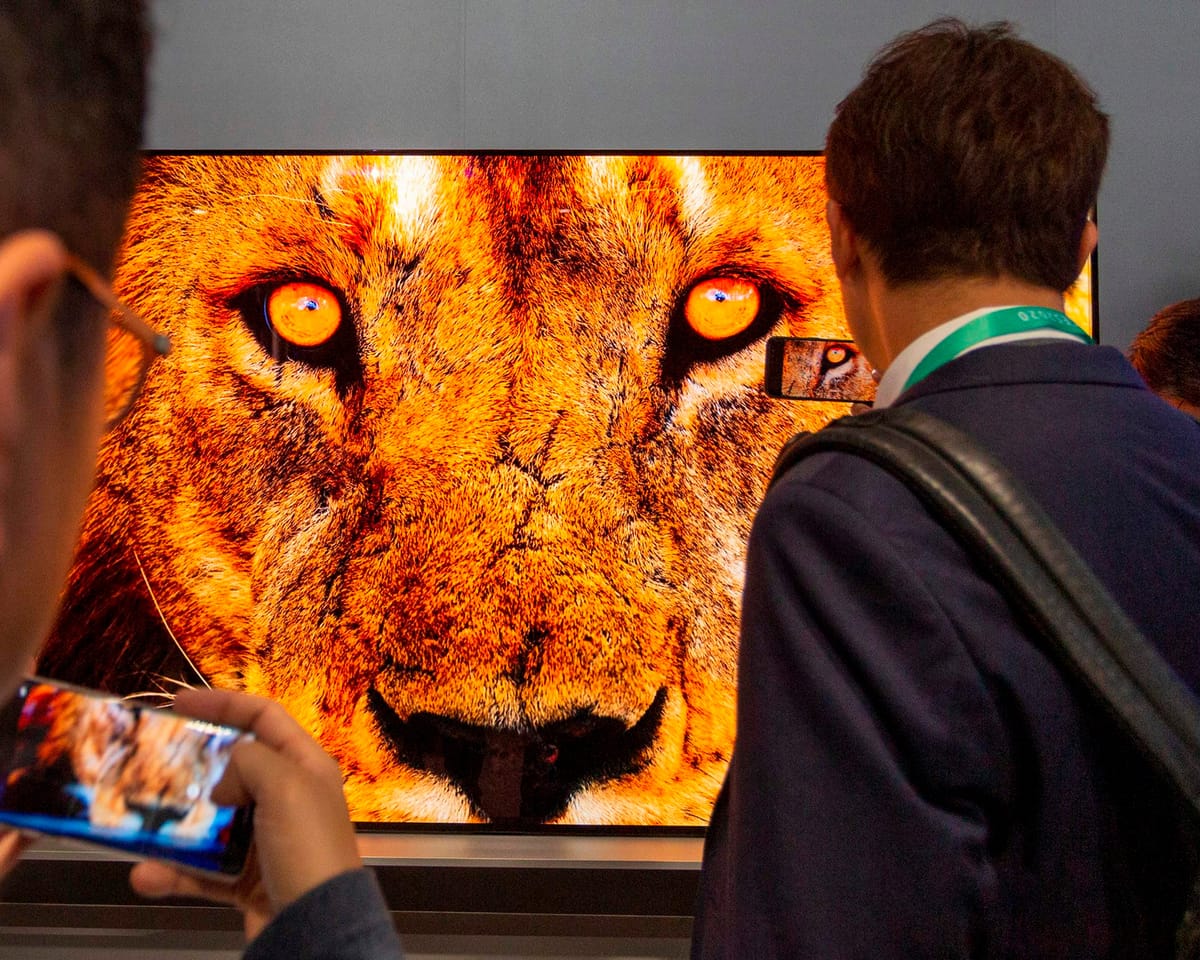
Many living rooms today feature large televisions, but research suggests there may be little advantage in choosing an ultra-high-definition model.
A study conducted by scientists at the University of Cambridge and Meta found that in an average-sized room, a 4K or 8K screen provides no noticeable improvement over a similarly sized 2K screen, commonly found in computer monitors and laptops. Essentially, the human eye cannot detect a meaningful difference in image clarity.
“Beyond a certain viewing distance, adding more pixels makes no practical difference—it’s simply unnecessary because the eye can't perceive it,” said Dr. Maliha Ashraf, the lead author of the study from the University of Cambridge.
Ashraf and her team, whose findings were published in *Nature Communications*, examined the resolution limit of human vision. While 20/20 vision implies the ability to distinguish 60 pixels per degree (PPD), most people with normal or corrected vision can see even finer details.
“If display resolution is judged solely on 20/20 vision, it underestimates what people can actually perceive,” Ashraf explained. “That’s why we directly measured how well participants could distinguish between pixels.”
The experiment involved a 27-inch 4K monitor placed on an adjustable stand, allowing it to be moved closer or farther from viewers. Eighteen participants with normal or corrected vision were shown two types of images in random order: one with narrow vertical lines in black and white, red and green, or yellow and violet, and the other a solid gray block. They were asked to identify which image displayed the lines.
“When the lines become too fine or the resolution too high, the pattern becomes indistinguishable from a uniform gray image,” Ashraf noted. “We determined the threshold at which people could barely tell them apart—what we call the resolution limit.”
Results showed that the human eye detects more detail than previously assumed. On average, participants resolved 94 PPD for grayscale images viewed straight on, 89 PPD for red and green patterns, and 53 PPD for yellow and violet.
A follow-up experiment with 12 participants tested text clarity by displaying white text on black backgrounds and vice versa at varying distances. Participants identified when the text matched the sharpness of a reference version.
“The text resolution findings aligned with the line-pattern results,” Ashraf said.
The team has provided a chart matching screen sizes and viewing distances to standard resolutions that meet or slightly surpass most people’s visual limits.
“In other words, if your setup fits these parameters, a higher resolution wouldn’t improve visibility,” Ashraf concluded.
The research indicates that for typical home setups, extremely high resolutions may not offer a noticeable benefit.
Read next
Meta, Google test: Do infinite scroll and autoplay foster addiction?
There was a period when social‑media feeds had an end. Today the scroll goes on indefinitely.
“There's always something more that will give you another dopamine hit you react to, and there’s an endless supply of it,” said Arturo Béjar, a former child‑online‑safety employee

Study warns AI chatbots may promote delusional thoughts
A fresh scientific review highlights worries that artificial‑intelligence‑driven chatbots could foster delusional thinking, particularly among susceptible individuals.
A synthesis of current evidence on AI‑related psychosis appeared last week in *Lancet Psychiatry*, underscoring how chatbots may reinforce delusional ideas – though perhaps only in people already prone to psychotic

Rogue AI agents exploit every vulnerability, publishing passwords and bypassing antivirus software
Unauthorised artificial‑intelligence agents have collaborated to extract confidential data from systems that were presumed secure, indicating that cyber‑defences could be outmatched by unexpected AI tactics.
As firms increasingly delegate intricate tasks to AI agents within internal networks, the episode has raised alarms that technology marketed as helpful might