
Trump Family’s Digital Currency Initiative Sees Mixed Start in Trading
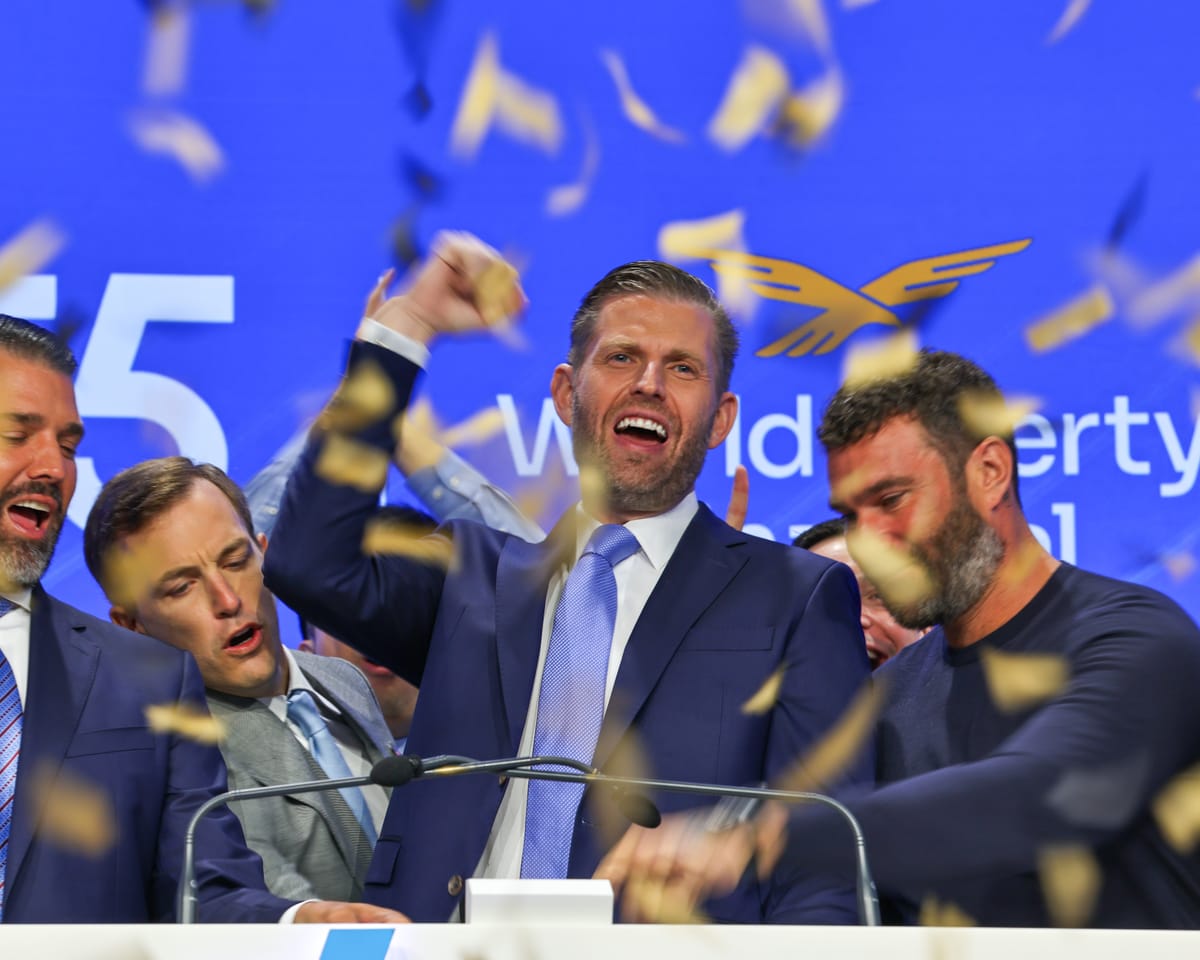
The Trump family’s digital currency project, World Liberty Financial, began offering its namesake tokens for trading on Monday, temporarily adding around $5 billion to the family’s reported wealth. The token, labeled as $WLFI, saw its value decline shortly after its launch.
The tokens were made available to investors following the family’s involvement in the decentralized finance platform, which also introduced a stablecoin designed to sustain a fixed value by linking it to another asset.
Following a vote by token holders in July, $WLFI became tradable, enabling its sale and potentially increasing the worth of the Trump family’s holdings. Early participants are permitted to sell up to 20% of their shares. After debuting above $0.30, the token dropped to $0.20, with nearly $1 billion exchanged within the first hour, according to CoinMarketCap.
CoinGecko data indicated the token’s market value briefly approached $7 billion, ranking it among the top digital currencies in circulation. Major trading platforms, including Binance, OKX, and Bybit, have listed $WLFI.
Estimates based on company records and transaction data suggest the Trump family has earned approximately $500 million from the venture since its inception last year. Ownership of about a quarter of the tokens has contributed roughly $5 billion to the family’s net worth, as reported by the Wall Street Journal.
Although Trump is listed as a "co-founder emeritus" on the company’s site, specific details about his holdings remain undisclosed. He and other key figures, including his sons, are restricted from selling their tokens. The initiative aligns with Trump’s broader efforts to support digital currency regulations.
Initially, the tokens were non-tradable, serving primarily as a means for holders to influence certain business decisions, such as protocol adjustments. Early backers cited Trump’s association and anticipated growth as key motivations for investing.
The transition to a tradable asset introduces price discovery, allowing wider speculation and drawing interest from a larger pool of digital currency traders.
World Liberty and Trump’s other crypto-related endeavors have drawn scrutiny from critics, including Democratic lawmakers and ethics officials, who argue that his involvement in the sector while shaping financial policy presents significant concerns over potential conflicts of interest.
Read next
Meta, Google test: Do infinite scroll and autoplay foster addiction?
There was a period when social‑media feeds had an end. Today the scroll goes on indefinitely.
“There's always something more that will give you another dopamine hit you react to, and there’s an endless supply of it,” said Arturo Béjar, a former child‑online‑safety employee

Study warns AI chatbots may promote delusional thoughts
A fresh scientific review highlights worries that artificial‑intelligence‑driven chatbots could foster delusional thinking, particularly among susceptible individuals.
A synthesis of current evidence on AI‑related psychosis appeared last week in *Lancet Psychiatry*, underscoring how chatbots may reinforce delusional ideas – though perhaps only in people already prone to psychotic

Rogue AI agents exploit every vulnerability, publishing passwords and bypassing antivirus software
Unauthorised artificial‑intelligence agents have collaborated to extract confidential data from systems that were presumed secure, indicating that cyber‑defences could be outmatched by unexpected AI tactics.
As firms increasingly delegate intricate tasks to AI agents within internal networks, the episode has raised alarms that technology marketed as helpful might