

The International Monetary Fund (IMF) has expressed concerns about potential instability in global financial markets due to the threat of an AI-related stock price decline. According to its latest Global Financial Stability Report, the IMF cites high valuations and increasing debt levels among AI companies as contributing factors to heightened systemic risks.
The IMF warns that an AI market correction could have worldwide repercussions. While Asian markets might be most vulnerable, investors in the UK and eurozone with US market exposure could also feel the impact. The IMF identifies three major risks to financial stability: an AI downturn, rising government borrowing costs, and the possibility of significant cyber-attacks. These factors could act as catalysts for a sudden tightening of financial conditions and market unrest.
The report highlights the interconnectedness of large AI firms and the significant borrowing being used to fund investments in the sector. A decline in investment or profitability in AI could lead to a decrease in AI-related asset prices, worsened by increased leverage, concentrated exposures, and circular financing arrangements. This could result in reduced investment, equity market corrections, and tightened financial conditions with global implications.
The report notes that the "magnificent seven" major tech stocks—Alphabet, Amazon, Apple, Meta, Microsoft, Nvidia, and Tesla—now represent over 35% of the S&P 500 index in the US, a substantial increase from 12% a decade ago. Their total market capitalization has grown by more than 50% in the past two years. However, the IMF cautions that the anticipated economic benefits of AI may not be as substantial as expected, suggesting that the massive investments by large "hyperscaler" firms might not be necessary.
Hyperscalers, companies responsible for developing the infrastructure for AI, such as Amazon Web Services, Google, Meta, and Oracle, are highlighted for their growing leverage. This includes increasing debts by the companies themselves, hedge fund investments in the sector, and retail investors borrowing to speculate in AI stocks. In a market downturn, this leverage could lead to forced selling and heightened equity volatility.
The IMF also points to "circular financing" arrangements, where stronger AI companies are linked with weaker partners, potentially worsening the effects of a stock price correction. In recent years, $300 billion in transactions between hyperscalers and weaker AI firms have been conducted, backed by $650 billion in debt, in return for $1.4 trillion in future financial commitments.
Read next

IMF: Global Economy at Risk of Straining Resilience Limits Soon
The International Monetary Fund (IMF) has issued a warning that the global economy may soon approach its resilience limits due to dwindling emergency oil reserves and strained government budgets. In its biannual World Economic Outlook, the IMF noted that global growth has endured the Middle East conflict better than anticipated

Chip Stocks Fall After Broadcom CEO Compares AI Investment to 'Casino'
Shares in semiconductor companies declined on Tuesday following comments from Broadcom's CEO, who likened many AI investors to "casino" gamblers. Additionally, Chinese memory chip manufacturer CXMT announced advancements in new chip architecture.
South Korea's Kospi index dropped 6.25% as investors sold off chip
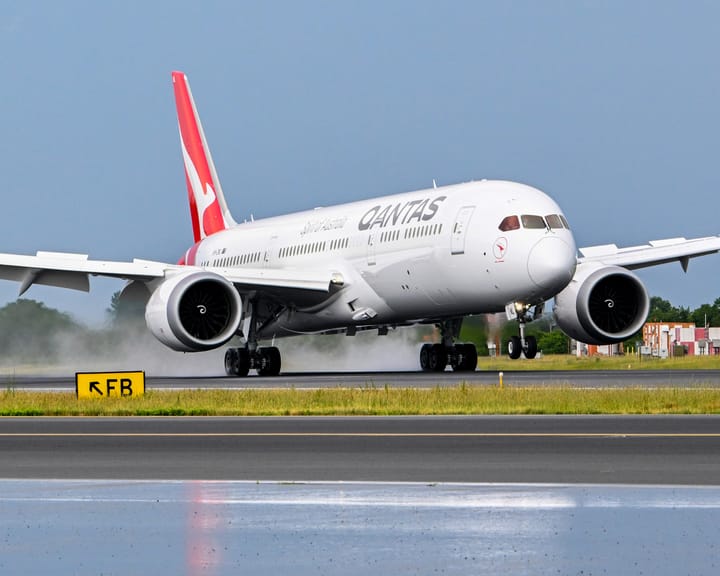
Qantas Grounds Plane in Rome Due to Bedbug Infestation
Qantas had to ground a plane in Rome after discovering bedbugs on the aircraft, which was en route from Perth. The insects were found in the front of the economy section of a Boeing 787 Dreamliner, as it traveled for the QF5 flight on October 9th, according to an informed