
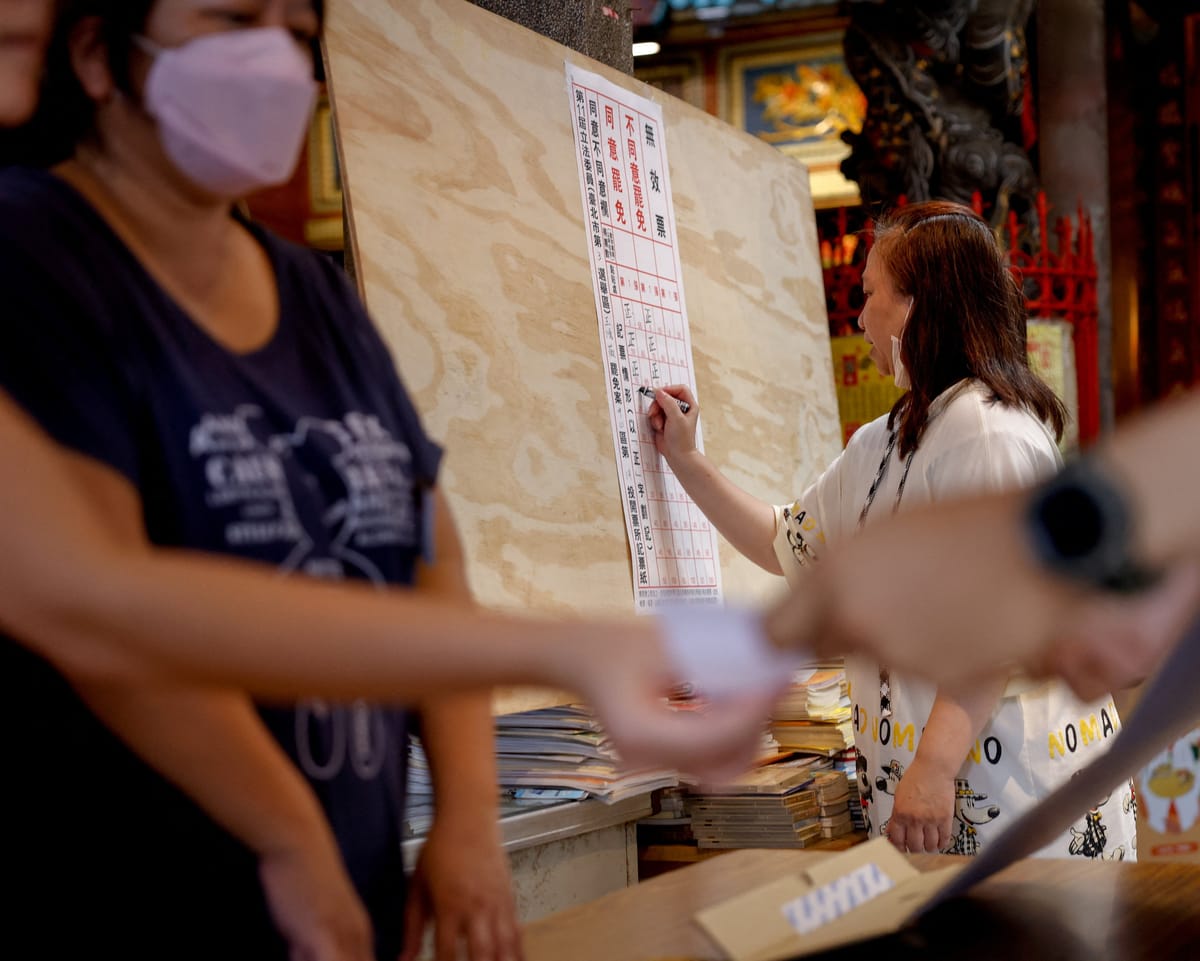
An effort in Taiwan to remove 24 opposition lawmakers aligned with China and secure a parliamentary majority for the ruling party seems to have fallen short, as early results suggest voters across all contested districts rejected the proposal.
Voting began on Saturday for the first 24 of the 31 targeted districts, with citizens deciding whether to recall their local representatives and trigger special elections. Polls closed at 4 p.m. local time, and initial tallies emerged within hours. By 7 p.m., the central election authority reported that all attempts had failed, according to CNA, the official news agency.
Under current regulations, a recall succeeds only if at least 25% of eligible voters support it and votes in favor outnumber those against.
All 24 seats—along with seven others still awaiting recall votes—are held by the opposition Kuomintang (KMT). Since last year's election, the KMT and a smaller ally have held a legislative majority, despite Lai Ching-te of the Democratic Progressive Party (DPP), which advocates for Taiwan’s autonomy, winning the presidency.
The opposition has used its majority to block DPP-backed measures, including defense budgets, delay judicial appointments, and introduce legislation perceived as weakening Taiwan’s security. These moves fueled public protests, giving rise to the recall effort. The KMT’s decisive result on Saturday will likely strengthen their position.
Gaining just six KMT seats would allow Lai and the DPP to advance their agenda, though it could also provoke stronger reactions from China’s government, which labels Lai and his party as separatists for resisting its claims over Taiwan. The legislature has 113 seats in total.
Recall votes in the remaining seven districts will take place in the coming weeks. However, Saturday’s outcome raises the stakes for campaigners seeking to secure six favorable votes.
William Yang, an analyst with the International Crisis Group, noted that the recalls have intensified Taiwan’s political divisions.
“All parties in Taiwan must carefully assess this process and consider how to find common ground on crucial issues affecting Taiwan’s stability and future,” he said.
Yang also questioned whether the DPP’s focus on the perceived Chinese threat in elections remains effective, at least locally.
“China might interpret these results as proof that fewer Taiwanese endorse the warnings promoted by Lai and the DPP, potentially reinforcing Beijing’s belief that peaceful unification is achievable,” he said. “Still, this doesn’t mean China will reduce its military or political pressure on Taiwan.”
The vote has heightened political tensions across the island.
Read next

Marché des Enfants Rouges, Known as Paris' 'Coolest Market,' Ravaged by Fire
A devastating fire has swept through Paris's oldest surviving covered food market, a beloved street food destination in the Marais district. This historical venue, which attracted both locals and tourists daily, dates back to the 17th century.
Ariel Weil, the mayor of central Paris, described the Marché des

German Minister Resigns Following Stepdaughter's Death and Political Criticism
Germany's Labour Minister Bärbel Bas, a co-leader of the Social Democrats (SPD), resigned from her positions, citing the loss of her stepdaughter and subsequent political attacks as her reasons. Her resignation poses a significant challenge to the already fragile coalition government.
Bas, in a Facebook statement, mentioned

Preserving 300-Year-Old Church-Bell Tradition: Lebanon's Sole Family Artisan
The story of Lebanon's sole remaining church-bell maker traces its origins to an unexpected encounter. In the 18th century, Youssef Gabriel, a local metalworker, was involved in covertly crafting and supplying rifles to Arab revolutionaries fighting against the Ottoman rule over Lebanon. One day, a Russian engineer