
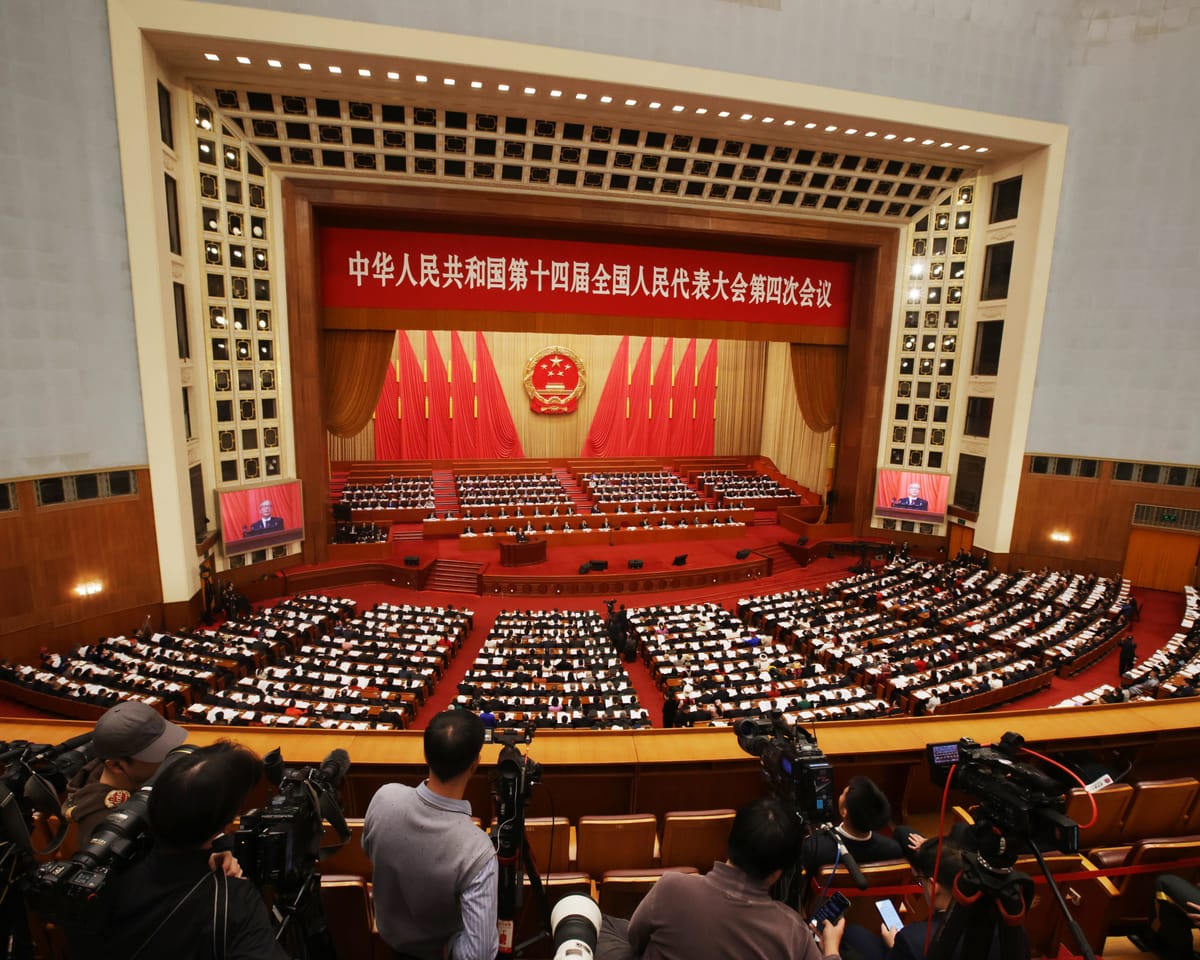
China has lowered its GDP growth goal to a historic 4.5‑5%, marking the first sub‑5% projection since 1991, and signalling a shift from an export‑driven model toward a framework officials believe will better withstand external disturbances.
Premier Li Qiang presented the 2026 target during the opening session of the National People’s Congress (NPC), the country’s yearly parliamentary meeting that commenced on Thursday.
Speaking to almost 3,000 delegates in Beijing’s Great Hall of the People, Li called 2025 a “truly remarkable” year marked by “profound and complex developments both domestically and abroad,” as noted in the government work report.
The NPC will also examine the 15th Five‑Year Plan, the economic and strategic blueprint for 2026‑2030.
The modest GDP goal reflects a move toward what Beijing terms “high‑quality growth,” a model based on high‑tech sectors and structural reforms instead of the traditional reliance on construction and exports.
China also faces downward pressures, including an ageing population, a struggling property market, tepid domestic demand and a slowdown that typically accompanies rising income levels.
“This year is a crucial period for structural reform,” said Dan Wang, China director at Eurasia Group, a political‑risk consultancy. Wang noted that China is using the one‑year US trade truce to pivot its economy away from export‑driven growth, and that the lower target also indicates a “greater tolerance for unemployment.”
Li set a 5.5% ceiling for urban unemployment and vowed to generate over 12 million new urban jobs, figures consistent with prior years. Yet some analysts warn that the emphasis on high‑tech sectors could jeopardise millions of blue‑collar workers.
China and the United States agreed in October to a one‑year pause in their trade dispute, with additional talks slated for this month ahead of a planned visit by President Donald Trump to Beijing on 31 March.
Even though the trade conflict has unsettled global supply chains, especially those linked to China, the nation closed last year with a record $1 trillion trade surplus. Li emphasized that “financial and economic discipline” will be a priority for 2026.
China also aims to strengthen domestic demand, a factor economists deem vital for long‑term stability. An editorial in state media last year argued that consumption should be overseen with the “same rigour” as production, indicating a move away from the historic emphasis on heavy industry to spur growth.
Read next

Tokyo tourist hotspot outlaws short-term rentals amid complaint surge
Shinjuku Ward, Tokyo, has moved to ban short-term rental accommodations in residential areas and near schools and important cultural sites, following a slew of complaints about visitor behaviour. The decision, to be enacted through a local ordinance, marks the latest sign that Japan’s patience with mass tourism is

Canada implements retaliatory US tariffs as trade dispute intensifies
Canada’s retaliatory tariffs on about $20 billion worth of American imports took effect at 12.01am on Tuesday, ranging from 15% to 50% and applying to steel, dairy, appliances, agricultural equipment, pulp and paper, and electronics. The measures, a response to the United States’ 50% tariff on $20 billion

Prosecutor general resigns amid political turmoil in Kyiv during Ukraine war
Ukraine’s prosecutor general Ruslan Kravchenko resigned amid corruption accusations after anti-graft officers searched his offices at the weekend. He called the allegations “completely unsubstantiated” and denied wrongdoing. The National Anti-Corruption Bureau (NABu) and Specialised Anti-Corruption Prosecutor’s Office (Sapo) announced Saturday they uncovered a money-laundering