
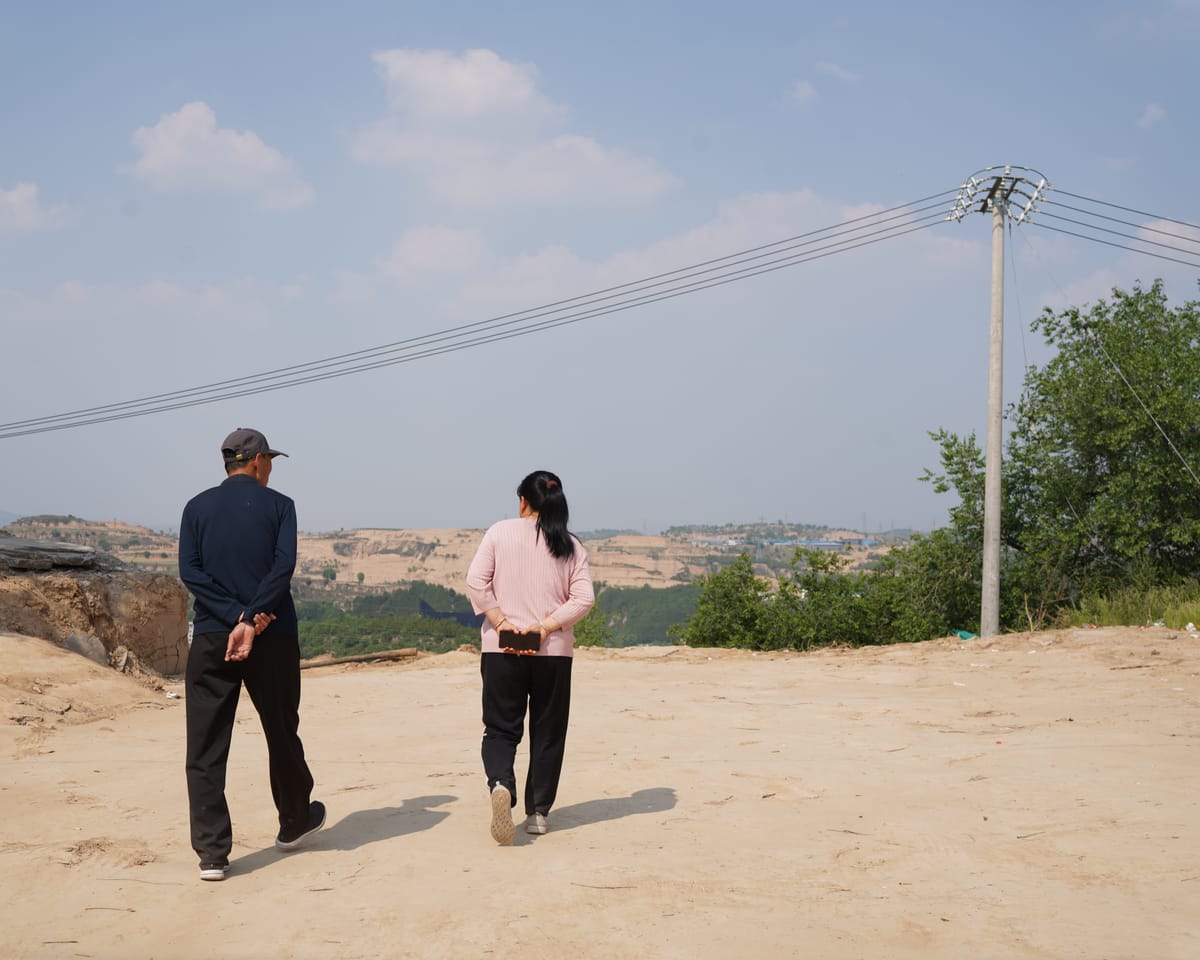
Looking at the ruins of his house, Wang Bingbing stares at an old jujube tree still blooming amid the debris, and the yard where he and his wife once kept pigs, now reduced to broken bricks.
Down in the valley, a vast coal mine is the reason for their displacement: years of excavation increased the danger of landslides, pushing Wang and his family out. To stop them from returning, officials later tore down their home.
"We truly didn’t want to go," says Wang’s wife, Wang Weizhen, with regret.
Wang’s life reflects the era when coal was a thriving, though perilous, industry. His children and grandchildren now confront the uncertainties of coal’s future—an economic and environmental challenge policymakers have not yet resolved.
As China, the world’s leading emitter of greenhouse gases, shifts toward cleaner energy, families like Wang’s risk being left behind in the country’s pursuit of sustainability. They worry about their livelihoods as the nation navigates a difficult balance between coal dependence and green energy goals.
Aged 55 but appearing older, Wang bears the scars of years in the mines. A faint mark above his right eyebrow is a reminder of an accident in his youth that claimed two coworkers’ lives. A decade ago, a liver ailment forced him to stop working entirely. Now, he and his wife rely on a monthly government welfare payment of 500 yuan.
Born in 1971 in Lüliang, a small city in Shanxi—China’s coal-rich region—Wang started working in the local mine at 18. "We were poor, and there were no other jobs," he says. "With little education, I had no choice."
As China moves away from coal, it also faces rising natural disasters, with 25 million people affected in the first half of this year, according to official reports.
Shanxi’s economy depends heavily on coal. From 2018 to 2023, over 10% of the world’s coal came from its dry, silt-filled valleys, as estimated by the Global Energy Monitor.
Yet coal remains a contentious issue in China’s strategy. The country is rapidly expanding renewables—enough wind and solar capacity was added in May to match Poland’s total electricity generation. However, coal still dominates China’s power supply, seen as crucial for energy stability and employment.
Though China leads in producing green technology like solar panels and electric vehicles, it remains the top emitter of greenhouse gases, linked to disasters like the 2021 floods in Shanxi that displaced nearly 2 million people.
Read next

Outrage and Crackdown: Controversial Electoral Changes Ignite Shock and Anger
In recent months, India has seen a rise in public discontent due to various political and administrative actions. Central to the current unrest is the demand for the removal of Chief Election Commissioner Gyanesh Kumar and the annulment of a controversial electoral roll revision that removed 130 million people from

Same-Sex Couple Challenges Slovakia Over Marriage Registration Refusal
In Slovakia, a same-sex couple is challenging the authorities for their refusal to recognize their Austrian marriage, testing whether an EU court ruling can ensure legal recognition at home. Ivan Novotný, 31, and Metod Špaček, 51, married in Austria in 2020, yet their marital status remains unrecognized in Slovakia,

Five Fatalities Reported on Mexico’s Pacific Coast as Hurricane Simon and Tropical Storm Rachel Strike
At least five fatalities have occurred following the impact of Hurricane Simon and Tropical Storm Rachel on Mexico's Pacific coast, resulting in widespread flooding that toppled trees and power lines, obstructed roads, and flooded homes.
Governor Evelyn Salgado reported that a 71-year-old man died in Chilpancingo,