
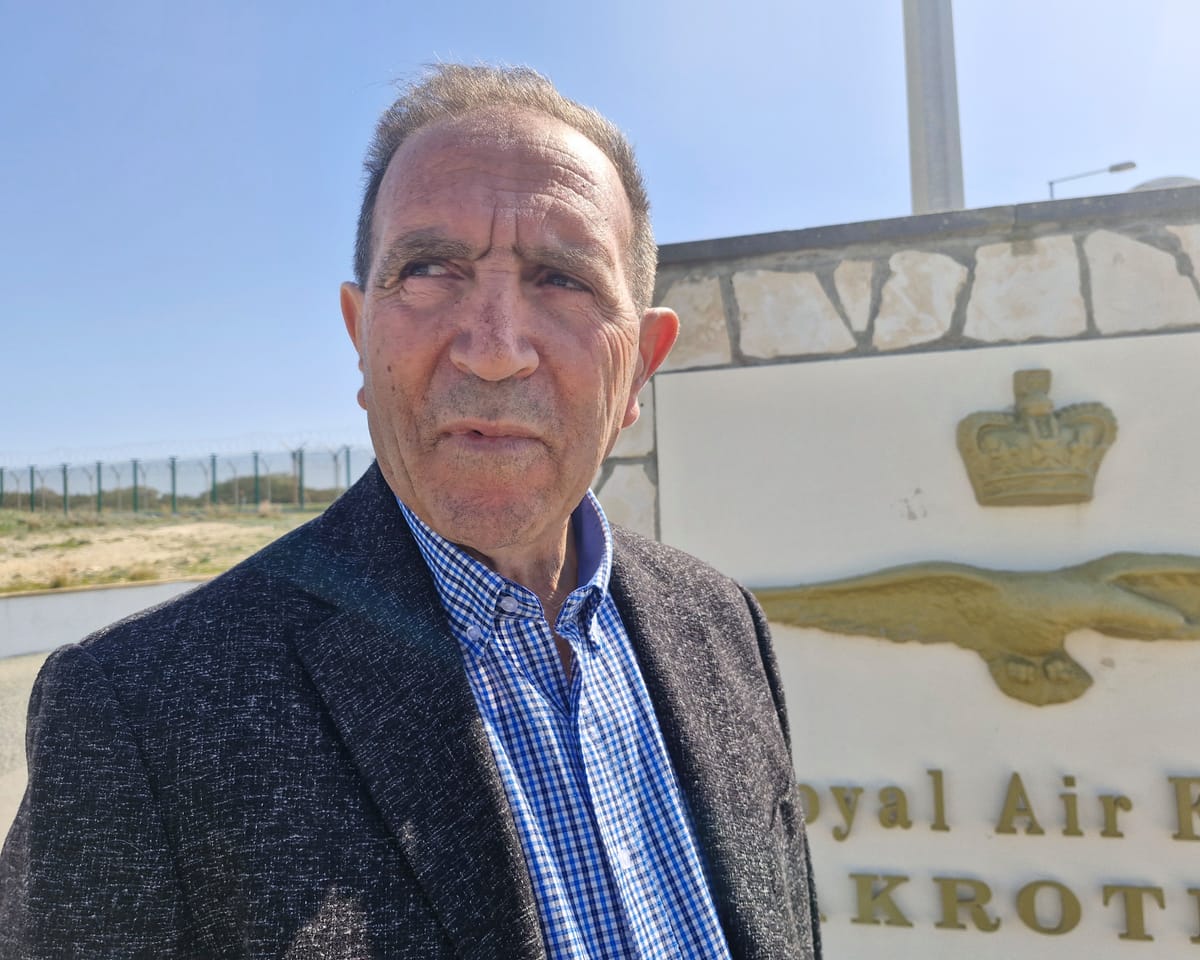
All his life, just as his parents did before him, Giorgos Konstantinos has learned to live beside RAF Akrotiri on Cyprus.
He has endured the roar of aircraft, the constant flow of military vehicles and the routine drills. Yet never before had Konstantinos, the village’s vice‑mayor, seen anything comparable to what unfolded over the last two days.
“We live here, we’re accustomed to all the exercises, we’re used to the planes, but this is something we never imagined,” the retired lawyer said on Tuesday, standing before the main gate of the installation. “Who could have foreseen a drone crossing our sky, detonating beyond that fence and forcing us all to evacuate?”
In an instant, he said, the hazards of residing next to a British base while a conflict raged not far away became starkly tangible. In the early hours of Monday, sirens began to wail after an unmanned, one‑way attack drone slammed into RAF Akrotiri’s runway.
The following day, the settlement of modest villas and houses was virtually empty; police cars were stationed outside its church, its streets lay silent, its school was locked – a clear sign of a government‑ordered evacuation carried out by civil‑defence units.
“There are more than a thousand of us in our community, but today fewer than thirty remain,” Konstantinos said. “Everyone has gone—to hotels, the nearby monastery or relatives in Limassol. People feel unsafe amid such uncertainty. Even the British cannot answer the question everyone here is raising: why, with so many air‑defence systems on that base, was the drone not spotted earlier?”
It is a question an increasing number of Cypriots are posing.
Cyprus, the EU’s easternmost member, lies barely a twenty‑minute flight from Lebanon, from where Cypriot officials believe the Shia militia Hezbollah launched the Shahed‑type drone and two others that were intercepted later on Monday morning.
“I work on the bases, like many of us in Akrotiri,” said Michalis Georgiou, one of the few locals who had returned to the village by Tuesday. “What happened on Sunday was terrifying. I was asleep, then the sirens sounded, and suddenly my parents and I were packing and fleeing. I’m not sure I will stay. The same thing could happen again, right?”
The RAF installation is all that Georgiou, 25, has ever known. He is the first to describe its presence on territory retained by Britain after the island gained independence in 1960 as “very odd”.
Covering a swath in the southern part of the eastern Mediterranean island, the British‑administered area extends over 99 sq mi. A terrain speckled with rugged fields and antennae – the most visible evidence of the site’s role as a listening post and surveillance station – surrounds the base’s barbed‑wire fence.
Across a bay in the distance lies Limassol, the coastal city nicknamed “Moscow on the Med” because of its popularity with Russian visitors.
Read next
Tokyo tourist hotspot outlaws short-term rentals amid complaint surge
Shinjuku Ward, Tokyo, has moved to ban short-term rental accommodations in residential areas and near schools and important cultural sites, following a slew of complaints about visitor behaviour. The decision, to be enacted through a local ordinance, marks the latest sign that Japan’s patience with mass tourism is
Canada implements retaliatory US tariffs as trade dispute intensifies
Canada’s retaliatory tariffs on about $20 billion worth of American imports took effect at 12.01am on Tuesday, ranging from 15% to 50% and applying to steel, dairy, appliances, agricultural equipment, pulp and paper, and electronics. The measures, a response to the United States’ 50% tariff on $20 billion
Prosecutor general resigns amid political turmoil in Kyiv during Ukraine war
Ukraine’s prosecutor general Ruslan Kravchenko resigned amid corruption accusations after anti-graft officers searched his offices at the weekend. He called the allegations “completely unsubstantiated” and denied wrongdoing. The National Anti-Corruption Bureau (NABu) and Specialised Anti-Corruption Prosecutor’s Office (Sapo) announced Saturday they uncovered a money-laundering