
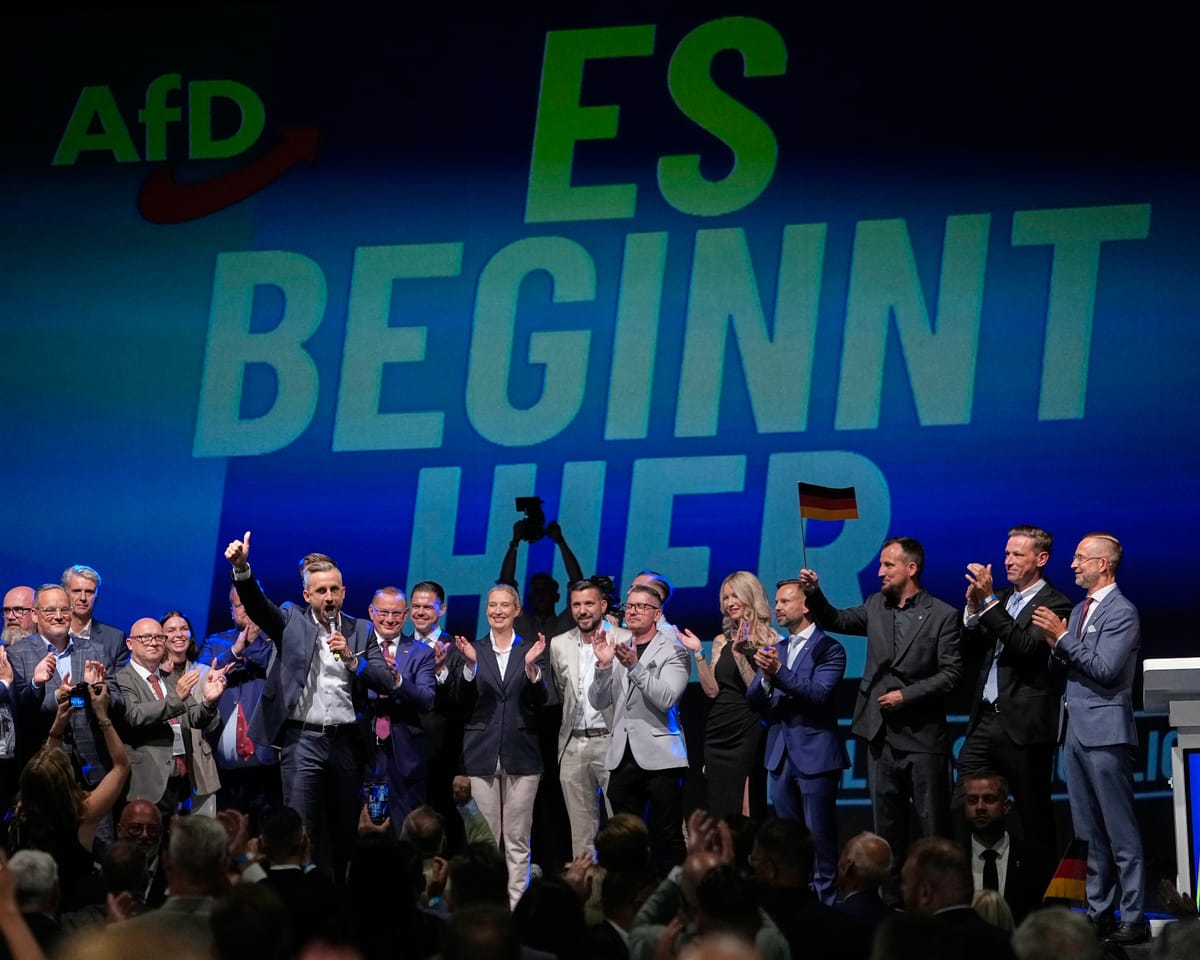
AfD Doubles Its Vote Share in Saxony-Anhalt as the German Centre Collapses
Alternative für Deutschland (AfD), a party that has used Nazi symbolism, distinguishes between “biological” and “passport” Germans, and has been rejected as too extreme by France’s far-right leader Marine Le Pen, nearly doubled its result in Sunday’s state election in Saxony-Anhalt, reaching 43.8% of the vote.
Meanwhile, the centre-right CDU of Chancellor Friedrich Merz dropped to 17.2%, less than half its share in the same race five years ago, and the centre-left SPD, Germany’s other main governing party for the past 60-odd years, scraped 9.3%. The centre clearly did not hold.
It remains unclear whether the AfD, whose local branch in Saxony-Anhalt is officially classified by Germany’s domestic intelligence service as “confirmed rightwing extremist,” will be able to form a government. It holds 39 seats in the 83-member parliament, just short of an outright majority.
But the result is the party’s strongest-ever state performance and brings it closer than any far-right party since the second world war to governing a German state. The outcome has sent shock waves across Europe, with nationalists celebrating a “historic win” they describe as “just the beginning,” while mainstream leaders warn of a “grave moment” for the continent.
Sweden holds legislative elections next week. France faces a decisive presidential ballot next spring. Key parliamentary races will follow in France, Italy, Spain and Poland later in the year. Far-right parties are polling strongly in all of them, and Europe’s centre fears a nationalist wave across the continent.
Analysts caution against drawing sweeping conclusions from one regional vote. Saxony-Anhalt, home to barely 1.8 million voters, has long been a far-right stronghold, with AfD support consistently double the national average over the past decade.
Tarik Abou-Chadi, professor of European politics at Oxford University, said: “A far-right party winning a regional election in Germany is not more scary than a far-right party winning a regional election in France, the UK or the Netherlands. Saxony-Anhalt should not be the basis for sweeping conclusions about the electoral sociology of the AfD.”
Nonetheless, the AfD leads in national polls, is narrowly ahead with the SPD in Mecklenburg-Western Pomerania, where elections are due later this month, and sits second in liberal Berlin. Its rise forms part of a decade-long advance by far-right parties across Europe.
Research led by Matthijs Rooduijn of the University of Amsterdam, involving more than 150 political scientists in 31 countries, found that nearly one in four European voters now cast their ballot for far-right parties. That share has grown nearly fivefold since the mid-1990s and climbed steeply over the past three years, reaching more than 23% in 2026, up from about 10% a decade ago and roughly 5% in 1995.
Far-right populist parties are now part of ruling coalitions in Croatia, Czechia, Italy and Finland, support a rightwing minority government in Sweden, and lead in polls in Austria, Belgium, France and Germany.
Recent defeats include Geert Wilders’s PVV in the Netherlands and Viktor Orbán’s Fidesz in Hungary. Still, as Cas Mudde of the University of Georgia put it after Orbán’s loss: “The far right is here to stay, and many of its parties are as established as the (former) ‘mainstream’ parties.”
Some commentators argue the “cordon sanitaire” has failed. By keeping the AfD out of government, mainstream parties have shielded it from compromise while forcing the centre into unstable coalitions that deliver little, driving voters toward the extremes.
Mujtaba Rahman of the Eurasia Group said: “There’s a self-reinforcing political dynamic that feeds the AfD’s rise.” Other research shows far-right parties grow stronger, not weaker, after entering government, gaining an average of six percentage points at the next election.
Political scientists argue that beyond mainstream parties’ failure to address voter discontent over living costs, it is the normalisation of far-right ideas, through media and political discourse, that continues to drive its steady rise.
Read next
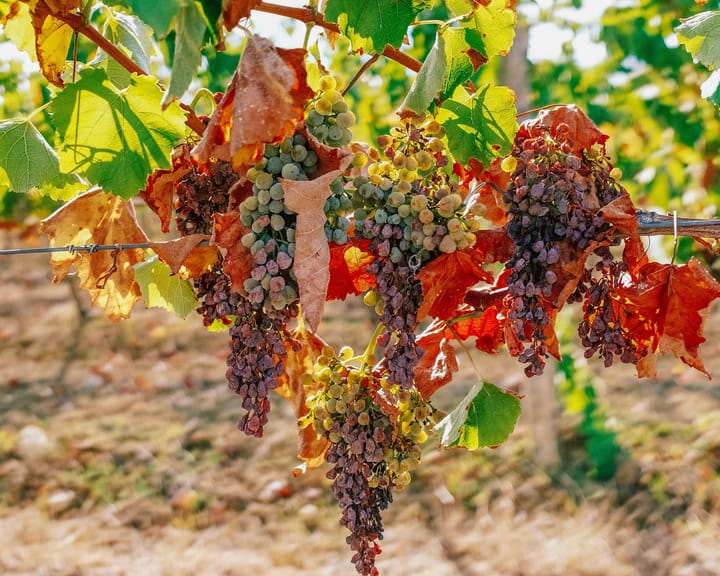
French Wine Harvest Set to Hit 30-Year Low Amid Severe Drought and Heat
French vineyards hit by severe drought and heatwaves are expected to report a 30-year low in wine production after the country's hottest ever recorded summer, according to the agriculture ministry.
Initial estimates suggest winemakers will produce just under 34m hectolitres from this year's harvest: a

UN: Syrian reactor could have produced nuclear weapons if finished
A nearly complete nuclear reactor constructed covertly during the tenure of the ousted Syrian leader Bashar al-Assad would have had the capacity to produce fissile material potentially usable in nuclear weapons, the head of the UN nuclear watchdog disclosed.
Inspectors from the International Atomic Energy Agency (IAEA) visited two
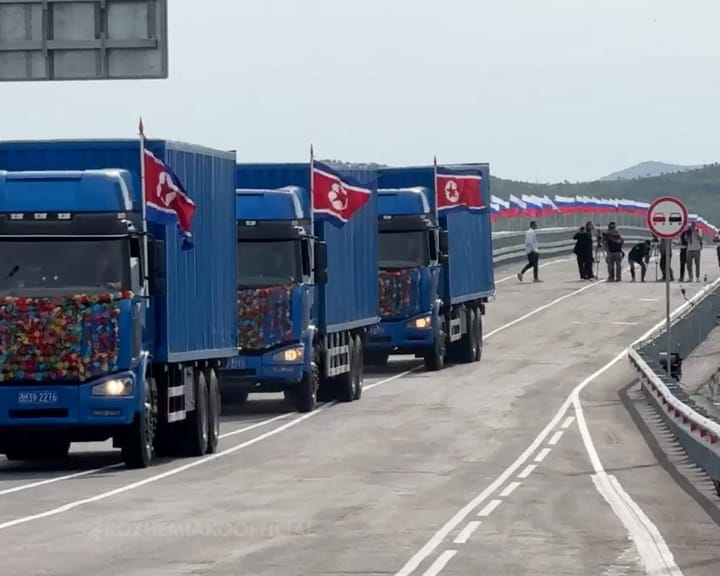
Russia and North Korea Inaugurate Inaugural Bridge Linking Shared Border
Russia and North Korea have opened the first road bridge across their shared border, in the latest sign of the rapidly deepening ties between the two countries since the start of the war in Ukraine.
The one-kilometre bridge spans the Tumen River between Khasan in Russia’s far east