
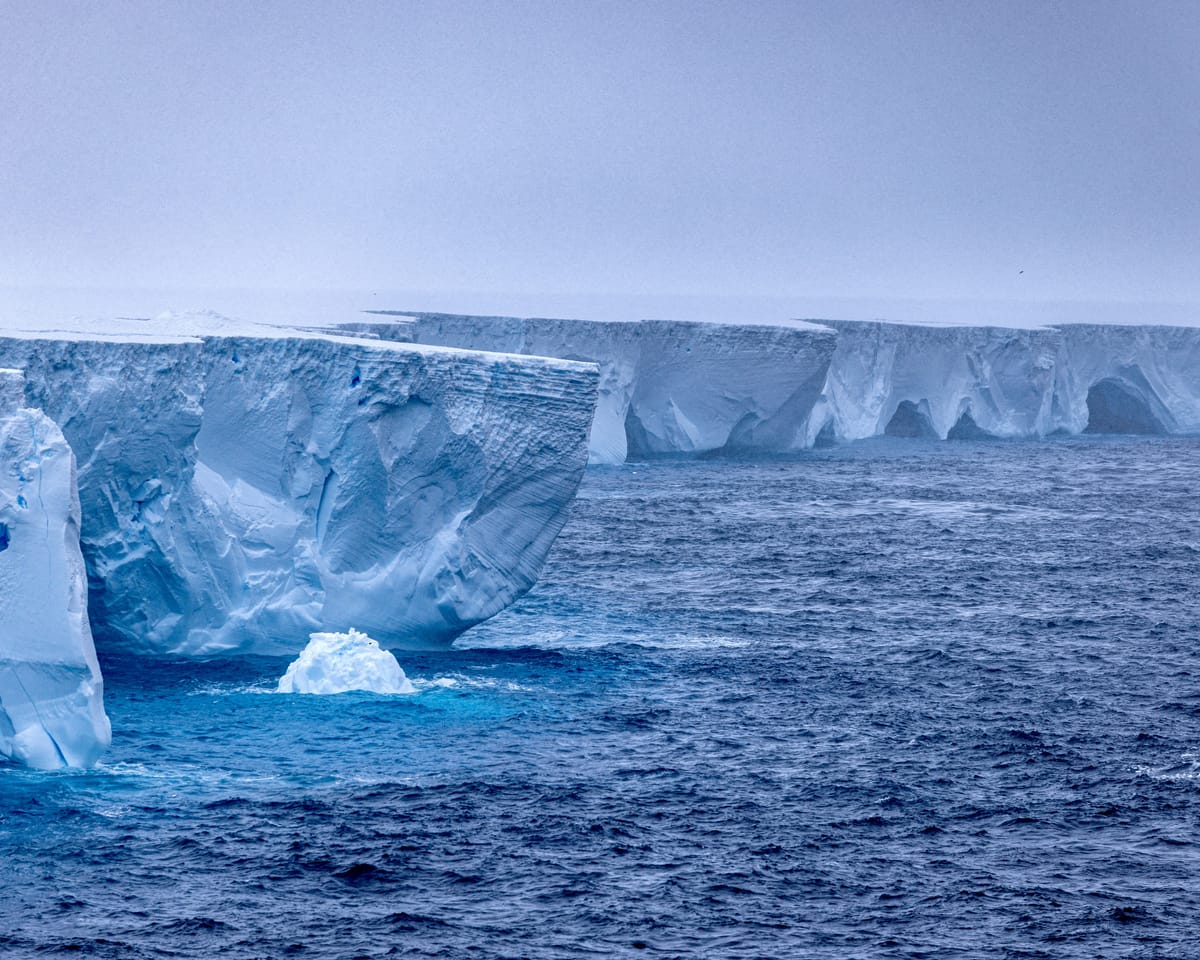
Gigantic Antarctic Iceberg Nears Disintegration After Nearly Four Decades
Nearly 40 years after separating from Antarctica, a massive iceberg—one of the oldest and largest ever recorded—is rapidly breaking apart in warmer waters and could vanish entirely in weeks.
Earlier this year, the iceberg, called A23a, weighed just under a trillion metric tons and was more than twice the size of Greater London, making it a colossal presence among floating ice masses.
The immense slab of frozen freshwater was so large that it temporarily raised concerns about disruptions to wildlife habitats near a remote South Atlantic island but eventually drifted past.
Now, it has diminished to less than half its original size, though it remains substantial—spanning 1,770 square kilometers (683 square miles), with its widest point stretching 60 kilometers (37 miles), according to satellite imagery analyzed by the EU's Copernicus Earth observation program.
In recent weeks, massive sections—some as large as 400 square kilometers—have splintered off, while smaller fragments, many still sizable enough to pose risks to ships, scatter the surrounding waters.
Andrew Meijers, a scientist with the British Antarctic Survey, told CuriosityNews that the iceberg was "breaking up fairly dramatically" as it moved farther north.
"It’s very much in its final phase… essentially decaying from below. The water is too warm for it to hold together. The melting is constant," he said.
"I expect this process to continue over the next few weeks, and soon, the iceberg may no longer be recognizable."
A23a broke away from Antarctica's ice shelf in 1986 but became lodged in the Weddell Sea, remaining stuck on the seafloor for more than three decades.
In 2020, it finally broke free and, as with many large icebergs before it, was carried by the Antarctic Circumpolar Current into the South Atlantic.
By March, it had become stranded in shallower waters near South Georgia Island, prompting concerns over potential disruptions to local penguin and seal populations. However, by late May, it had broken loose and resumed its journey.
Recent satellite images show that the iceberg has gained speed as it rounds the island, occasionally covering up to 20 kilometers in a single day.
Exposed to increasingly warmer temperatures and battered by powerful waves, A23a has deteriorated quickly.
Meijers noted that scientists were "surprised" by how long the iceberg had managed to stay intact.
"Most icebergs don’t travel this far. This one’s exceptional size allowed it to survive longer and move farther than others."
Ultimately, though, icebergs that drift away from Antarctica's freezing conditions are "destined to disappear," he added.
While icebergs naturally break off from ice shelves, researchers note that the rate of ice loss from Antarctica has accelerated, likely due to human-driven climate change.
Read next
Three-year project lifts lid on Britain’s little-understood shark species
Shark Scientists Turn to Anglers for Answers on Vulnerable Species
Dr Lucy Hawkes, associate professor at the University of Exeter, is co-leading a new three-year project to study some of England’s most vulnerable shark species. “I like the porbeagle, which looks like a baby great white shark,

Rare gull drifts thousands of kilometres to Australia, making birdwatching an 'extreme sport'
A rare seabird has created excitement among birdwatchers after appearing on the coast of Western Australia, thousands of kilometers away from its typical migration route.
The black-headed gull, a species that generally migrates between Asia and Europe, was spotted in Geraldton. The sighting was first shared on a local

Why U.S. Cities Prioritizing Cars Lag Behind Global Peers in Public Transit
The only train station in Houston, the US’s fourth‑largest city and one of the fastest‑growing conurbations in the country, is a diminished, morose sight. Intercity trains arrive at this squat, shed‑like Amtrak building, which cringes in the shadows of roaring highways, just three times a week.