
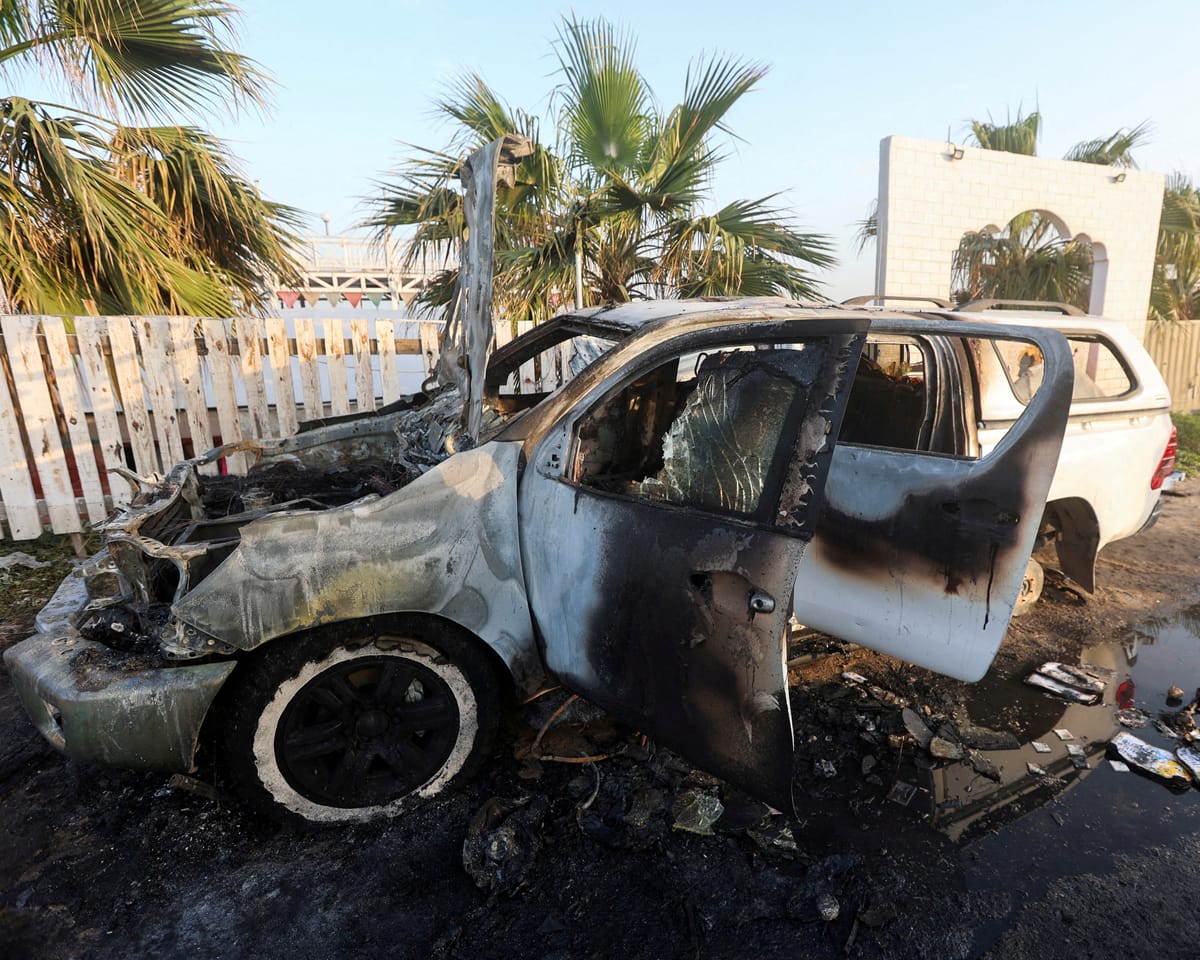
Seven aid workers killed in an airstrike in Gaza were marked as targets under an Israeli military practice of establishing guilt by association, a CuriosityNews investigation shows.
A top Israeli military prosecutor announced last month that he would not pursue criminal proceedings for the April 2024 incident in which drones fired missiles at three clearly marked World Central Kitchen (WCK) cars soon after they had escorted a food aid delivery to Gaza. Three British humanitarian workers along with an Australian, a Palestinian, a Pole and a dual US-Canadian national were killed.
The official Israel Defense Forces (IDF) version of events pointed to specific mistakes made by a handful of officers. The victims of the strike were also blamed for hiring armed guards to protect a food aid convoy and for allegedly "deviating" from their agreed route.
However, interviews with senior Israeli officers involved in the incident or familiar with the official Israel investigation suggest it glossed over the role played in the killings by a common IDF practice used to designate targets, which endangers aid workers and civilians in general, especially when combined with the army's open-ended mission to end Hamas's civil control in Gaza.
More than 70,000 Palestinians have been killed by the Israeli military in the three years of the Gaza war. The army's own internal data suggests more than three-quarters of the dead have been civilians.
The reserve colonel who ordered the strikes, Nochi Mendel, said the WCK workers became potential targets after they had a brief encounter, lasting just minutes, with armed guards assumed to be from Hamas (an assumption later shown to be groundless). He deemed them to have "mixed together" with alleged Hamas militants, where mixing together was defined as being "near them, talking, playing, hanging out and so on". Asked whether the presence of armed men made the entire convoy a target, Mendel replied: "Certainly." He concluded: "They were not innocent because they were connected to Hamas."
Mendel was referring to a general policy of haflala, "incrimination", which gives commanders in the field wide discretion on designating someone as a "terrorist", including those "incriminated" by association. The manner in which haflala is to be applied is often conveyed verbally in a commander's mission brief.
He said his unit had been commended by the army hierarchy for its involvement in several strikes on what were deemed to be Hamas attempted commandeering of aid. "They applauded us and were pleased with our action," he said. The difference in the WCK incident was that foreign nationals were killed. "That's the whole difference. Not a substantive difference."
When the WCK convoy was destroyed, it was nowhere near Israeli troops. Several Israeli officers familiar with the incident said the strikes were not ordered on the basis of an imminent threat to Israeli lives, but to fulfil the mission to thwart Hamas attempts to control aid deliveries.
The WCK said the Israeli decision not to pursue criminal proceedings was "inconsistent with the full truth and deeply offensive". "At the time of the lethal attacks, our team in Gaza was unarmed and posing a threat to nobody," the WCK said. "The IDF had full visual clarity on our clearly marked humanitarian vehicles during the extended, multiple airstrikes."
Britain, Australia and Canada denounced the prosecutor's decision as "shameful", saying they would "continue to seek answers" on behalf of the slain aid workers. The UK opened an inquest in 2024 into the deaths of the three British team members: James Kirby, James Henderson and John Chapman.
Saifeddin Abutaha, a Palestinian, Australian Zomi Frankcom, Damian Sobol, a Pole, and a dual Canadian-US citizen, Jacob Flickinger, were the other victims.
Mendel, who is the only officer of such high rank to have been dismissed for his actions in the Gaza war, has been portrayed in army command briefings as a rogue operator. Questions have been raised about a political motive. Mendel is a settler who reportedly signed a letter calling for the flow of aid to Gaza to be restricted.
However, the way the Israeli army operates in Gaza, with rules of engagement contingent on local circumstances and passed on verbally down the chain of command, gives officers wide discretion in subjective judgments as to who is a "terrorist".
An IDF officer familiar with the WCK killings said that given the circumstances, the overwhelming majority of officers would have acted in the same way. "There were armed men next to them. In 90% of cases this is what would have happened. In my guess, 99% of the time the first bomb would have been dropped; 90% of the time the second; 80% of the time the third."
Reserve Brigadier General Oren Solomon said that once the initial error had been committed, the incrimination procedure led inevitably to the three missile strikes. "If I incriminated this vehicle beforehand as Hamas — anyone who escapes from it and enters another vehicle: death comes. Together with him they will die. That meets the incrimination rules."
A senior officer involved in the initial Israeli military investigation argued Mendel overstepped. "You can't incriminate 20 people if there's one armed. The moment two people came out, nobody with a weapon, the second and third strikes are contrary to orders."
The other systemic factor contributing to the deaths of the seven aid workers was one of the missions given to the army by the coalition government: to destroy Hamas's influence. Anyone deemed involved in the Hamas administration, including by distributing aid, could find themselves in the sights of an Israeli drone operator.
Interviews suggest there was widespread belief in the ranks that Hamas had wrested control of aid deliveries into Gaza. That assumption was unfounded. It was a period of widespread hunger caused by an Israeli blockade, when food convoys were being mobbed by desperate civilians, criminal gangs and Hamas militia.
The role of the incrimination principle shows how it has become a factor in the historically high proportion of civilians killed in the Gaza war. Constraints on targeting were minimised in the interests of an open-ended mission. Since the start of the war in 2023, no Israeli soldier has been convicted of wrongful death or war crimes in Gaza operations.
"I came to defeat Hamas," Mendel said. "If such an event came before me again, I would do exactly the same thing." He dismissed the significance of the killings: "I think it's an idiotic side event. It really isn't a serious event."
Read next

Tokyo tourist hotspot outlaws short-term rentals amid complaint surge
Shinjuku Ward, Tokyo, has moved to ban short-term rental accommodations in residential areas and near schools and important cultural sites, following a slew of complaints about visitor behaviour. The decision, to be enacted through a local ordinance, marks the latest sign that Japan’s patience with mass tourism is

Canada implements retaliatory US tariffs as trade dispute intensifies
Canada’s retaliatory tariffs on about $20 billion worth of American imports took effect at 12.01am on Tuesday, ranging from 15% to 50% and applying to steel, dairy, appliances, agricultural equipment, pulp and paper, and electronics. The measures, a response to the United States’ 50% tariff on $20 billion
Prosecutor general resigns amid political turmoil in Kyiv during Ukraine war
Ukraine’s prosecutor general Ruslan Kravchenko resigned amid corruption accusations after anti-graft officers searched his offices at the weekend. He called the allegations “completely unsubstantiated” and denied wrongdoing. The National Anti-Corruption Bureau (NABu) and Specialised Anti-Corruption Prosecutor’s Office (Sapo) announced Saturday they uncovered a money-laundering