
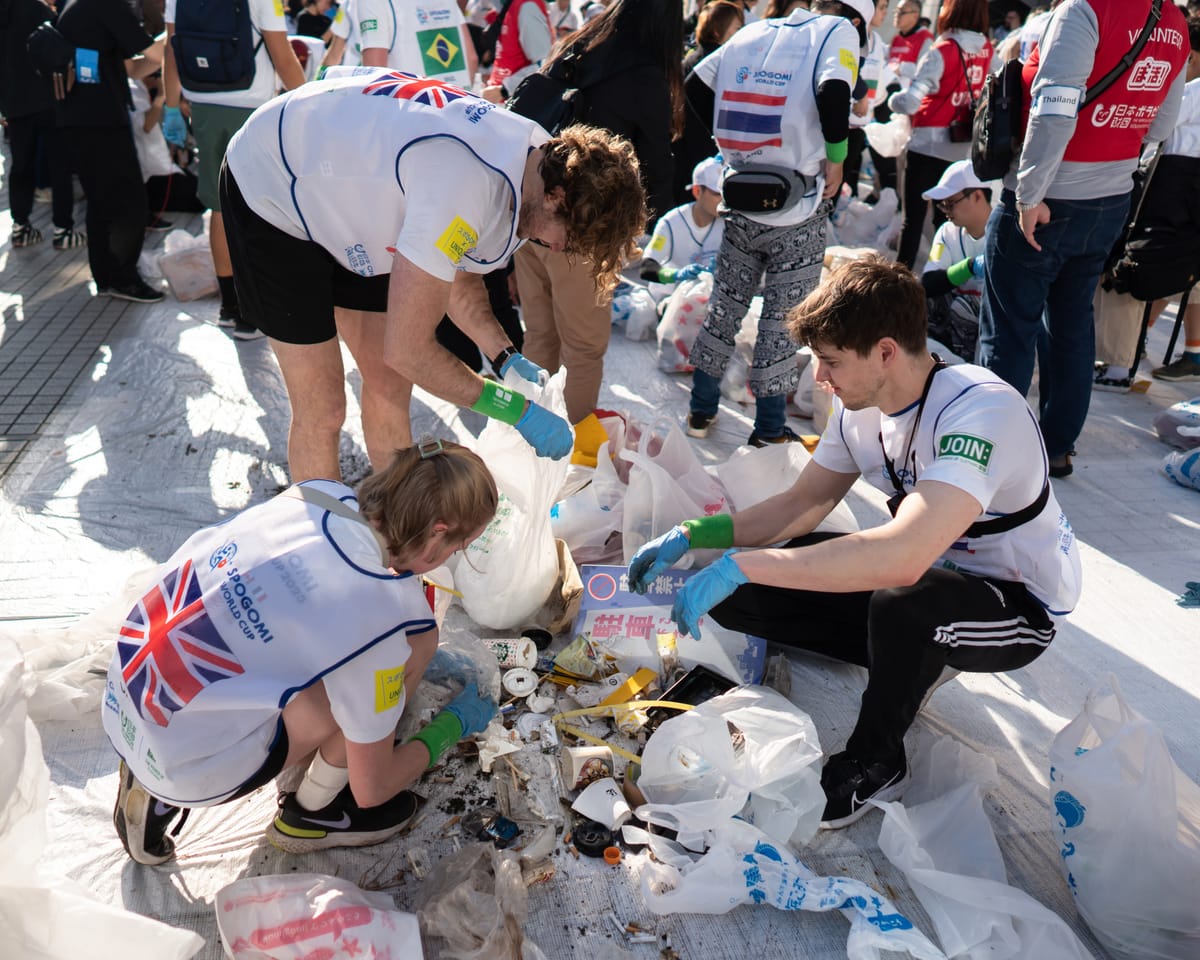
Equipped with gloves, tongs, and trash bags, dozens of determined volunteers will gather at Hackney Marshes in east London this weekend.
The activity, known as Spogomi, originates from Japan, where it was developed in 2008 as a competitive way to encourage public space cleanup. It has since spread to schools and communities, turning litter collection into a game.
Sarah Parry, a 29-year-old doctor from Glasgow, was part of the team that won the last Spogomi World Championship in Tokyo in 2023. Her group outperformed the Japanese competitors by collecting 61lbs (28kg) more waste.
Teams have 45 minutes to gather as much litter as possible, followed by 20 minutes to sort it. Points are awarded based on the type of waste and how it can be recycled.
Parry, an avid marathon runner with 33 races under her belt, became interested in Spogomi after her brother spotted information about it. She quickly formed a team and signed up for the event.
“We weren’t regular litter collectors before—it was more about the challenge and excitement than anything else,” she said.
This Sunday, Parry will join the Hackney cleanup but won’t compete officially, as past winners are barred from consecutive victories. Instead, she aims to see how much trash she can collect.
Despite its seemingly simple nature, Spogomi is physically demanding.
“It’s surprisingly tough,” Parry said. “After running 33 marathons, the sorest my legs have ever been was after winning the Spogomi World Cup. You’re walking quickly while carrying oddly shaped, heavy items, using muscles you don’t normally engage. Plus, Tokyo was extremely hot—and we collected over 50kg of litter while navigating a crowded city.”
Parry described Spogomi as a unique sport. “It’s incredibly fun. You don’t usually get to compete in a busy area where bystanders have no idea why you’re so thrilled to find a glass bottle.”
More importantly, she said, it highlights a critical issue: the widespread problem of litter in the UK.
“The amount is staggering. Before, people barely noticed it, but once you do, it’s everywhere. Now I can’t stop seeing it.”
Though the sport began in Japan, Parry noted that the country has far less litter than the UK. “Japan is much cleaner because people there have a strong sense of community and respect for their surroundings—something we lack here.”
For that reason, she hopes Spogomi gains more traction in the UK, raising awareness and encouraging cleaner habits.
Read next

Three-year project lifts lid on Britain’s little-understood shark species
Shark Scientists Turn to Anglers for Answers on Vulnerable Species
Dr Lucy Hawkes, associate professor at the University of Exeter, is co-leading a new three-year project to study some of England’s most vulnerable shark species. “I like the porbeagle, which looks like a baby great white shark,

Rare gull drifts thousands of kilometres to Australia, making birdwatching an 'extreme sport'
A rare seabird has created excitement among birdwatchers after appearing on the coast of Western Australia, thousands of kilometers away from its typical migration route.
The black-headed gull, a species that generally migrates between Asia and Europe, was spotted in Geraldton. The sighting was first shared on a local

Why U.S. Cities Prioritizing Cars Lag Behind Global Peers in Public Transit
The only train station in Houston, the US’s fourth‑largest city and one of the fastest‑growing conurbations in the country, is a diminished, morose sight. Intercity trains arrive at this squat, shed‑like Amtrak building, which cringes in the shadows of roaring highways, just three times a week.