
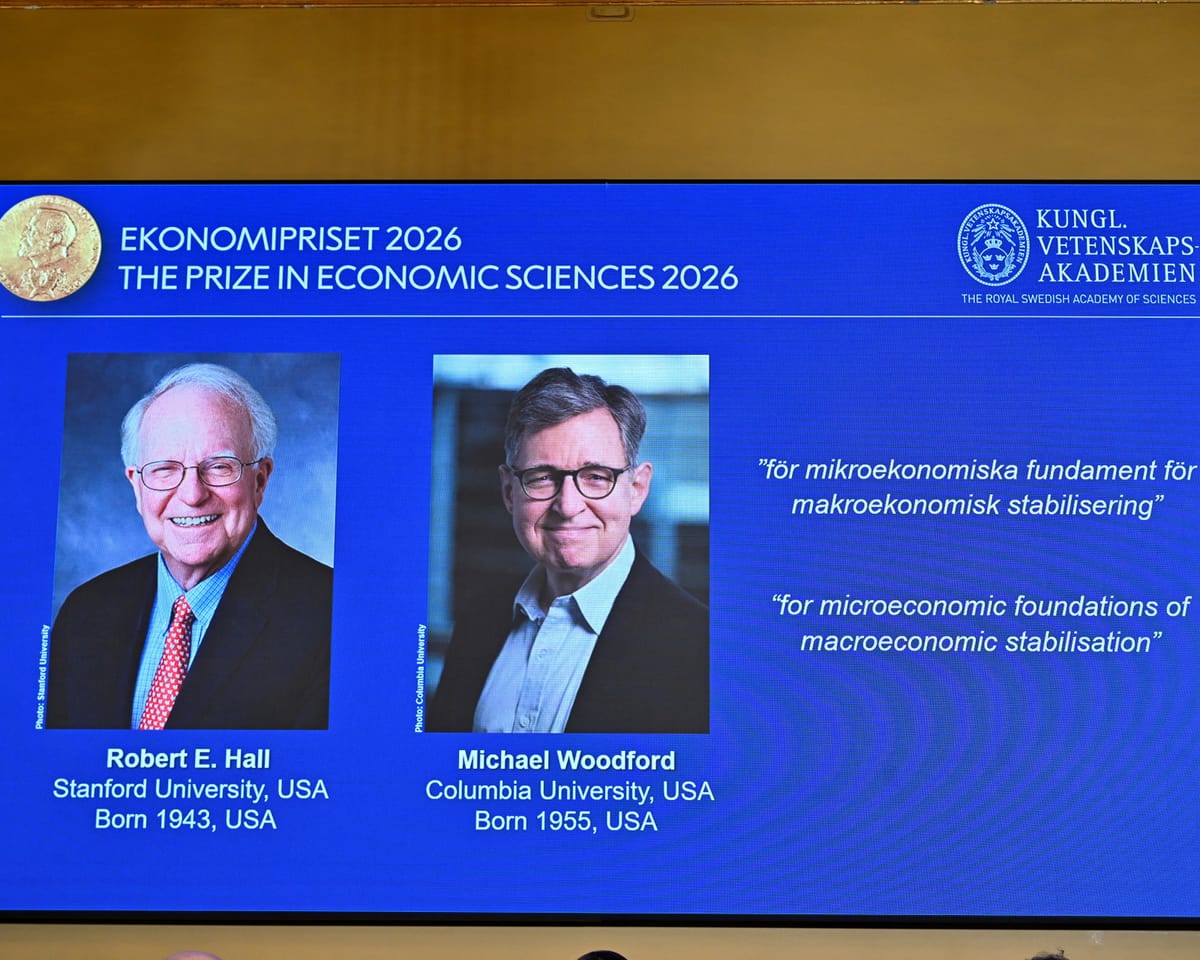
The Nobel Prize in Economics has been awarded to Robert E. Hall and Michael Woodford for their contributions to the "microeconomic foundations of macroeconomic stabilization." Their work has significantly enhanced the implementation of effective stabilization policies, influencing both fiscal and monetary measures to mitigate economic fluctuations. This recognition aligns with the New Keynesian paradigm, emphasizing the importance of building economic models on microfoundations to better understand and manage economic downturns.
The Royal Swedish Academy of Sciences highlighted that Hall and Woodford's research has enabled central banks and finance ministries worldwide to adopt models that quantify the impact of stabilization policies on business cycles. Their approach builds upon the foundational work of John Maynard Keynes, adapting it to address challenges such as the oil crises of the 1970s, which revealed limitations in traditional macroeconomic assumptions.
Woodford, in particular, has been a key figure in developing modern forward guidance, a strategy that central banks use to influence public expectations about inflation, beyond traditional interest rate adjustments. This method became crucial during the 2008 financial crisis when traditional monetary tools were insufficient due to low interest rates and high unemployment.
The Nobel Prize in Economics, formally known as the Sveriges Riksbank Prize in Economic Sciences in Memory of Alfred Nobel, carries a monetary award of 12 million Swedish kronor and significant prestige. The announcement was made by the Royal Swedish Academy of Sciences in Stockholm.
In related news, UK bond yields have decreased slightly, reflecting optimism about a potential energy ceasefire between Russia and Ukraine, which could lower oil prices and ease inflation. However, geopolitical tensions persist, with Ukraine reporting targeted strikes on energy infrastructure.
In the economic policy arena, the Fight Inequality Alliance has urged finance ministers at the IMF/World Bank meeting in Bangkok to consider debt cancellation to aid the Global South. They advocate for ending austerity measures and increasing taxes on the super-rich to support public services.
The UK faces a potential £35bn budget shortfall due to rising inflation, which has eroded the value of government budgets and increased borrowing costs. The Institute for Fiscal Studies warns that the upcoming budget must address these pressures to avoid fiscal challenges.
As the Nobel Prize for Economics was awarded, the anticipation for the Paris Motor Show continues, alongside the release of Russia's trade balance for August. The economic landscape remains dynamic, with ongoing discussions about policy responses to global economic challenges.
Read next

Stellantis and Renault Support UK's Bid for EU Car Industry Protection
Stellantis and Renault have supported the inclusion of the UK car industry in proposed EU regulations aimed at safeguarding European manufacturers. They have, however, urged the British government to consider restricting imports of Chinese vehicles.
Emanuele Cappellano, who oversees Stellantis’s European brands like Fiat, Citroën, Opel, and Vauxhall, alongside

Father Required to Provide DNA for Daughter's Passport Application
My teenage daughter is unable to visit her grandparents in the UK due to new rules requiring dual nationals to possess a UK passport.
As a UK citizen living in France with my French spouse, our older children have both French and UK passports. Our youngest, born in Zimbabwe, only

IFS Warns: Budget Lacks Substance Without Strategy to Address UK Spending Pressures
As Britain faces financial challenges exacerbated by the Middle East conflict, leading tax and spending experts have cautioned John Healey, the Chancellor, that his budget could be seen as unrealistic unless he addresses a £35bn funding gap. The Institute for Fiscal Studies (IFS) highlighted that inflation's impact necessitates