
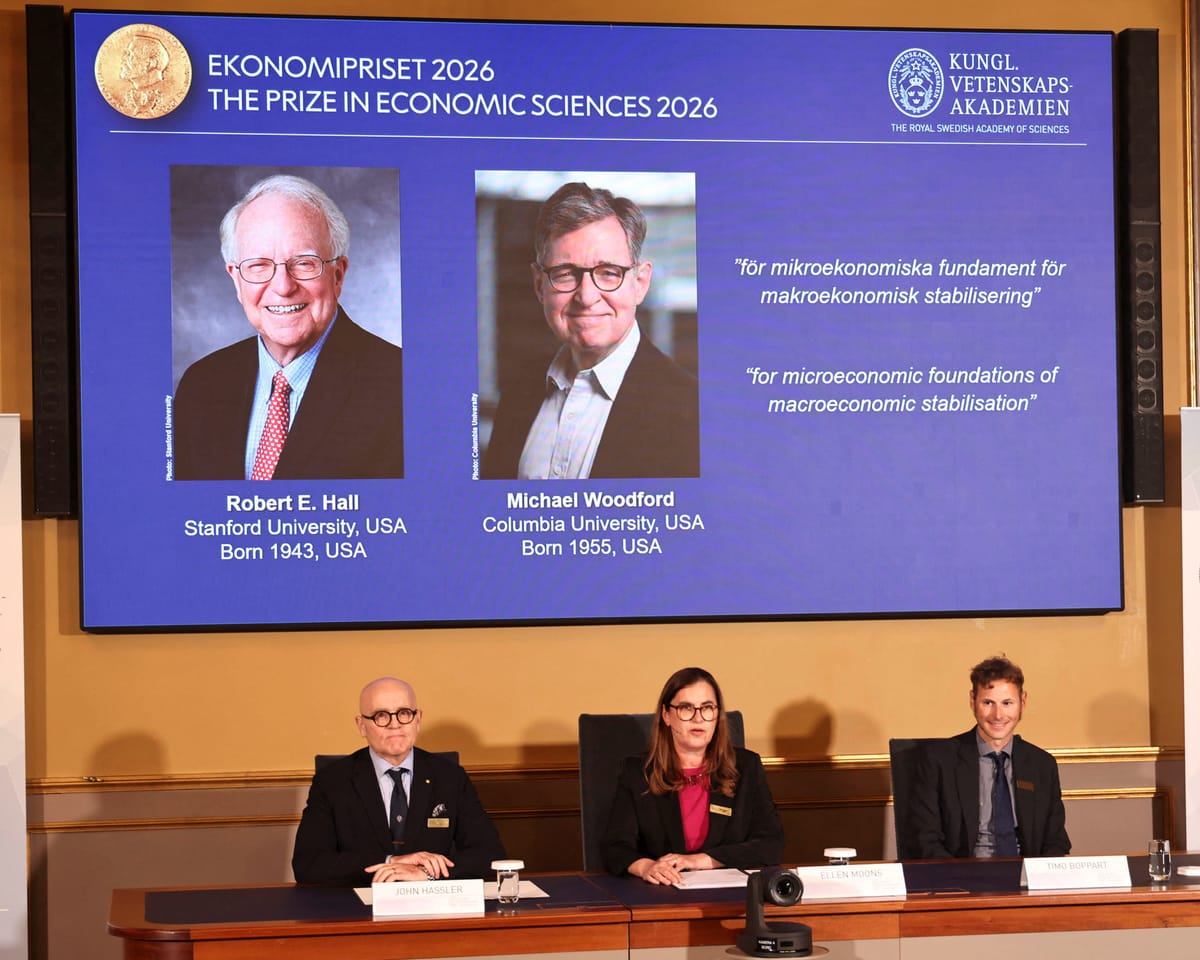
Two US economists, Robert Hall of Stanford University and Michael Woodford of Columbia University, have been awarded the 2026 Nobel Prize in Economics for their contributions to economic modeling. Their work has provided central banks and finance ministers with tools to stabilize economies, helping to prevent prolonged recessions and uncontrolled inflation.
The Royal Swedish Academy of Sciences honored Hall and Woodford for creating the "microeconomic foundations of macroeconomic stabilization," marking a significant shift in policy frameworks. The award, valued at $1.2 million, acknowledges their development of New Keynesian models that now guide central banks and finance ministries worldwide.
These models build on the work of John Maynard Keynes, addressing limitations in handling crises like the 1970s oil shock, which led to high inflation, weak growth, and unemployment. Hall's research focused on forward-looking consumer behavior, moving beyond Keynes's traditional models that relied on fixed rules linking variables such as inflation, unemployment, and GDP. Woodford expanded on this to develop a comprehensive macroeconomic stabilization framework, which has become essential for policymakers.
The New Keynesian model was instrumental during the 2008 financial crisis, aiding global economic recovery and averting a potential second great depression. John Hassler, chair of the economics prize committee, noted that their work offers a stable theoretical base for models used by central banks and governments, enhancing their ability to manage economic shocks, including energy crises and changes in household consumption.
Their research also led to the adoption of forward guidance, where central bankers forecast future interest rates. This tool gained importance after the 2008 crisis and during the Covid pandemic, when interest rates reached historic lows. However, forward guidance has faced criticism, with some, like former US Federal Reserve chair Kevin Warsh, suggesting its use should be limited to avoid confusion. Similarly, former Bank of England governor Mark Carney faced criticism for misleading hints about interest rate changes.
Woodford expressed his joy upon receiving the news, describing it as a "tremendous honor" and a pleasant surprise. Hall is also known for his distinction between "fresh water" and "salt water" economists. The "fresh water" group, often from inland universities like the University of Chicago, favors free markets and monetarism. In contrast, "salt water" economists, typically from coastal institutions such as Harvard and MIT, support government intervention to influence economic demand, aligning with Keynesian and New Keynesian principles.
Read next

Marché des Enfants Rouges, Known as Paris' 'Coolest Market,' Ravaged by Fire
A devastating fire has swept through Paris's oldest surviving covered food market, a beloved street food destination in the Marais district. This historical venue, which attracted both locals and tourists daily, dates back to the 17th century.
Ariel Weil, the mayor of central Paris, described the Marché des

German Minister Resigns Following Stepdaughter's Death and Political Criticism
Germany's Labour Minister Bärbel Bas, a co-leader of the Social Democrats (SPD), resigned from her positions, citing the loss of her stepdaughter and subsequent political attacks as her reasons. Her resignation poses a significant challenge to the already fragile coalition government.
Bas, in a Facebook statement, mentioned

Preserving 300-Year-Old Church-Bell Tradition: Lebanon's Sole Family Artisan
The story of Lebanon's sole remaining church-bell maker traces its origins to an unexpected encounter. In the 18th century, Youssef Gabriel, a local metalworker, was involved in covertly crafting and supplying rifles to Arab revolutionaries fighting against the Ottoman rule over Lebanon. One day, a Russian engineer