
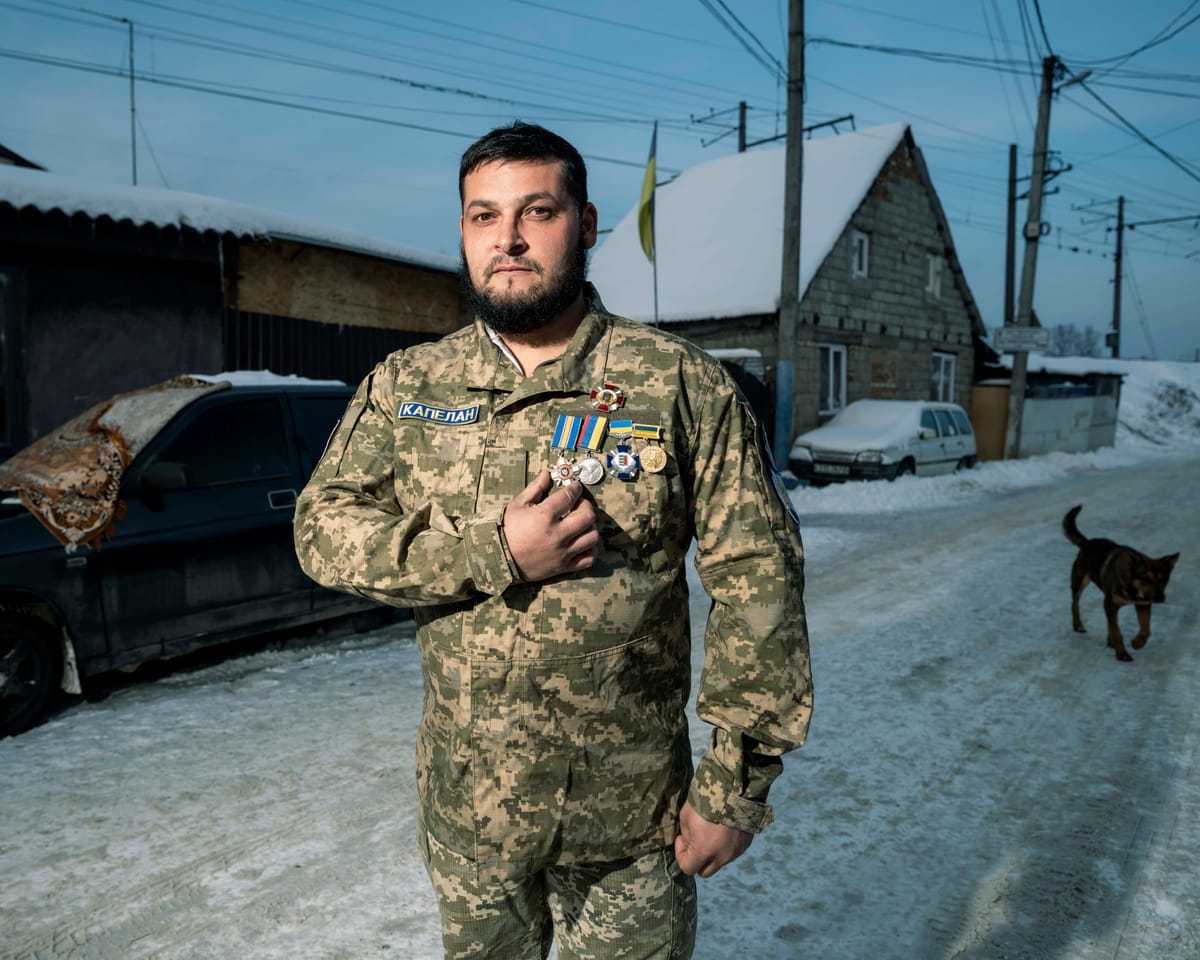
As a father of four, Viktor Ilchak was not expected to be called up. Ukrainian law exempts men with three or more children from mobilisation. His wife and children wept and pleaded with him not to go to the front, yet he had already decided. “A true Capricorn, very obstinate,” his wife Sveta says.
In 2015 the fighting in Donbas was intensifying. “I heard someone on television say that Roma do not defend their country. That angered me, so I signed up,” Ilchak recalls. At the territorial recruitment office in Uzhhorod the soldiers were taken aback, but they had to accept him.
Ilchak and his family reside in Radvanka, one of several Roma settlements in Uzhhorod, the capital of Transcarpathia, a western Ukrainian region bordering Hungary, Slovakia, Romania and Poland. The area contains the country’s largest Roma concentration. About 3,500 inhabitants live there, according to Myroslav Horvat, the city’s sole Roma councillor. The streets are unpaved and many homes lack running water.
The Ilchaks occupy a room of roughly 10 square metres. It has no windows and only minimal furnishings. The parents and three daughters share a large bed, while their teenage son sleeps on the floor.
Ilchak fought in Donbas and, after the full‑scale invasion, also served near Mariupol. As a tank mechanic he was wounded four times and still bears shrapnel from a Russian bomb in his arm. His army jacket bears several decorations, among them the Order for Courage awarded by President Volodymyr Zelenskyy. He also received a municipal medal, as no other Roma from Uzhhorod had served as long as he—ten years.
He returned home last September. For now he looks after his children and helps his neighbourhood where he can. His principal aim for the year is to launch a non‑governmental organisation; the paperwork is already submitted. The title: Transcarpathian Roma Association of Combatants, War Veterans, Chaplains and Volunteers. It is the first body of its kind in the country.
Accurate figures for Ukraine’s Roma population are lacking. The 2001 census listed 47,587 people, while the Council of Europe estimates the real number could be up to ten times higher. Horvat suspects the state deliberately publishes lower counts. “The larger the Roma presence, the clearer the need for political representation,” he says.
The status of ethnic minorities—Roma being the most disadvantaged—features in Ukraine’s EU accession negotiations. Pilot schemes are being launched to register undocumented Roma and provide them with identity papers, a prerequisite for full civic participation. “Without identification, people cannot access basic services and are treated as second‑class citizens,” Horvat notes, estimating that as many as 30,000 individuals lack documents.
Estimating how many Roma serve in the Ukrainian armed forces is even harder. Horvat is aware of roughly 500, a figure drawn from 2024 data and covering only those from his region.
Read next
Tokyo tourist hotspot outlaws short-term rentals amid complaint surge
Shinjuku Ward, Tokyo, has moved to ban short-term rental accommodations in residential areas and near schools and important cultural sites, following a slew of complaints about visitor behaviour. The decision, to be enacted through a local ordinance, marks the latest sign that Japan’s patience with mass tourism is
Canada implements retaliatory US tariffs as trade dispute intensifies
Canada’s retaliatory tariffs on about $20 billion worth of American imports took effect at 12.01am on Tuesday, ranging from 15% to 50% and applying to steel, dairy, appliances, agricultural equipment, pulp and paper, and electronics. The measures, a response to the United States’ 50% tariff on $20 billion
Prosecutor general resigns amid political turmoil in Kyiv during Ukraine war
Ukraine’s prosecutor general Ruslan Kravchenko resigned amid corruption accusations after anti-graft officers searched his offices at the weekend. He called the allegations “completely unsubstantiated” and denied wrongdoing. The National Anti-Corruption Bureau (NABu) and Specialised Anti-Corruption Prosecutor’s Office (Sapo) announced Saturday they uncovered a money-laundering