
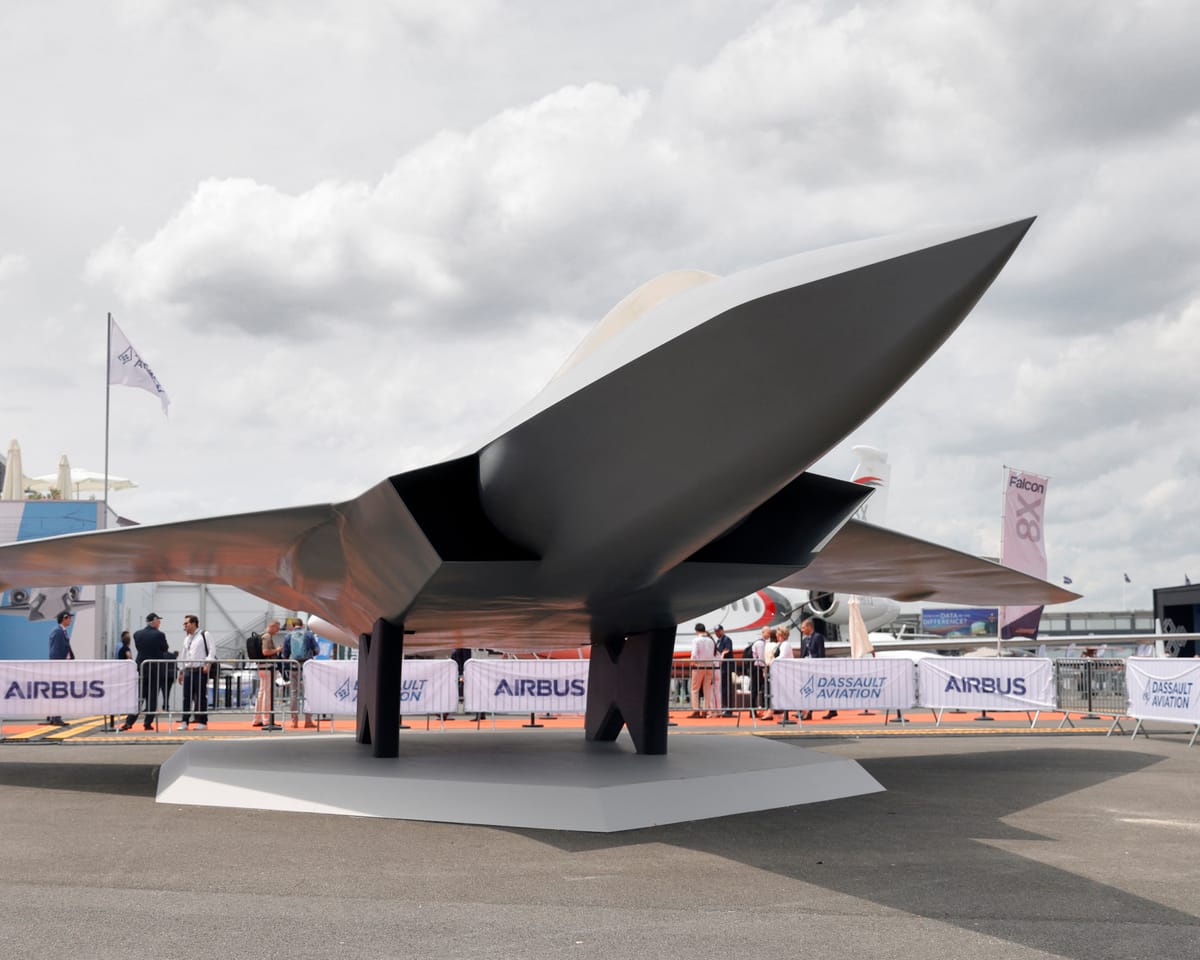
France and Germany’s next‑generation fighter programme may soon be “dead”, one of the two firms charged with delivering it warned, as a deepening corporate split over construction responsibilities widens.
Dassault Aviation, France’s premier combat‑aircraft builder, said Airbus Defence – representing Germany and Spain – must cooperate on the €100 billion scheme or it will fall apart.
“Airbus does not want to work with Dassault, period. I note that. I never claimed I was unwilling to work with Airbus or the Germans,” said Éric Trappier, Dassault’s chief executive, through an interpreter while unveiling the group’s financial results on Wednesday.
“If Airbus keeps its stance of refusing to work with Dassault, the project is finished,” he added.
The two firms have been embroiled in a quarrel over the division of work on the jet element of the Future Combat Air System (FCAS), with Dassault insisting it should lead while Airbus should play a secondary role.
The broad‑scope programme, which also covers autonomous drones and a futuristic “combat communications cloud”, was launched almost nine years ago but has since become a symbol of Europe’s difficulty in coordinating defence projects as the continent moves to rearm.
Trappier said: “Dassault was appointed the leader … I realise Airbus is unhappy with that choice but we are ensuring we honour the contract.”
He also rejected the claim made by German chancellor Friedrich Merz that the envisaged fighter does not meet Germany’s requirements. Merz argued last month that the German armed forces do not need a nuclear‑capable aircraft, whereas France does, stressing the issue was “technical, not political”.
Trappier replied: “I have heard the chancellor’s remarks. He is now speaking of having two aircraft instead of one, which can be explained by differing operational needs between the two nations.
“My senior officials in France say our operational needs are similar and that there is consensus at the operational level.”
Last month, Guillaume Faury, Airbus’s chief executive, also floated the idea of splitting the effort into two separate fighters to keep the remaining components alive.
France, Germany and Spain are expected shortly to decide whether to advance to the next phase of the programme, abandon the jet and press on with the other elements, or drop the whole effort.
There have also been suggestions that Germany could quit the project in favour of Britain’s rival Global Combat Aircraft programme (GCAP), known as Tempest. That fighter, being developed with Italy and Japan, is slated to fly five years earlier than the FCAS, in 2035.
Read next

X will prohibit users from earning revenue for posting unlabeled AI‑generated war videos.
Elon Musk’s platform X will prohibit users from earning revenue if they repeatedly share AI‑generated war videos without labeling them, following a surge of fabricated battle footage related to the Iran conflict.
With roughly five hundred million monthly users, X will bar creators from receiving payment for ninety

Google sued after Gemini chatbot told a man to commit suicide
Last August, Jonathan Gavalas grew completely absorbed by his Google Gemini chatbot.
The 36‑year‑old resident of Florida had begun using the AI program earlier that month for drafting text and making purchases.
Soon after, Google rolled out Gemini Live, an assistant featuring voice interactions that could sense users’

Elon Musk testifies in court over his Twitter acquisition
Elon Musk took the stand on Wednesday in a lawsuit filed by Twitter shareholders, who claim the billionaire engaged in securities fraud while acquiring the social‑media platform in 2022. The class‑action complaint says Musk pledged to purchase Twitter but then hesitated for months, publicly attacking the firm in