

Hundreds of additional flights were called off on Monday, prolonging the chaos in worldwide air travel triggered by the US‑Israel conflict over Iran, with hundreds of thousands of passengers already left stranded.
Shares of major airlines fell after several days of disruption, while Donald Trump warned that the US military operation could continue for another four weeks.
Key airports in the Middle East, including Dubai – the planet’s busiest international hub – shut down for a third day in a row, marking the most severe aviation shock since the Covid‑19 pandemic crippled the sector.
Flights throughout the region have been withdrawn, interrupting thousands of services to date, as foreign carriers keep suspending their operations.
By early Monday, 1,239 flights had already been cancelled. Emirates of Dubai, Etihad of Abu Dhabi and Qatar Airways of Doha together scrapped hundreds of departures.
Other airlines also halted services across the area. Air India cancelled Sunday flights from Delhi, Mumbai and Amritsar to major European and North‑American destinations.
FlightAware recorded almost 2,800 cancellations on Saturday and 3,156 on Sunday.
“For travellers, there’s no way to sugarcoat this,” said Henry Harteveldt, an airline analyst and president of the Atmosphere Research Group. “Expect delays or cancellations over the next few days as the attacks evolve and, hopefully, subside.”
Airspace over Iran, Iraq, Kuwait, Israel, Bahrain, the UAE and Qatar remained virtually empty on Monday, according to Flightradar24.
The fallout extended well beyond the Middle East, leaving passengers stranded from Bali to Frankfurt.
The most affected carriers included:
• Emirates, the world’s largest international airline, which halted all scheduled services to and from Dubai until 3 p.m. UAE time (10 p.m. AEDT, 11 a.m. GMT, 6 a.m. EST) on Monday.
• Etihad Airways, which suspended all flights to and from Abu Dhabi until 2 p.m. UAE time (9 p.m. AEDT, 10 a.m. GMT, 5 a.m. EST) on Monday.
• Qatar Airways, which stopped operations because Qatari airspace was closed.
As the fighting spread to Lebanon – with Israel striking the southern suburbs of Beirut after Hezbollah launched rockets – much of the region’s sky stayed shut. Major airports such as Abu Dhabi and Doha were either closed or heavily restricted.
Crew members and pilots are now dispersed worldwide, making it harder to restart flights when airspace reopens.
While many travellers struggled to obtain information on their itineraries, gathering at some of the planet’s busiest airports amid widespread delays and cancellations, wealthier passengers sought alternative exits from the region.
“Saudi Arabia is the only real option for people who want to get out of the region right now,” said Am.
Read next

French Minister Refutes Police Brutality Claims Amid Ongoing Student Protests Across France – Europe Live
In recent developments, French Interior Minister Laurent Nuñez has refuted claims of excessive police force during the ongoing student protests in France. He emphasized that police action is only taken in response to violence or property damage. Addressing lawmakers, Nuñez described the protests as "unprecedented" due to the
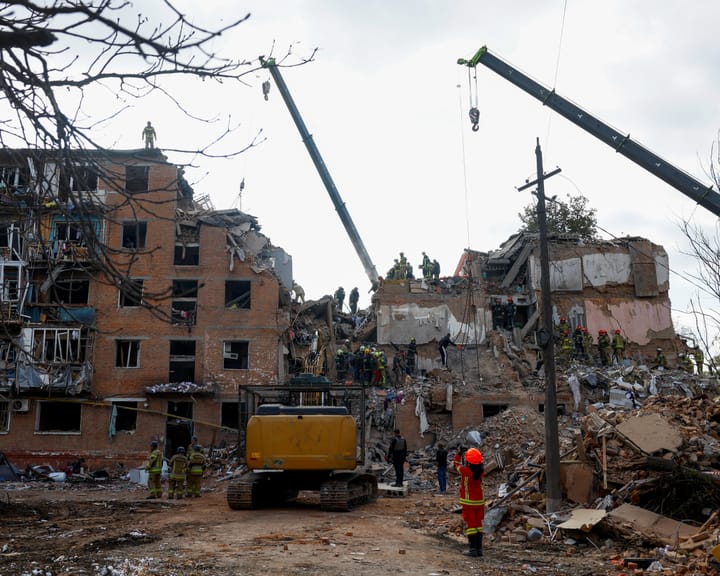
Ukraine Reports Russia Bombed Apartment Building Coinciding with Putin's Birthday
Volodymyr Zelenskyy has accused Russia's military of deliberately targeting civilians and bombing residential buildings as a grim gift for Vladimir Putin, who celebrates his 74th birthday on Wednesday.
Ukraine’s president described Russia’s overnight drone and missile strikes, which killed at least 24 people, as “despicable.” “The

Fears of 'another coup d'état' grow as Flávio Bolsonaro vows to 're-democratise' Brazil
Flávio Bolsonaro, the leading candidate for Brazil's presidency, has promised to "re-democratise" the nation, raising concerns about potential authoritarian governance should he win. Brazil transitioned to democracy in the 1980s after a harsh 21-year dictatorship, a period lauded by Flávio's father, former