

Over six decades of research has yielded a consistent series of inconclusive findings regarding intelligent extraterrestrial life. Despite extensive efforts by scientists to identify unequivocal evidence supporting our shared existence with other advanced beings, no such discoveries have been made thus far.
Nonetheless, the quest for alien civilizations appears poised for a new chapter in scientific inquiry. Researchers from Breakthrough Listen, the leading global research initiative dedicated to this pursuit, believe that recent technological advancements are set to revolutionize our search methods within the cosmos.
These developments will be presented at an upcoming conference hosted by the group for the first time in Oxford, UK. The event is expected to draw hundreds of scientists from various disciplines including astronomy and zoology.
Astronomer Steve Croft, a member of Breakthrough Listen's project team, highlighted emerging technologies such as cutting-edge telescopes being constructed across continents like Africa and Australia, alongside significant strides in artificial intelligence (AI). These advancements are expected to substantially enhance our ability to discover intelligent life beyond Earth.
Among the notable upcoming instruments include the Square Kilometre Array, consisting of numerous radio telescopes under construction in South Africa and Australia—the latter boasting the title of the world's most powerful radio astronomy facility. Additionally, Chile is constructing the Vera Rubin Observatory, which will become the largest camera globally, capable of capturing images of the entire visible sky every three or four nights. Both these facilities are slated to commence operations in the near future and contribute valuable data for Breakthrough Listen's research endeavors.
Combining AI technology with vast quantities of information obtained from these instruments will significantly improve our capacity to identify subtle patterns indicative of intelligent life, according to Croft. This breakthrough signifies a departure from the conventional focus on deliberate signals sent out by extraterrestrial civilizations and paves the way for detecting unintentional transmissions, including alien airport radars or potent television broadcasts.
Supporting this approach is astrophysicist Prof Adam Frank of the University of Rochester in New York, who underscinas the value of searching for technosignatures—evidence resulting from an intelligent society's daily activities. In his book "The Little Book of Aliens," he elaborates on how these new techniques will offer innovative approaches to uncovering civilizations beyond our world.
Technosignatures encompass a range of indicators suggesting the presence of advanced societies, including artificial lighting and atmospheric pollution. Some experts have even proposed that alien civilizations might be identifiable through solar panel installations or ambitious constructs like Dyson spheres—a concept introduced by physicist Freeman Dyson. Although several potential candidates for such structures, including Boyajian's star in the constellation Cygnus, have been proposed, definitive evidence remains elusive.
The search for extraterrestrial civilizations has long held a prominent place in science fiction narratives and movies like E.T., Contact, Arrival, and District 9. However, despite decades of scientific pursuit beginning in the 1960s with Frank Drake's pioneering radio telescope search for signals from Tau Ceti and Epsilon Eridani, concrete discoveries have yet to be made.
Nevertheless, researchers like Croft maintain an optimistic outlook on future breakthroughs. Reflecting the profound nature of potential extraterrestrial encounters—or lack thereof—Croft emphasizes that it would indeed challenge our understanding if we were the sole inhabited planet in the universe or cosmos at large, though such a reality remains unverified thus far.
Read next

How meteorologists recreated weather that helped decide the Second World War
Andrew Scott, in a Royal Air Force uniform with a trim moustache, looks queasy – as he might. Behind him stretches a massive Channel map; facing him, Brendan Fraser as General Eisenhower demands: “I need a forecast.”
The film Pressure, adapted from a true story, casts Scott as Group Captain James

Weight-loss drugs fail: Users experience cravings comparable to heroin withdrawal
When Mercedes's doctor informed her in 2024 that she could be prescribed GLP-1 weight loss injections, she broke down emotionally. "When she said yes, I cried in her office. I didn't really stop crying for a week," she recalled.
"Finally, after being
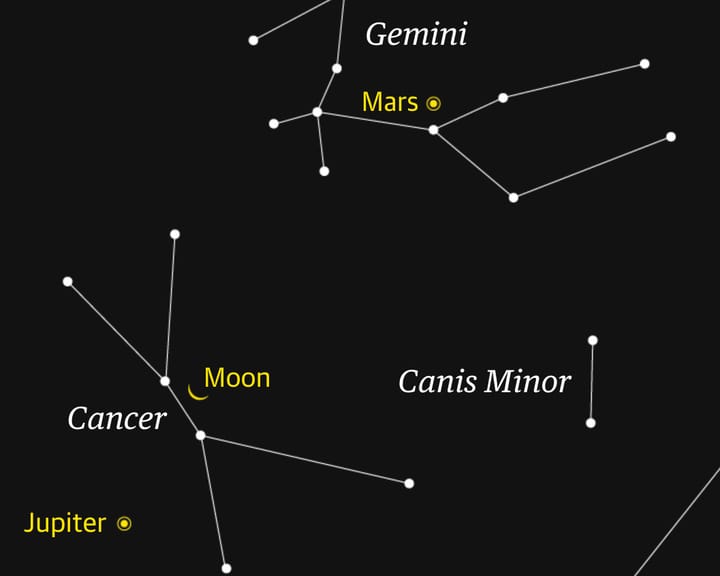
Waning crescent moon pairs closely with bright Jupiter
Early risers at 5am this week will be greeted by a waning crescent moon approaching Jupiter, with Mars visible from a greater distance.
The chart depicts the view looking east from London at 5am on Tuesday. The waning moon will be clearly visible, with roughly 10% of its illuminated surface