
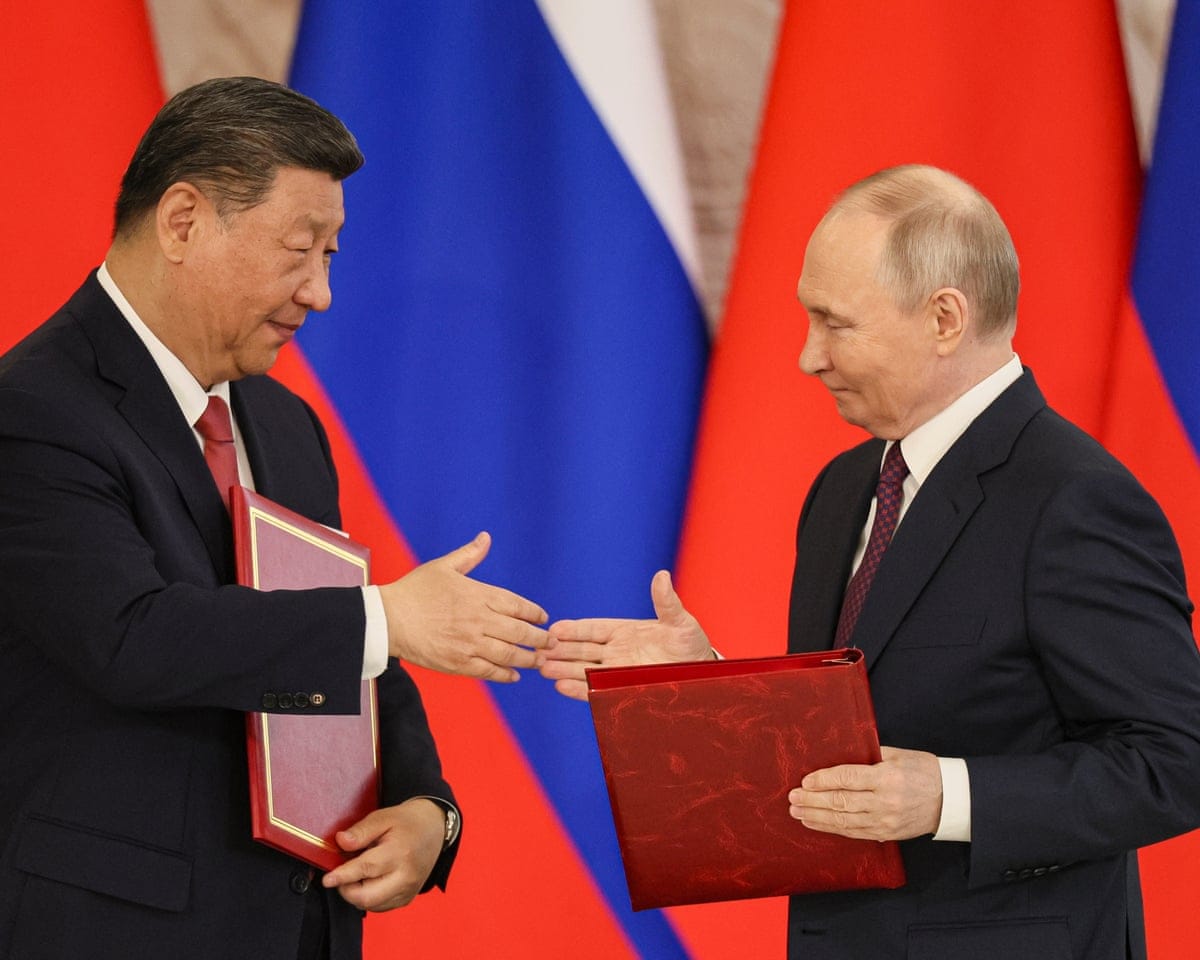
Russia and China will not send their top leaders to the upcoming Brics summit in Brazil this Sunday, suggesting the group’s recent enlargement may have weakened its ideological significance for the two founding members.
Chinese leader Xi Jinping, who has attended Brics meetings for the past 12 years, will be absent, with Premier Li Qiang attending instead. No specific reason was given beyond scheduling conflicts.
Russian President Vladimir Putin, who faces an ICC arrest warrant, may be avoiding travel to prevent discomfort for the Brazilian hosts, who are ICC members. Mongolia previously faced criticism for not acting on the warrant during Putin’s visit last year.
Putin also skipped the 2023 Brics summit in South Africa after host officials could not guarantee protection from arrest. The ICC accuses him of involvement in the forced removal of Ukrainian children.
Often seen as an alternative to the G7, Brics has expanded quickly but now struggles with cohesion as an ideological counter to Western capitalism. Originally consisting of Brazil, Russia, India, China, and South Africa, it recently added Indonesia, Iran, Egypt, Ethiopia, Saudi Arabia, and the UAE—nations with differing economic levels and relations with the West. The inclusion of more autocratic states has unsettled Brazil, South Africa, and India.
Brazil has framed Brics as part of a shifting global order. Former foreign minister and current London ambassador Antonio Patriota recently noted at the Overseas Development Institute that policies like “America first” are hastening a move toward a multipolar world, reducing U.S. dominance.
“The U.S., through tariffs and sovereignty policies, is speeding up multipolarity in various ways,” he said. He predicted new alliances would challenge the current power balance.
“It’s hard to claim Europe fully aligns with the U.S. on trade, security, or democracy support now. Where there was once a single Western pole, there may now be two.”
As an influential voice in the Global South, Brazil could gain from the reduced high-profile attendance at the summit. Its focus is on inclusive governance reform, not just criticism of Western policies in Ukraine and the Middle East.
Read next
Jaguar Land Rover suppliers voice ‘everything is against us’ amid cutbacks
David Roberts, chair of Coventry-based Evtec, says the outlook for Britain’s automotive sector is grim, with “everything against us.” Evtec is a tier 1 supplier to Jaguar Land Rover, which this week announced 4,000 job cuts over two years despite chancellor John Healey’s attempt to talk
Europe’s fighter jet plans in disarray: what comes next?
When former ECB president and Italian PM Mario Draghi urged Europe to catch up economically with the US and China, defence collaboration was prescribed. No more should each nation build independent boats, tanks or jets; allies should share costs and technologies.
Europe stumbled at the first hurdle. German Chancellor Friedrich
John Healey supports growth but insists Labour must be truthful about spending
John Healey has stated that his primary goal as chancellor will be to boost economic growth, while acknowledging that Labour must be straightforward about controlling public spending at next month's budget.
In his first major address since assuming the role in July, Healey said the leading focus of